
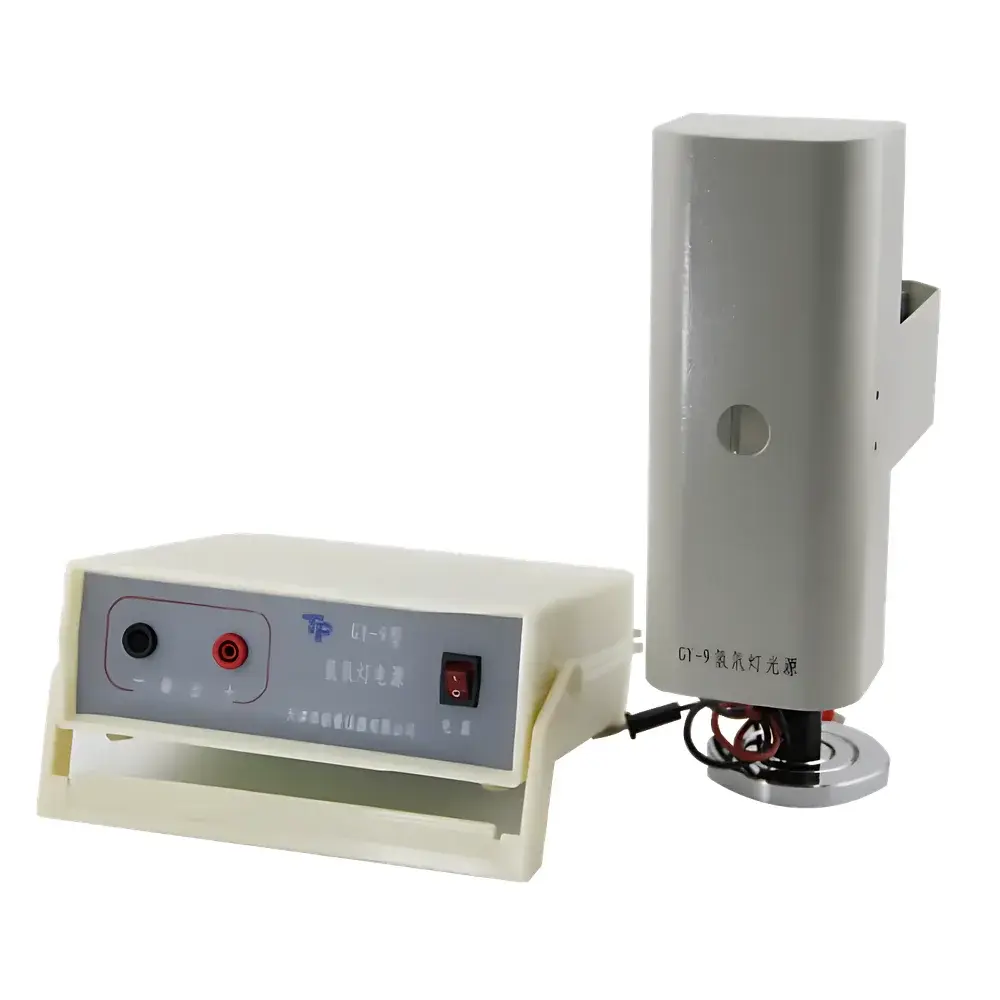
Deuterium-Hydrogen Arc Lamp (TP GY-9)
| Brand | TP |
|---|---|
| Origin | Tianjin, China |
| Manufacturer Type | Direct Manufacturer |
| Regional Origin | Domestic (China) |
| Model | GY-9 |
| Pricing | Upon Request |
Overview
The TP GY-9 Deuterium-Hydrogen Arc Lamp is a precision-calibrated dual-emission spectral source engineered for high-accuracy wavelength calibration and spectral reference applications in academic and research laboratories. Operating on the principle of low-pressure gas discharge in sealed quartz envelopes containing hydrogen and deuterium gases, the lamp emits sharp, well-defined atomic emission lines arising from electronic transitions in neutral H and D atoms. Its stable output and reproducible line positions make it particularly suitable for validating spectrometer wavelength scales, verifying monochromator performance, and supporting traceable optical metrology in UV–visible spectroscopy. Designed for integration into teaching labs and R&D environments, the GY-9 complies with fundamental requirements for spectral line standardization as referenced in ISO/IEC 17025-accredited calibration procedures.
Key Features
- Dual-gas discharge architecture enabling simultaneous emission of hydrogen and deuterium spectral lines—facilitating direct isotopic shift comparison and instrumental resolution assessment.
- Quartz envelope with high UV transmission (>85% down to 190 nm), optimized for use in both scanning monochromators and array-based spectrometers.
- Stable arc ignition and thermal equilibrium achieved within ≤5 minutes, ensuring consistent radiance output during extended calibration sessions.
- Integrated current-regulated DC power supply interface (compatible with standard 12–24 V DC input) minimizing intensity drift over time.
- Compact, air-cooled housing with standardized SMA905 or FC/PC fiber coupling options for flexible optical path integration.
- Manufactured under controlled cleanroom conditions in Tianjin, with individual unit spectral verification using NIST-traceable reference spectrometers.
Sample Compatibility & Compliance
The GY-9 lamp does not require sample introduction; it functions exclusively as a primary radiometric and wavelength reference source. Its emission lines are internationally recognized benchmarks: the Balmer series lines of hydrogen (656.28 nm, 486.13 nm, 434.05 nm, 410.18 nm) and deuterium (656.11 nm, 486.01 nm, 433.93 nm, 410.07 nm) serve as authoritative references in spectroscopic method validation. The lamp conforms to general safety standards for low-power gas-discharge sources (IEC 62471:2006, Risk Group 1), and its spectral data aligns with values published in the NIST Atomic Spectra Database (ASD) v. 6.2. While not certified to GLP or GMP per se, its documented line positions and stability profile support compliance with ASTM E275–22 (Standard Practice for Describing and Measuring Performance of UV–Visible Spectrophotometers) and ISO 6326-1:2019 (Optics and photonics — Spectrometers — Part 1: Terminology and basic principles).
Software & Data Management
The GY-9 operates as a hardware reference device without embedded firmware or digital control interfaces. It is fully compatible with third-party spectroscopic software platforms—including OceanInsight OceanView, Thermo Fisher OMNIC, and open-source tools such as Python-based PySpectra and SpecUtils—for automated peak detection and wavelength deviation analysis. Users may import certified line position tables (provided in CSV format with each unit) to enable algorithmic residual error mapping across the 400–660 nm range. Audit trails generated during calibration workflows—including acquisition timestamps, instrument ID, and operator metadata—can be retained in accordance with institutional GLP documentation policies when paired with compliant data acquisition systems.
Applications
- Wavelength calibration of UV–Vis spectrophotometers, CCD-array spectrometers, and FT-UV instruments.
- Educational demonstration of the hydrogen isotope shift and quantum mechanical energy level structure in undergraduate physics and analytical chemistry curricula.
- Verification of monochromator linearity, stray light rejection, and spectral bandwidth (SBW) performance.
- Reference source for developing and validating chemometric models requiring precise spectral anchor points.
- Supporting inter-laboratory comparison studies where traceable line position agreement is critical (e.g., proficiency testing under ISO/IEC 17043).
FAQ
What is the typical lifetime of the GY-9 lamp under continuous operation?
Rated operational life is ≥1,000 hours at nominal current; actual longevity depends on duty cycle, thermal management, and power supply stability.
Can the GY-9 be used for intensity calibration?
No—it is designed solely for wavelength reference; absolute irradiance calibration requires a NIST-traceable broadband standard lamp (e.g., FEL-type).
Is the lamp compatible with fiber-optic spectrometers?
Yes, when equipped with SMA905 or FC/PC termination; coupling efficiency should be verified empirically due to étendue mismatch constraints.
Does TP provide spectral certification reports with each unit?
Yes—each GY-9 ships with a factory-measured emission spectrum and tabulated peak centroids referenced to NIST ASD values.
How does deuterium substitution affect the observed spectral lines?
Nuclear mass difference shifts Balmer series lines by ~0.17–0.20 nm (e.g., Hα at 656.28 nm vs. Dα at 656.11 nm), enabling resolution limit assessment and Doppler broadening studies.



