
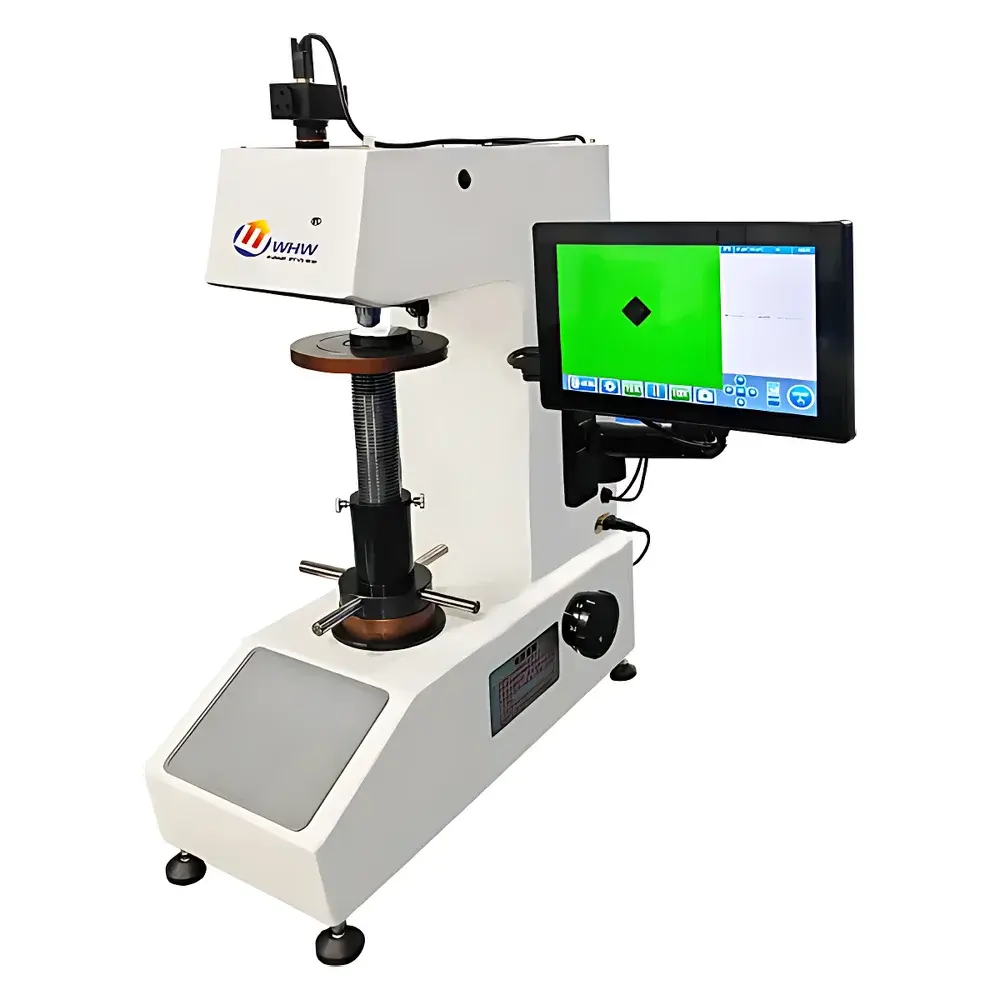
YANRUN MVS-10T Vision-Based Vickers Hardness Tester
| Brand | YANRUN |
|---|---|
| Origin | Shanghai, China |
| Manufacturer Type | Direct Manufacturer |
| Product Category | Domestic |
| Model | MVS-10T |
| Instrument Type | Vickers Hardness Tester |
| Measurement Range | 8–3000 HV |
| Total Test Force | 10 kgf |
| Maximum Specimen Height | 240 mm |
| Maximum Specimen Depth | 130 mm |
| Objective Lenses | 10× (observation), 20× (measurement) |
| Total Magnification | 100× (observation), 200× (measurement) |
| Measurement Resolution | ≈0.14 µm (with 10× objective) |
| Load Application Speed | ≈0.05 mm/s |
| Dwell Time Range | 0–99 s (1 s increments) |
| Illumination Control | 20-step adjustable brightness (step = 1) |
| Machine Frame | Cast aluminum body (8–10 mm wall thickness) |
| Dimensions (W×D×H) | 570 × 220 × 680 mm |
| Weight | ~60 kg |
| Power Supply | AC 220 V / 50 Hz |
| Standards Compliance | GB/T 4340.2, ISO 6507-2, ASTM E384 |
| Turret Positioning Accuracy | ≤2 µm |
| Force Selection | External rotary knob with automatic force recognition |
| Loading/Unloading/Holding | Fully automated |
| Optical Measurement Mode | Single-screen tablet-based vision system |
| Operating System | Android-based embedded platform |
Overview
The YANRUN MVS-10T Vision-Based Vickers Hardness Tester is a fifth-generation materials characterization instrument engineered for precision, repeatability, and operational efficiency in metallurgical, ceramic, semiconductor, and advanced composite testing environments. It implements the standardized Vickers indentation principle—where a diamond pyramid indenter (136° included angle) is applied under controlled static load to produce a geometrically defined impression on the specimen surface. The diagonal lengths of the resulting indentation are measured optically using high-resolution digital imaging, and hardness values (HV) are calculated per ISO 6507-1 and ASTM E384 equations. Unlike conventional analog or semi-automatic systems, the MVS-10T integrates an embedded Android platform with real-time image acquisition, sub-micron-scale measurement algorithms, and closed-loop force control—enabling traceable, operator-independent hardness evaluation across research labs, quality control departments, and production-floor metrology stations.
Key Features
- Fully automated indentation cycle—including loading, dwell, and unloading—with programmable dwell time (0–99 s, 1 s resolution) and consistent load application speed (~0.05 mm/s).
- Motorized turret with ≤2 µm positioning repeatability, enabling seamless, repeatable switching between 10× observation and 20× measurement objectives and the Vickers indenter.
- High-contrast, single-screen 10.1-inch tablet interface running a dedicated Android OS—supporting touch-driven navigation, live video feed, and on-device data annotation.
- Dual-magnification optical path: 100× for rapid field scanning and defect localization; 200× for precise diagonal measurement with ≈0.14 µm resolution at 10× objective magnification.
- Robust cast aluminum frame (8–10 mm wall thickness) ensures mechanical stability during high-load (up to 10 kgf) indentation, minimizing vibration-induced measurement drift.
- Externally mounted force-selection knob with auto-recognition logic eliminates manual input errors and enables immediate transition between standard test forces (0.3, 0.5, 1.0, 3.0, 5.0, and 10 kgf).
- 20-step adjustable LED illumination (step = 1) ensures optimal contrast across diverse surface finishes—from polished metallographic mounts to as-sintered ceramics.
Sample Compatibility & Compliance
The MVS-10T accommodates specimens up to 240 mm in height and 130 mm in depth, supporting large cross-sections, heat-treated components, and multi-layered substrates. Its open-stage design allows direct placement of irregularly shaped parts without fixture reconfiguration. All hardness calculations conform to the geometric definitions and uncertainty requirements specified in ISO 6507-2 (Calibration of reference blocks), GB/T 4340.2 (Verification of hardness testers), and ASTM E384 (Microindentation Hardness of Materials). The system supports hardness conversion across GB, ISO, and ASTM scales—including HV to HRC, HB, and HK—based on empirically validated correlation tables compliant with ISO 18265. Data output formats meet GLP/GMP documentation requirements, with timestamped results, operator ID tagging, and audit-ready export (CSV, PDF).
Software & Data Management
The embedded Android application provides full lifecycle data handling: real-time indentation capture, auto-diagonal detection with manual override, statistical summary (mean, SD, CV%), and customizable report templates. All measurements include metadata—test force, dwell time, objective used, illumination level, and environmental timestamp. Export options include USB storage and network transfer (via optional Ethernet/Wi-Fi module). The software architecture supports 21 CFR Part 11-compliant user access control (role-based login), electronic signatures, and immutable audit trails—making it suitable for regulated environments requiring FDA or ISO 17025 accreditation. Firmware updates are delivered over-the-air or via microSD card, ensuring long-term compliance with evolving metrological standards.
Applications
The MVS-10T delivers reliable hardness profiling for case-hardened steels, nitrided surfaces, thin-film coatings (e.g., TiN, DLC), sintered carbides, optical glasses, and brittle intermetallic phases. Its high spatial resolution and low-force capability (down to 0.3 kgf) enable accurate case depth analysis per ISO 2639 and ASTM E1077. In R&D settings, it supports comparative studies of grain-boundary hardening, precipitation strengthening, and irradiation-induced embrittlement. In manufacturing QA, it verifies batch consistency of forged aerospace alloys, medical-grade stainless steel implants, and semiconductor packaging substrates—where indentation geometry must remain unaffected by substrate compliance or edge effects.
FAQ
What standards does the MVS-10T comply with for calibration and verification?
It meets GB/T 4340.2, ISO 6507-2, and ASTM E384 for routine verification and periodic calibration using certified reference hardness blocks.
Can the system measure case depth profiles automatically?
Yes—when combined with motorized X-Y-Z stage integration (optional accessory), it supports sequential indentation arrays along a linear or grid pattern for case depth mapping.
Is the Android OS upgradable, and how is firmware maintained?
Firmware updates are distributed via secure OTA channels or microSD card, with version history and rollback capability retained in system logs.
Does the instrument support network connectivity for centralized lab data management?
Ethernet and Wi-Fi modules are available as factory-installed options, enabling integration with LIMS or enterprise MES platforms.
What is the typical measurement uncertainty for HV values at 10 kgf load?
Under controlled laboratory conditions (23 ± 2 °C, <60% RH), expanded uncertainty (k=2) is ≤1.5% for HV ≥ 100, per ISO/IEC 17025 validation protocols.
Related Products



