
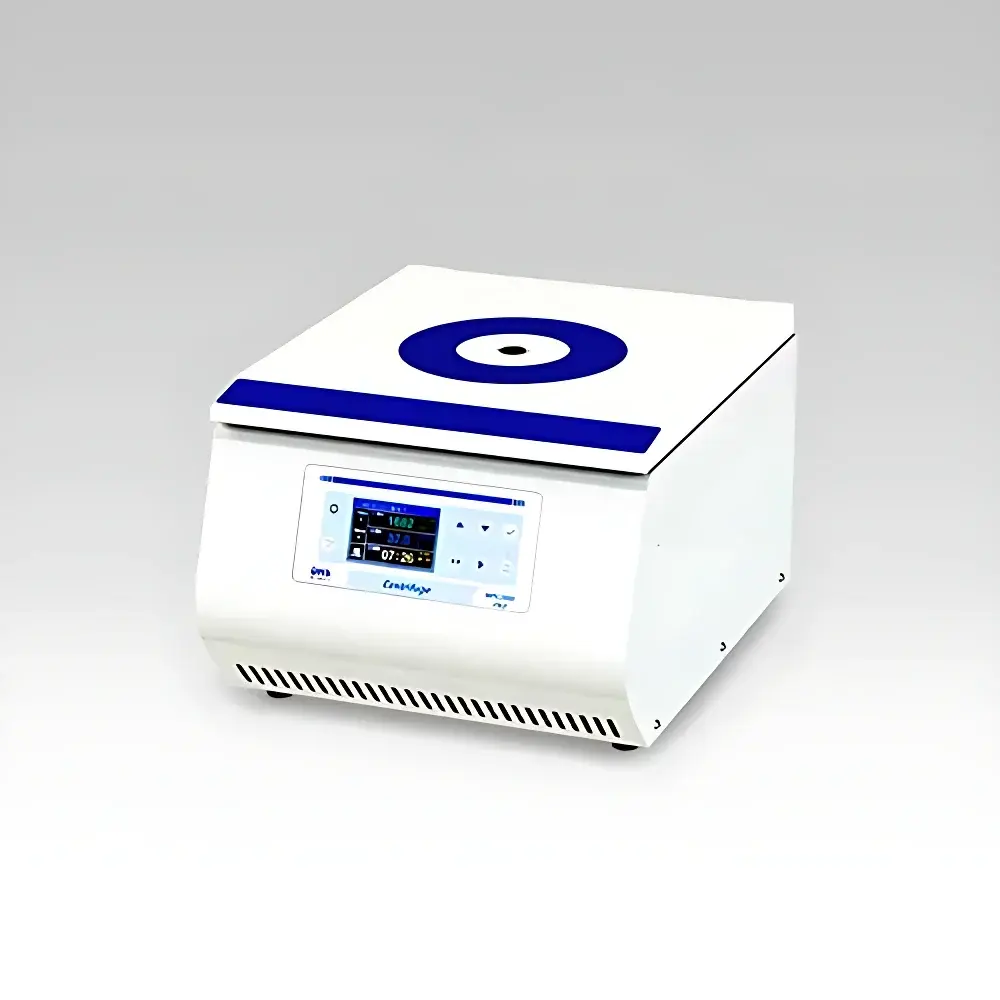
DHS MPC2000 PRO Benchtop Refrigerated Centrifuge
| Brand | DHS |
|---|---|
| Origin | Tianjin, China |
| Model | MPC2000 PRO |
| Instrument Type | Benchtop Centrifuge |
| Configuration | Horizontal Rotor Centrifuge |
| Max Capacity | 6 × cell culture plates / microplates / skirted PCR plates |
| Max Speed | 4500 rpm |
| Max RCF | 2860 × g |
| Dimensions (W×H×D) | 384 × 288 × 480 mm |
| Power Supply | 220 V / 50 Hz, 750 W |
| Temperature Range | Ambient +5 °C to 45 °C |
| Speed Range | 300–4500 rpm |
| Timer Range | 1 s–99 min 59 s or 1 min–99 h 59 min |
| Acceleration Steps | 9 levels |
| Deceleration Steps | 10 levels |
| Display | 3.5-inch LCD screen |
| Net Weight | 35 kg |
Overview
The DHS MPC2000 PRO is a precision-engineered benchtop refrigerated centrifuge designed specifically for gentle, temperature-controlled separation of sensitive biological samples in modern life science laboratories. Utilizing horizontal rotor architecture and active thermoelectric cooling, it maintains precise thermal stability across the full operating range (ambient +5 °C to 45 °C), enabling reproducible centrifugation of primary cells, organoids, 3D spheroids, and other thermolabile specimens where conventional ambient-speed centrifuges risk viability loss or structural disruption. Its core mechanical design follows ISO 13485-aligned manufacturing practices, with robust cast-aluminum housing, balanced rotor assembly, and brushless DC motor drive ensuring long-term operational consistency and low-maintenance reliability.
Key Features
- Thermally regulated operation with ±0.5 °C accuracy across the full setpoint range (ambient +5 °C to 45 °C), validated per IEC 61010-2-020 safety standards for laboratory equipment.
- Horizontal swing-out rotor accommodating standardized microplate formats: up to six 96-well cell culture plates, ELISA plates, or fully skirted PCR plates—or two 96-well deep-well plates or standard PCR plates—without adapter reconfiguration.
- Programmable acceleration and deceleration profiles (9 acceleration levels, 10 deceleration levels) minimize hydrodynamic shear during ramp-up and coast-down phases, preserving fragile cell monolayers and extracellular matrix integrity.
- High-resolution 3.5-inch LCD interface with real-time display of speed (rpm), relative centrifugal force (×g), elapsed time, remaining time, temperature, and rotor status—including automatic imbalance detection and error logging.
- Compliant with electromagnetic compatibility (EMC) requirements per EN 61326-1 and electrical safety standards per EN 61010-1, suitable for GLP/GMP-adjacent workflows requiring traceable instrument performance.
Sample Compatibility & Compliance
The MPC2000 PRO supports universal plate-based sample carriers including ANSI/SLAS-compliant 96-well formats (flat-bottom, U/V-bottom, skirted/unskirted, semi-skirted), as well as 384-well microplates when used with optional adapters. It accommodates common consumables such as Corning Costar, Thermo Fisher Nunc, and Eppendorf twin.tec PCR plates without modification. All rotor assemblies are certified for autoclaving (121 °C, 20 min) and meet ISO 22870:2016 requirements for in vitro diagnostic (IVD) support equipment. The unit includes built-in audit trail capability for parameter changes and run logs, supporting compliance with FDA 21 CFR Part 11 when integrated with validated LIMS environments.
Software & Data Management
While the MPC2000 PRO operates via standalone front-panel control, its embedded firmware supports RS-232 serial output for external data capture and integration into centralized lab automation systems. Run parameters—including speed, time, temperature, acceleration/deceleration profile, and start/stop timestamps—are stored internally for ≥1000 cycles and exportable via USB-to-serial bridge. Optional PC software (DHS CentriLink v2.1) provides remote monitoring, method library management, PDF report generation with digital signature fields, and CSV export compatible with JMP, GraphPad Prism, and LabWare LIMS.
Applications
- Organoid and spheroid pelleting prior to dissociation or cryopreservation
- Cell harvesting from suspension cultures with minimal membrane damage
- Plate-based nucleic acid precipitation and cleanup workflows (e.g., ethanol precipitation post-PCR)
- Centrifugal concentration of extracellular vesicles (EVs) from conditioned media in 96-well format
- High-throughput washing steps in ELISA, immunoassay, and cell-based assay development
- Temperature-sensitive protein complex stabilization during co-immunoprecipitation plate setups
FAQ
Does the MPC2000 PRO support refrigeration below ambient temperature?
No—it is a thermoregulated (not cryogenic) system; minimum setpoint is ambient +5 °C. For sub-ambient operation, refer to DHS’s MPC3000 series.
Can I use non-DHS branded PCR plates?
Yes—any ANSI/SLAS-compliant 96-well plate meeting dimensional tolerances (±0.1 mm) is supported, including unskirted, semi-skirted, and fully skirted variants.
Is rotor balancing required before each run?
No—the horizontal rotor is factory-balanced and dynamically compensated; however, symmetrical plate loading across the rotor arc is recommended for optimal vibration control.
What maintenance intervals are recommended?
Annual verification of temperature calibration and rotor integrity inspection are advised; no routine lubrication is required due to sealed bearing and brushless motor design.
Is the unit compliant with EU RoHS and WEEE directives?
Yes—certified under Directive 2011/65/EU (RoHS2) and 2012/19/EU (WEEE), with full material declaration available upon request.



