
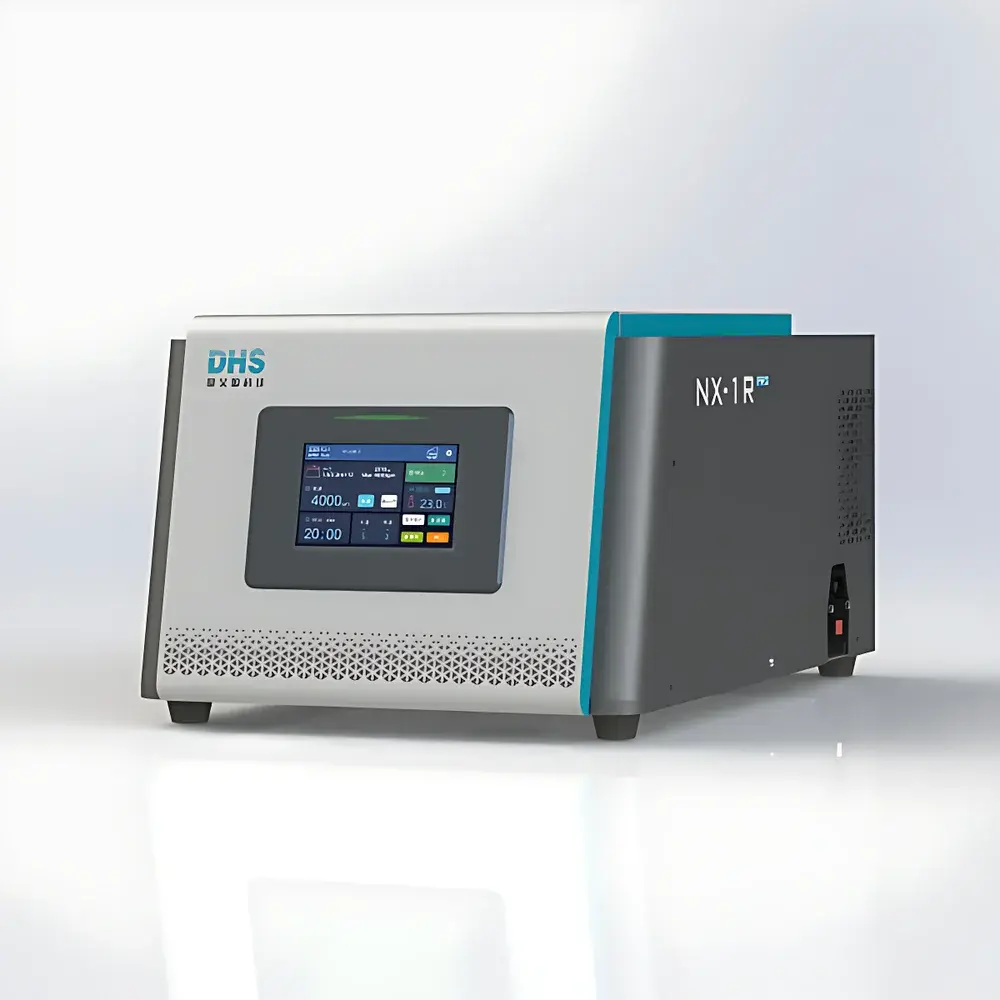
DHS NX-1R Pro High-Speed Refrigerated Microcentrifuge
| Brand | DHS |
|---|---|
| Origin | Tianjin, China |
| Instrument Type | Benchtop Centrifuge |
| Category | High-Speed Refrigerated Centrifuge (10,000–30,000 rpm range) |
| Function | Refrigerated Centrifugation |
| Configuration | Fixed-Angle Rotor System |
| Target Applications | Biomolecular Separation |
| Maximum Capacity | 24 × 2 mL |
| Maximum Speed | 17,500 rpm |
| Maximum RCF | 23,300 × g |
| Dimensions (W × D × H) | 325 × 295 × 540 mm |
| Temperature Range | −20 °C to +40 °C |
| Acceleration/Deceleration Steps | 9-step acceleration, 10-step deceleration |
| Rotor Options | Five interchangeable fixed-angle rotors (12 × 1.5/2.0 mL, 24 × 1.5/2.0 mL, 12 × 5.0 mL, 18 × 2.0 mL spin-column, 8 × 8 × 0.2 mL PCR strip) |
| Speed Setting Range | 300–17,500 rpm |
| Time Setting | 1 s–99 min 59 s or 1 min–99 h 59 min |
| Display | 5-inch full-color capacitive touchscreen |
| Stored Programs | 100 user-defined protocols |
| Program Structure | Up to 10 segments per program (minimum 1) |
| Data Logging | Graphical run curves and chronological history logs with timestamped metadata |
Overview
The DHS NX-1R Pro is a high-performance benchtop refrigerated microcentrifuge engineered for precision separation of biomolecules—including nucleic acids, proteins, organelles, and viral particles—in research, clinical diagnostics, and quality control laboratories. It operates on the principle of sedimentation under controlled centrifugal force, where differential migration rates of macromolecules in solution are exploited to achieve physical fractionation based on size, shape, and density. With a maximum rotational speed of 17,500 rpm and an RCF of 23,300 × g, the NX-1R Pro delivers sufficient force for rapid pelleting of subcellular components and small-volume samples while maintaining thermal stability critical for heat-labile analytes. Its compact footprint (325 × 295 × 540 mm) enables integration into biosafety cabinets or crowded benchtop environments without compromising accessibility or ergonomic operation.
Key Features
- Refrigerated operation across a wide temperature range (−20 °C to +40 °C), with automatic thermal cutoff at >45 °C to prevent rotor damage and sample degradation.
- Intelligent acceleration and deceleration profiling: nine programmable acceleration steps and ten deceleration steps ensure reproducible rotor spin-up/down behavior—critical for minimizing shear stress on sensitive biological complexes.
- Five interchangeable fixed-angle rotors optimized for diverse sample formats: standard microtubes (1.5/2.0 mL), larger capacity tubes (5.0 mL), spin-column cartridges, and 0.2 mL PCR strip configurations—supporting parallel processing of up to 64 samples per run when using the 8 × 8 PCR rotor.
- High-resolution 5-inch color capacitive touchscreen interface with intuitive icon-based navigation, real-time graphical feedback, and multilingual UI support (English, Spanish, German, French).
- Robust mechanical architecture featuring brushless DC motor drive, reinforced aluminum rotor chamber, and active magnetic bearing-assisted rotor detection for enhanced longevity and vibration damping.
- Comprehensive data traceability: onboard storage of 100 user-defined programs (each supporting up to 10 sequential segments), plus time-stamped run logs including RCF, temperature, duration, and rotor ID verification.
Sample Compatibility & Compliance
The NX-1R Pro is validated for use with common laboratory consumables compliant with ISO 8573-1 (compressed air purity) and ASTM D4169 (packaging performance testing) standards for tube integrity under high g-force conditions. All rotors are certified to IEC 61010-2-020 (safety requirements for laboratory centrifuges) and undergo annual recalibration per manufacturer-recommended intervals. The system supports routine GLP/GMP workflows through audit-trail-capable logging features and optional export of CSV-formatted run records compatible with LIMS integration. While not FDA 21 CFR Part 11–certified out-of-the-box, its password-protected program editing, electronic signature fields, and immutable log files align with foundational data integrity principles required by regulatory auditors.
Software & Data Management
No external PC software is required for basic operation; however, optional USB data export allows transfer of graphical run curves and historical logs to external analysis platforms (e.g., Excel, GraphPad Prism). Each stored protocol retains full parameter fidelity—including segment-wise speed, temperature, time, and brake profile—enabling strict procedural adherence across shifts and operators. The instrument automatically associates rotor identification codes with every executed run, ensuring compliance with ISO/IEC 17025 clause 7.7 (equipment traceability). Firmware updates are delivered via secure HTTPS download and installed through the touchscreen interface, with version history retained in system diagnostics.
Applications
- Routine isolation of plasmid DNA, genomic DNA, and RNA from bacterial lysates and mammalian cell suspensions.
- Purification of exosomes and extracellular vesicles using differential ultracentrifugation protocols adapted to fixed-angle geometry.
- Clarification of protein expression lysates prior to chromatography or electrophoresis.
- Spin-column–based clean-up of enzymatic reaction mixtures (e.g., restriction digests, ligations, PCR products).
- High-throughput preparation of samples for mass spectrometry, NGS library construction, and ELISA assay setup.
- Stabilization of thermosensitive reagents during cold-chain processing in QC labs.
FAQ
What is the minimum sample volume supported by the NX-1R Pro?
The instrument accommodates standard microcentrifuge tubes down to 0.2 mL volume, including PCR strips and spin columns—no minimum fill requirement is enforced, though balanced loading remains essential for rotor safety.
Does the NX-1R Pro support swing-bucket rotors?
No. The NX-1R Pro is configured exclusively for fixed-angle rotor systems to maximize RCF efficiency and minimize run time for microvolume applications.
Can rotor calibration be performed in-house?
Yes. Rotor identification and speed calibration can be verified using the built-in tachometer test mode and certified reference tachometers traceable to NIST standards.
Is remote monitoring available?
Remote monitoring is not natively supported, but periodic manual data extraction via USB ensures compatibility with centralized lab informatics infrastructure.
How often should maintenance be scheduled?
DHS recommends biannual preventive maintenance—including vacuum pump inspection, refrigerant pressure check, and rotor seat torque verification—per the service manual’s schedule aligned with ISO/IEC 17025 clause 6.4.10.



