
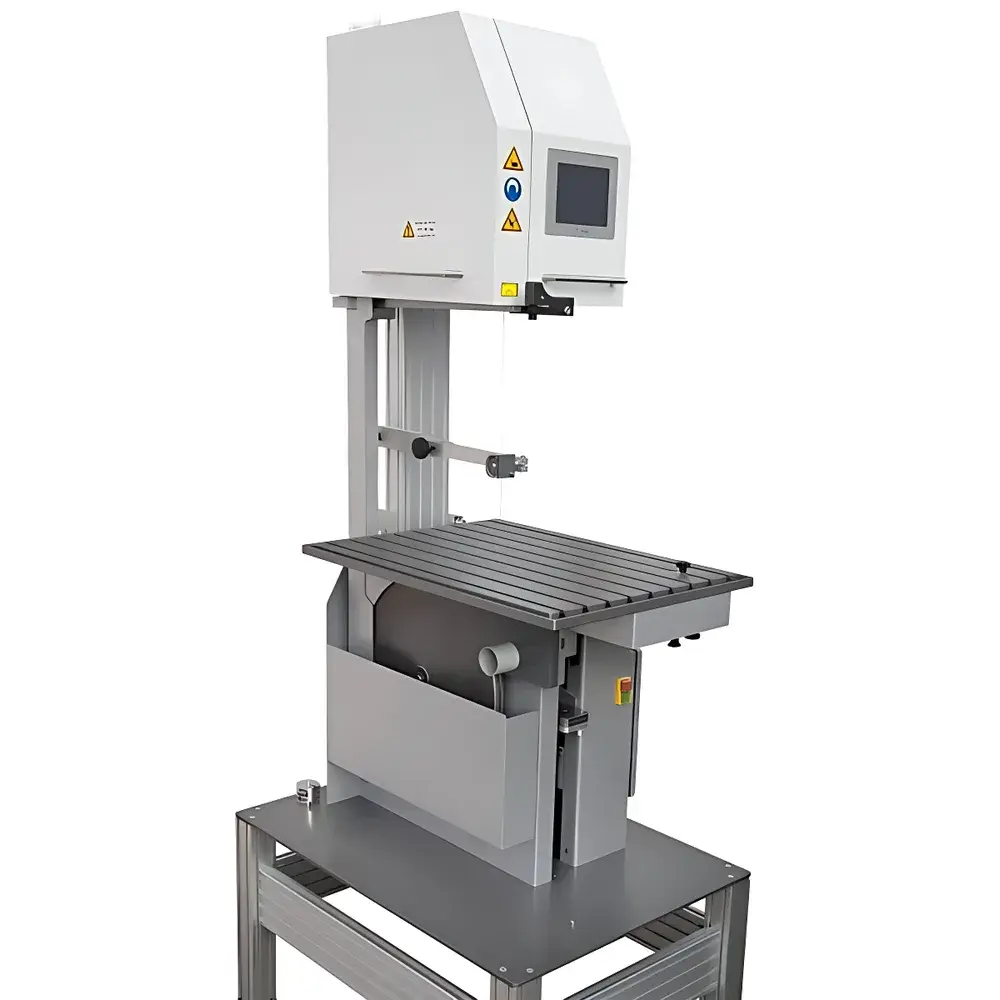
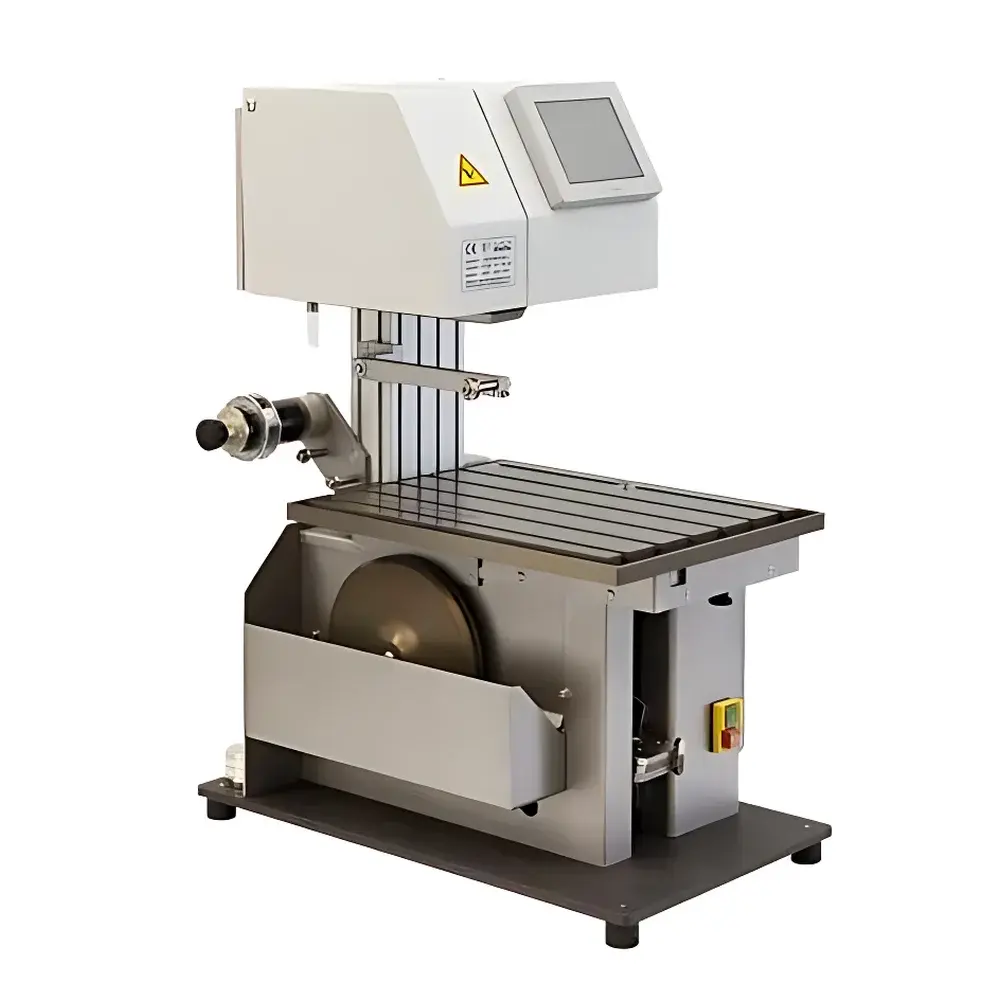
Diamond WireTec DWS250E & DWS375E Diamond Loop Wire Cutting Machines
| Brand | Diamond WireTec |
|---|---|
| Origin | Germany |
| Model | DWS250E, DWS375E |
| Cutting Method | Unidirectional diamond loop wire |
| Max Wire Speed | 0–12 m/s |
| Kerf Width | 0.1–0.5 mm |
| Max Sample Cross-Section | 245 × 245 mm (DWS250E), 370 × 370 mm (DWS375E) |
| Feed Force | Gravity-driven constant force |
| Control Interface | 7-inch color touchscreen |
| Positioning Accuracy | 0.01 mm (with optional micrometer translation stage) |
| Safety Features | Automatic wire-break shutdown, end-of-cut stop |
| Compliance | CE, ISO 12100 (machinery safety), GLP-compatible operation log |
Overview
The Diamond WireTec DWS250E and DWS375E are precision-engineered unidirectional diamond loop wire cutting systems designed for high-fidelity sample sectioning in materials science, geology, metallurgy, and advanced manufacturing R&D laboratories. Unlike reciprocating wire saws, these machines employ a continuous-loop diamond-impregnated wire driven at constant linear velocity (up to 12 m/s), enabling true unidirectional kerf formation with minimal thermal input and mechanical disturbance. This operational principle—based on controlled abrasive erosion under sustained tensile load—ensures exceptional dimensional fidelity, low subsurface damage, and reproducible cut quality across heterogeneous, brittle, or multi-phase specimens including ceramics, sintered carbides, optical glass, geological cores, reinforced composites, and cementitious materials. The gravity-fed feed mechanism eliminates pneumatic complexity while delivering consistent, vibration-damped material removal rates. Both models comply with EU Machinery Directive 2006/42/EC and are certified to EN ISO 12100 for functional safety architecture.
Key Features
- Unidirectional diamond loop wire drive system: Eliminates wire reversal-induced micro-vibrations and surface chatter; achieves up to 3× higher effective throughput versus comparable reciprocating systems.
- Industrial-grade linear motor and servo-controlled motion system: Ensures sub-millimeter positional repeatability and smooth acceleration/deceleration profiles during feed initiation and termination.
- Modular T-slot granite base platform: Accepts standardized DIN 65071 accessories—including adjustable clamping arms, cylindrical vise fixtures, rotating side-cutting jigs, and motorized angular positioning stages—for full 3-axis sample orientation control.
- Tool-less diamond wire rethreading in ≤30 seconds: Patented closed-loop wire path design minimizes downtime and operator exposure to sharp edges.
- Gravity-based constant-force feed: Delivers stable, noise-free, maintenance-free loading without compressed air dependency—ideal for cleanroom and quiet lab environments.
- 7-inch capacitive touchscreen HMI with native multilingual firmware (English, German, Chinese): Includes graphical step-by-step workflow guidance, real-time wire tension monitoring, and programmable cut sequences with parameter recall.
- Dual cooling modes: Dry-cutting capability for non-hygroscopic or oxidation-sensitive samples; wet-cutting via integrated coolant reservoir and recirculating pump (compatible with water-soluble synthetic coolants per ISO 6743-7).
- Integrated safety logic: Automatic emergency stop upon wire break detection, overtravel limit switch activation, or door interlock disengagement—fully traceable in audit logs.
Sample Compatibility & Compliance
The DWS250E and DWS375E accommodate a broad spectrum of rigid and semi-rigid materials ranging from monocrystalline silicon wafers to basaltic rock cores and fiber-reinforced polymer laminates. Their low-heat cutting profile preserves microstructural integrity—critical for subsequent SEM-EDS, XRD, or metallographic analysis. All models meet CE marking requirements and conform to EN 61000-6-2 (immunity) and EN 61000-6-4 (emission) standards. Data logging functionality supports GLP-compliant documentation: timestamped operation records, user ID tracking, parameter versioning, and exportable CSV reports align with FDA 21 CFR Part 11 readiness when deployed with validated IT infrastructure. Optional calibration certificates traceable to PTB (Physikalisch-Technische Bundesanstalt) are available upon request.
Software & Data Management
Firmware v4.2+ includes embedded job management with up to 99 programmable cutting protocols—each storing wire speed, feed rate, coolant mode, dwell time, and Z-axis travel limits. Parameter sets can be exported/imported via USB or Ethernet (TCP/IP). Audit trails record all operator actions, system faults, and environmental anomalies (e.g., ambient temperature drift >±2°C). For integration into LIMS or ELN ecosystems, RESTful API endpoints support JSON-based command injection and status polling. No proprietary runtime or dongle licensing is required; firmware updates are delivered as signed .bin files verified via SHA-256 checksum.
Applications
- Precise cross-sectioning of battery electrode stacks for porosity and coating uniformity analysis.
- Sectioning of archaeological ceramic shards and fossilized bone without delamination or edge chipping.
- Preparation of thin sections from sintered tungsten carbide inserts prior to hardness mapping.
- Cutting of optical-grade fused silica blanks for interferometric testing.
- Isolation of representative volumes from concrete cores for chloride diffusion coefficient determination (ASTM C1556).
- Manufacturing QA of additive-manufactured Ti-6Al-4V parts—removing support structures while retaining near-net-shape geometry.
FAQ
What wire diameters are supported, and how does kerf width affect material loss?
Standard diamond wires range from 0.12 mm to 0.35 mm nominal diameter; actual kerf width depends on wire tension, feed rate, and material hardness—but typically falls between 0.10 mm and 0.48 mm. Lower kerf widths reduce material waste by up to 60% compared to conventional abrasive blade saws.
Can the system perform angled cuts?
Yes—using the optional motorized rotary side-cutting jig (DWS-RJ-360), users achieve programmable tilt angles from –10° to +90° relative to the vertical plane, with ±0.1° repeatability.
Is remote diagnostics supported?
All units include embedded Ethernet port with Modbus TCP and SNMPv3 support; remote firmware updates and diagnostic session initiation require prior authorization via SSH key exchange.
How often does the diamond wire require replacement?
Typical service life ranges from 80–200 hours depending on material abrasiveness and cutting parameters; integrated wire wear compensation adjusts feed rate dynamically to maintain consistent kerf geometry.
Are custom fixture designs available?
Diamond WireTec offers OEM fixture engineering services—including FEA-supported stress analysis—and provides STEP/IGES files for customer-integrated metrology workflows.



