
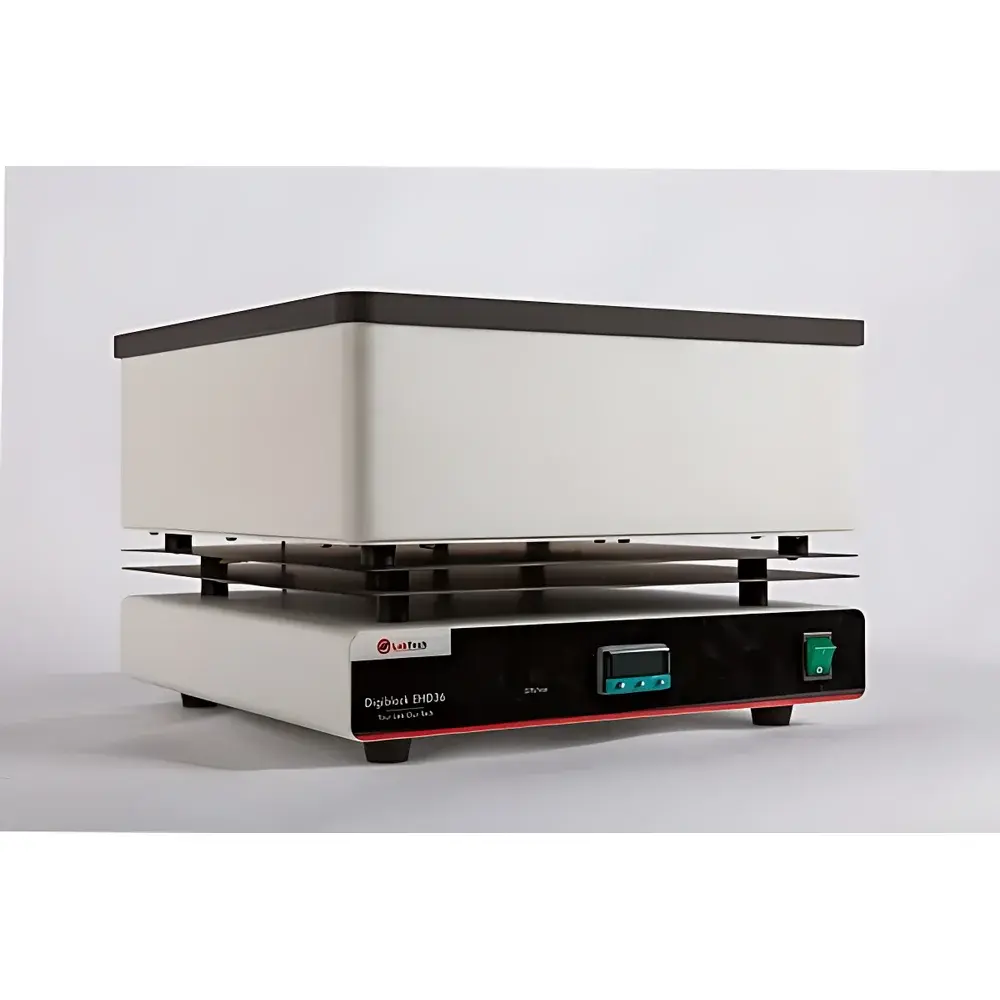
DigiBlock ED and EHD Series Electric Heating Block Digestion Systems
| Brand | LabTech |
|---|---|
| Origin | Beijing, China |
| Manufacturer Type | Original Equipment Manufacturer (OEM) |
| Product Line | ED and EHD Series |
| Instrument Type | Electric Heating Digestion System |
| Automation Level | Semi-Automatic |
| Sample Capacity | Up to 77 positions |
| Max. Sample Mass | ≥5 g per vessel |
| Heating Technology | Uniform circumferential graphite block heating with imported thermal insulation |
| Temperature Control | Intelligent PID algorithm |
| Inter-position Temperature Uniformity | ≤±1.5 °C |
| Surface Coating | High-temperature corrosion-resistant ceramic coating on graphite blocks |
| Enclosure | Fully sealed, chemically resistant housing |
| Compliance | Designed for ISO/IEC 17025-compliant laboratories |
Overview
The DigiBlock ED and EHD Series Electric Heating Block Digestion Systems are precision-engineered thermal platforms designed for reproducible, high-throughput open-vessel acid digestion of solid and semi-solid samples in environmental, geochemical, food safety, clinical, and regulatory testing laboratories. Unlike conventional hot plates or muffle furnaces, these systems employ a monolithic, high-density graphite heating block with circumferential thermal distribution—ensuring uniform heat transfer across all sample positions via conductive and radiant pathways. The core architecture leverages optimized thermal mass and proprietary insulation materials to minimize energy loss and achieve rapid thermal equilibration. This design enables consistent ramp rates, stable hold temperatures (typically 90–220 °C), and minimal inter-vessel temperature deviation—critical parameters for trace-metal analysis where incomplete digestion or volatile element loss directly compromises ICP-MS, ICP-OES, or AAS quantitation accuracy.
Key Features
- Uniform Circumferential Heating Architecture: Engineered graphite block with 360° thermal envelope ensures symmetrical heat flux to each digestion vessel, eliminating edge-to-center gradients commonly observed in planar heating systems.
- High-Temperature Corrosion-Resistant Surface: Graphite blocks are coated with a dense, inert ceramic layer rated for continuous operation up to 230 °C and resistant to HNO₃, HCl, HF (with appropriate vessel selection), and aqua regia exposure.
- Sealed, Chemically Inert Enclosure: Full housing sealing prevents acid vapor ingress into electronics and protects operators from fumes; integrated ventilation port supports optional ducted exhaust connection per OSHA and local laboratory safety codes.
- PID-Controlled Thermal Stability: Microprocessor-based controller delivers ±0.5 °C setpoint accuracy and maintains inter-position uniformity within ±1.5 °C across the full working area—validated per ASTM E220 calibration protocol.
- Scalable Throughput Configuration: Standard configurations support 24, 48, or 77 digestion tube positions (e.g., 16 mm × 100 mm or 28 mm × 150 mm formats); modular footprint allows integration into automated sample prep lines with robotic arm compatibility.
- Robust Mechanical Design: Stainless steel chassis, reinforced mounting brackets, and vibration-damped feet ensure long-term dimensional stability under repeated thermal cycling and heavy vessel loading.
Sample Compatibility & Compliance
The DigiBlock ED/EHD systems accommodate a wide range of digestion vessels—including borosilicate glass, PTFE, quartz, and high-purity quartz tubes—enabling method flexibility across EPA, ISO, and USP protocols. Vessels are secured using chemically resistant silicone or PEEK retention rings to prevent displacement during vigorous reflux. The platform is routinely deployed in GLP- and GMP-regulated environments for heavy metal testing in pharmaceutical excipients (USP /), soil and sediment analysis (ISO 11466, EPA 3050B), and food matrix digestion (AOAC 999.10). All electrical components comply with IEC 61010-1 safety standards, and firmware supports audit-trail-enabled operation when paired with LabTech’s optional LIMS-integrated control software.
Software & Data Management
While the base ED/EHD models operate via front-panel keypad and LCD interface, optional USB- or Ethernet-connected controllers enable remote parameter setting, real-time temperature logging (0.1 °C resolution, 1 Hz sampling), and CSV export for traceability. Firmware versions support configurable ramp-hold profiles (up to 10 segments), event-triggered alarms (e.g., overtemperature, lid-open detection), and password-protected method libraries. When deployed in regulated labs, the system meets FDA 21 CFR Part 11 requirements for electronic records and signatures when used with validated software modules—including user access controls, electronic signatures, and immutable audit trails for all critical parameters and deviations.
Applications
- Preparation of environmental samples (soils, sediments, sludges) prior to multi-element analysis by ICP-OES or ICP-MS
- Digestion of biological tissues (liver, muscle, plant matter) for nutritional or toxicological screening
- Acid leaching of catalysts, alloys, and electronic waste for recovery and purity assessment
- Routine QA/QC digestion in food and feed testing laboratories compliant with EN 13804 and ISO 6497
- Method development for novel matrices requiring controlled oxidative decomposition without microwave-induced pressure risks
FAQ
What digestion vessel types are compatible with the DigiBlock ED/EHD series?
Standard compatibility includes 16 mm and 28 mm OD borosilicate glass tubes, PTFE digestion vials, and quartz tubes—provided vessel height and thermal expansion coefficients align with the block’s cavity geometry.
Can the system be integrated into an automated sample preparation workflow?
Yes—mechanical mounting interfaces and digital I/O signals (RS-232/485, dry contact outputs) support synchronization with liquid handlers and robotic arms per ISO/IEC 62443-3-3 industrial communication guidelines.
Is validation documentation available for regulatory submissions?
LabTech provides IQ/OQ documentation templates, temperature mapping reports (per ASTM E220), and material compliance certificates (RoHS, REACH, UL recognition) upon request for qualified installations.
What maintenance is required to sustain thermal accuracy over time?
Annual verification of block emissivity and PID calibration against NIST-traceable reference thermometers is recommended; graphite surface coating integrity should be visually inspected before each high-acid batch.



