
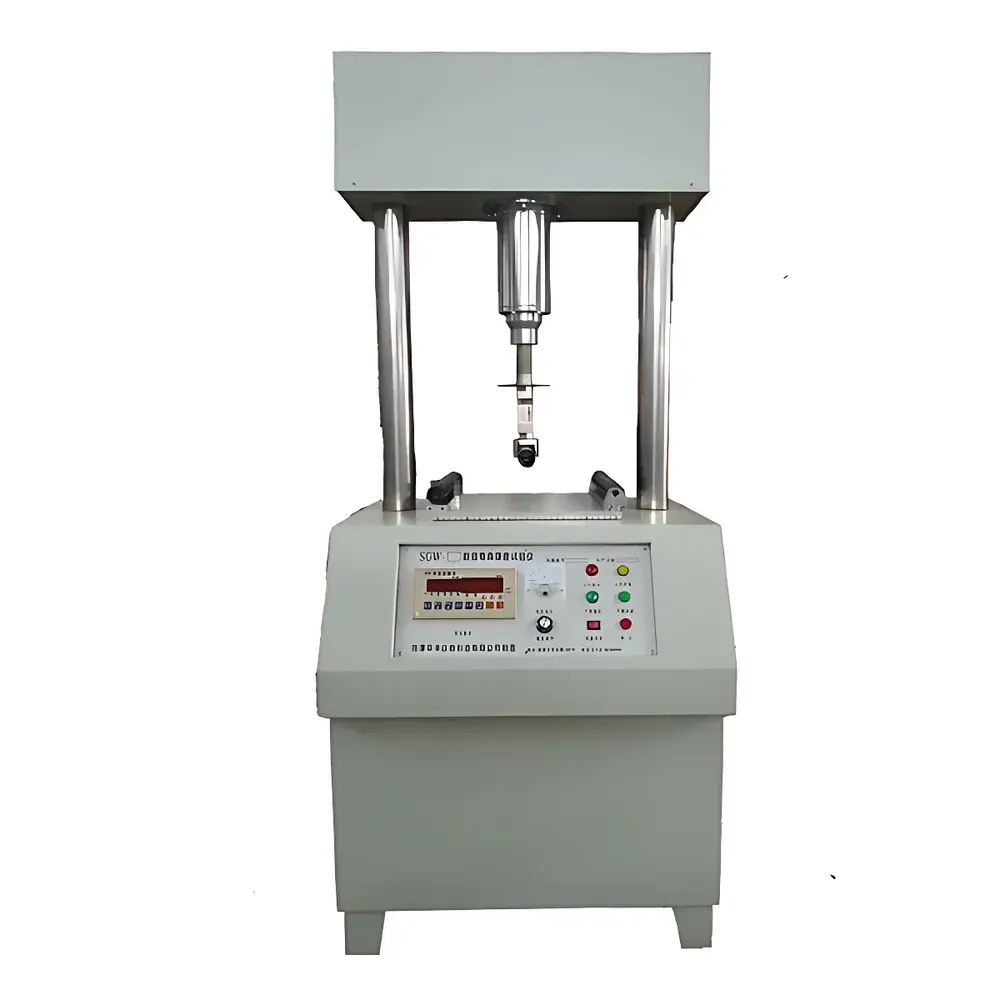
Digital Display Bending Strength Testing Machine SGW Series
| Origin | Hunan, China |
|---|---|
| Manufacturer Type | Distributor |
| Product Origin | Domestic |
| Model | SGW |
| Price Range | USD 1,400 – 7,000 (FOB) |
| Max Test Load | 10 kN |
| Load Application Rate | 5–700 N/s |
| Platen Spacing | 200 mm |
| Platen Dimensions | 300 × 300 mm |
Overview
The SGW Series Digital Display Bending Strength Testing Machine is a precision-engineered mechanical testing system designed for the quantitative evaluation of flexural strength (modulus of rupture) in brittle and quasi-brittle materials under controlled three-point or four-point bending configurations. Built upon a robust dual-column frame with motor-driven load application, the machine delivers consistent, traceable force generation through a calibrated electromechanical actuation system—eliminating hydraulic fluid dependency while ensuring high repeatability and low maintenance. Its core measurement principle follows ASTM C1161, ISO 14704, and GB/T 6569–2006 standards, which define specimen geometry, support span, loading rate, and failure criteria for engineering ceramics, structural tiles, refractory bricks, cementitious composites, and porcelain insulators. The system operates at ambient laboratory temperature (23 ± 2 °C), with load resolution maintained via high-accuracy load cell feedback and real-time digital display of applied force, displacement, and peak load.
Key Features
- Electromechanical loading architecture with adjustable crosshead speed, enabling precise control of load application rate from 5 to 700 N/s—critical for compliance with rate-sensitive ceramic fracture testing protocols.
- Digital force readout with ≤0.5% full-scale accuracy, integrated with internal calibration memory and auto-zero compensation.
- Modular platen configuration: standard 300 × 300 mm parallel platens with 200 mm adjustable vertical spacing, accommodating standard beam specimens per GB/T 6569 (e.g., 3×4×45 mm or 5×6×60 mm).
- Interchangeable fixture sets—including three-point bending supports (with hardened steel rollers), four-point bending fixtures, compression platens, and custom mandrels—for multi-modal mechanical characterization.
- Low-noise AC servo motor drive (0.3–1.5 kW options) coupled with precision ball-screw transmission, ensuring smooth, non-oscillatory loading profiles and minimal inertial error during dynamic ramping.
- Front-panel digital interface with LED display showing real-time load (kN), displacement (mm), and test status—no external PC required for basic operation.
Sample Compatibility & Compliance
The SGW series is validated for use with standardized ceramic, cement, and clay-based specimens conforming to international test method requirements. Compatible sample types include sintered alumina, silicon carbide components, electrical porcelain bushings, fired clay bricks, autoclaved aerated concrete (AAC) blocks, and vitrified tile substrates. All configurations comply with mechanical testing prerequisites defined in ASTM C773 (flexural strength of advanced ceramics), ISO 14704 (ceramic flexural strength), and EN 14411 (ceramic tiles). The machine supports GLP-aligned documentation when paired with optional data logging modules, meeting traceability requirements for quality control laboratories operating under ISO/IEC 17025 accreditation frameworks.
Software & Data Management
While the base model operates autonomously via embedded firmware, optional USB-connected PC software enables advanced data acquisition, curve plotting (load vs. displacement), automatic peak detection, statistical reporting (mean, SD, CV%), and export to CSV or PDF formats. Software modules support audit trail functionality compliant with FDA 21 CFR Part 11 (when configured with user authentication and electronic signature), making them suitable for regulated QC environments in building materials manufacturing and ceramic R&D facilities. Calibration certificates are issued with NIST-traceable load cell verification and annual recalibration reminders.
Applications
- Quality assurance testing of engineering ceramics used in semiconductor processing equipment, aerospace thermal barriers, and wear-resistant liners.
- Evaluation of flexural strength retention in aged or thermally cycled porcelain insulators per IEC 60383.
- Development and validation of new cementitious admixtures by measuring modulus of rupture in mortar beams (ASTM C78).
- Batch-to-batch consistency checks for architectural terra cotta cladding systems and fire-rated brick assemblies.
- Research-grade mechanical property mapping across sintering temperature gradients in lab-scale ceramic fabrication.
FAQ
What standards does the SGW machine support for flexural testing?
It complies with GB/T 6569–2006, ASTM C1161, ISO 14704, and EN 14411 for three- and four-point bending configurations.
Can the machine perform compression tests on cylindrical concrete specimens?
Yes—by replacing bending fixtures with flat compression platens and adjusting platen spacing; it meets ASTM C39/C109 requirements when equipped with appropriate alignment guides.
Is the load application rate programmable in closed-loop mode?
Yes—the system uses load-cell feedback to maintain constant rate-of-load (N/s) regardless of specimen stiffness or deformation resistance.
What maintenance is required for long-term accuracy?
Annual load cell recalibration, periodic ball-screw lubrication, and visual inspection of roller surfaces for wear or pitting—documented in the included maintenance log template.
Does the machine support automated pass/fail judgment based on specification limits?
When used with optional PC software, users can define upper/lower specification limits and generate compliance flags with timestamped results per test record.



