
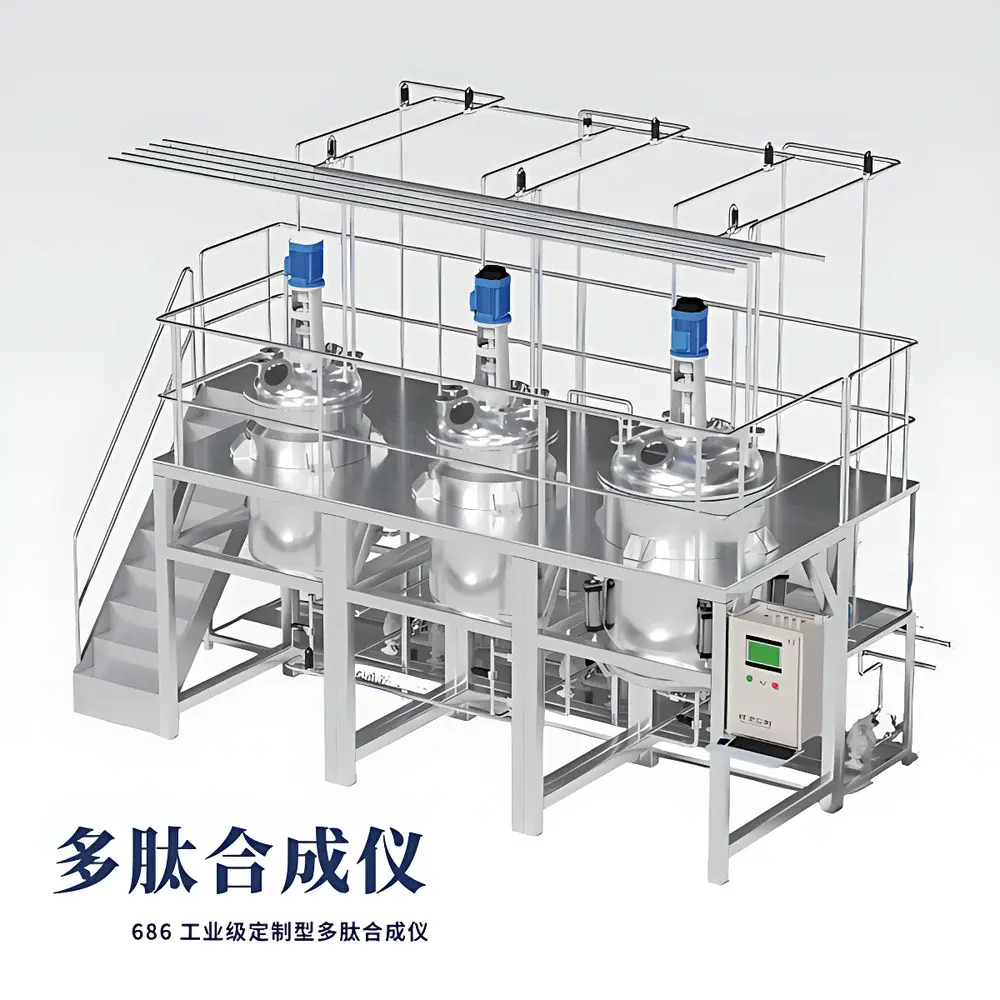
Dilun Bio 686 Industrial-Grade Custom Peptide Synthesizer
| Brand | Dilun Bio |
|---|---|
| Origin | Beijing, China |
| Manufacturer Type | Authorized Distributor |
| Product Origin | Domestic (China) |
| Model | 686 |
| Quotation | Upon Request |
| Amino Acid Delivery | Automated |
| Reagent Delivery | Automated |
| Synthesis Scale | ≥0.3 mol |
| Reaction Vessel Count | 4 |
| Reaction Vessel Capacity Options | 20/50 mL, 50/100 mL, 150/300 mL, 300/500 mL |
| Reactor Volume Range | 20–2000 L |
| Reactor Material | 304 stainless steel shell with 316L stainless steel lining |
| Solvent Port Count | ≤9 |
| Stirring Mode | Mechanical agitation |
| Amino Acid Activation Vessel Material | 304 SS shell / 316L SS lining |
| Piperidine Buffer Vessel Material | 304 SS shell / 316L SS lining |
| Explosion Protection Rating | Exia IIC T4 GB |
| Power Supply | 220/380 V AC |
Overview
The Dilun Bio 686 Industrial-Grade Custom Peptide Synthesizer is a fully automated, GMP-aligned solid-phase peptide synthesis (SPPS) platform engineered for scalable, reproducible, and traceable manufacturing of therapeutic peptides, peptide APIs, and research-grade sequences. Built on the Fmoc/tBu strategy foundation, it employs precise gravimetric and volumetric reagent delivery, dual-zone temperature-controlled reaction vessels, and real-time process monitoring to ensure batch consistency across development, pilot-scale, and commercial production environments. Unlike benchtop synthesizers limited to millimole-scale output, the 686 supports synthesis scales ≥0.3 mol per run—enabling direct transition from process validation to multi-kilogram API campaigns without re-optimization. Its modular architecture accommodates configurable reactor arrays (up to four independent vessels), each equipped with double-jacketed temperature control (–20 °C to +50 °C), pressure-sensing, solvent-level tracking, and variable-speed mechanical stirring—critical for managing exothermic coupling steps and minimizing racemization during extended syntheses.
Key Features
- Quad-reactor configuration with independently programmable thermal control (–20 °C to +50 °C) and real-time pressure monitoring per vessel
- Optically transparent viewport windows integrated into synthesis, activation, and piperidine buffer reactors for visual process verification
- High-precision quantitative peristaltic and piston-driven solvent transfer system with ≤±0.5% volumetric accuracy across all nine solvent positions
- Dual-material construction: 304 stainless steel structural housing with 316L stainless steel wetted surfaces—validated for compatibility with DMF, DCM, piperidine, HOBt, DIC, and TFA-based cleavage cocktails
- Intrinsically safe design certified to Exia IIC T4 GB standard for operation in Class I, Division 1 hazardous locations
- Integrated data logging of temperature, pressure, stir speed, valve actuation, and reagent dispense timestamps—compliant with ALCOA+ principles
Sample Compatibility & Compliance
The 686 synthesizer supports linear and branched peptides up to 120 residues, including sequences containing sterically hindered (e.g., Aib, N-Me-amino acids), acid-labile (e.g., Trp(Boc), Tyr(tBu)), and oxidation-prone (e.g., Cys(Trt), Met) residues. Its solvent handling architecture enables seamless switching between low-polarity (DCM), polar aprotic (DMF), and acidic (TFA/H2O) media without cross-contamination. The system meets fundamental requirements for cGMP-compliant peptide manufacturing per ICH Q5C, USP <851>, and ISO 13485:2016. Full audit trail capability—including user login history, method versioning, electronic signatures, and change control logs—is implemented in accordance with FDA 21 CFR Part 11 and EU Annex 11 when paired with validated software modules.
Software & Data Management
The embedded control interface runs Dilun SynthOS v4.2—a deterministic real-time OS supporting method import/export via XML, sequence library management, and step-by-step execution validation. All process parameters are recorded at 1 Hz resolution and stored in encrypted SQLite databases with SHA-256 checksums. Raw data exports comply with ASTM E2500-17 for raw data integrity. Optional integration with LIMS (e.g., LabWare, Thermo Fisher SampleManager) and MES platforms is supported via OPC UA and RESTful API endpoints. Electronic batch records (EBRs) generated by the system include full metadata: operator ID, environmental conditions (room temp/humidity), instrument calibration status, and deviation flags—all timestamped with NIST-traceable UTC synchronization.
Applications
- GMP-compliant synthesis of clinical-stage peptide APIs (e.g., GLP-1 analogs, somatostatin derivatives, antimicrobial peptides)
- Process development and scale-up studies bridging 0.1 mmol (R&D) to >100 mmol (pilot) and ≥300 mmol (commercial) synthesis volumes
- Manufacturing of peptide conjugates (e.g., PEGylated, biotinylated, fluorescently labeled) under controlled inert atmosphere
- Multi-vessel parallel synthesis for comparative route scouting (e.g., coupling reagents, resin types, deprotection cycles)
- Automated synthesis of peptide libraries for epitope mapping or structure–activity relationship (SAR) analysis
FAQ
What synthesis strategies does the 686 support?
The system natively executes standard Fmoc-based SPPS; Boc protocols may be implemented via custom method configuration and compatible resin/resolving chemistry.
Is remote monitoring and intervention possible?
Yes—via TLS-secured web interface with role-based access control (RBAC), enabling real-time view of active runs, historical trend analysis, and emergency pause/resume commands from authorized devices.
How is cleaning validation addressed?
The system includes an automated solvent wash sequence with programmable dwell times, flow rates, and rinse cycle counts; residue testing protocols align with ICH Q5A and USP <1051>.
Can the 686 integrate with existing plant automation infrastructure?
It supports Modbus TCP, Profibus DP, and OPC UA connectivity for bidirectional communication with DCS/SCADA systems and enterprise resource planning (ERP) platforms.
What regulatory documentation is provided upon delivery?
Each unit ships with Factory Acceptance Test (FAT) report, Installation Qualification (IQ) templates, Operational Qualification (OQ) protocol drafts, and material traceability certificates for all wetted components.





