
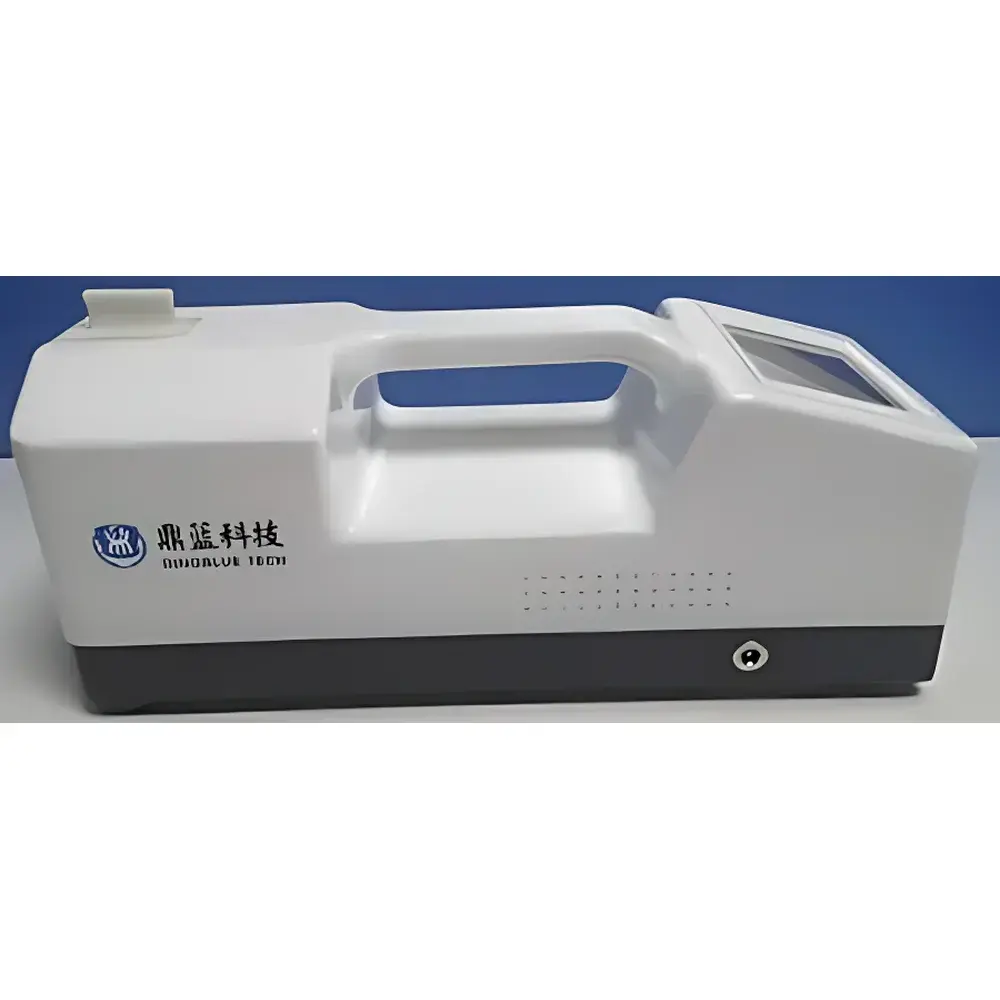
DINGBLUE WA-15 Portable Liquid Impaction Bioaerosol Sampler
| Brand | DINGBLUE |
|---|---|
| Origin | Beijing, China |
| Model | WA-15 |
| Sampling Principle | Liquid Impaction via Tangential Cyclonic Flow |
| Sample Collection Medium | Aqueous Liquid (e.g., PBS, Viral Transport Medium) |
| Compatibility | Standard 15 mL or 50 mL Conical Centrifuge Tubes / Cryovials |
| Operating Temperature Range | −10 °C to 45 °C |
| Weight | < 2.5 kg |
| Power Supply | Rechargeable Li-ion Battery (≥8 h continuous operation) |
| Touchscreen Interface | 5-inch capacitive display with intuitive sampling protocol setup |
| Adjustable Sampling Duration | 1–60 min (1 sec resolution) |
| Cut-off Diameter (50% collection efficiency) | ≤ 0.65 µm (at 120 L/min flow rate) |
| Flow Rate | 100–130 L/min (calibrated, ±2% accuracy) |
| Compliance | Designed per ISO 14698-1:2003 (Biocontamination control), ASTM E2997-15 (Standard Practice for Bioaerosol Sampling), and aligned with CDC/NIOSH bioaerosol sampling guidance |
Overview
The DINGBLUE WA-15 Portable Liquid Impaction Bioaerosol Sampler is an engineered field-deployable instrument designed for quantitative, viability-preserving collection of airborne microorganisms—including bacteria, fungi, bacteriophages, and enveloped/non-enveloped viruses—into liquid suspension. It operates on the principle of tangential cyclonic impaction: ambient air is drawn at high volumetric flow (100–130 L/min) into a precision-machined sampling head, where laminar-to-turbulent transition induces rotational flow. Within this cyclonic chamber, inertial forces drive particles ≥0.65 µm aerodynamic diameter toward the inner wall surface, where they impact tangentially onto a continuously recirculating or static liquid film (e.g., phosphate-buffered saline or viral transport medium). This mechanism preserves microbial integrity and culturability far more effectively than dry-filter or electrostatic precipitation methods—critical for downstream culture-based isolation, qPCR, RT-LAMP, metagenomic sequencing, or infectivity assays.
Key Features
- True portability: Integrated rechargeable lithium-ion battery supports ≥8 hours of continuous operation; total system mass < 2.5 kg enables single-operator deployment in remote, mobile, or austere environments.
- Liquid-phase collection: Direct deposition into biocompatible aqueous media minimizes desiccation stress and maximizes recovery of fragile respiratory viruses (e.g., influenza A, SARS-CoV-2) and thermolabile spores.
- Low cut-off diameter: Certified 50% collection efficiency at ≤0.65 µm ensures robust capture of fine-mode bioaerosols generated by coughing, talking, or aerosolized procedures—aligning with WHO and ECDC recommendations for respiratory pathogen surveillance.
- Single-use consumables: Sterile, pre-assembled sampling heads eliminate cross-contamination risk between sampling events and support GLP-compliant chain-of-custody protocols.
- Intuitive human interface: 5-inch capacitive touchscreen enables real-time parameter configuration—including duration (1–60 min, 1-sec increments), flow verification, and battery status—with on-device data logging.
- Wide environmental tolerance: Operational across −10 °C to +45 °C and 10–95% RH (non-condensing), validated for use in outdoor emergency response, cold-chain pharmaceutical facilities, and tropical field epidemiology studies.
Sample Compatibility & Compliance
The WA-15 accepts standard conical centrifuge tubes (15 mL or 50 mL) and cryogenic vials, enabling seamless integration with existing laboratory workflows—no proprietary consumables required. Collected eluates are immediately compatible with ISO 11731 (Legionella culture), USP <61>/<62> (microbial enumeration), ISO 14698-2 (biocontamination monitoring), and CLSI MM18-A (viral detection in environmental samples). The device’s impaction geometry and flow calibration adhere to ASTM E2997-15 and ISO 21501-4 for aerosol particle sizing traceability. All firmware and data logs meet ALCOA+ principles (Attributable, Legible, Contemporaneous, Original, Accurate, Complete, Consistent, Enduring, Available) for audit readiness under FDA 21 CFR Part 11 and EU Annex 11 requirements.
Software & Data Management
Onboard non-volatile memory stores timestamped sampling metadata (start/stop time, flow rate, ambient temperature, battery level, user ID) for each run. Data export is supported via USB-C or Bluetooth 5.0 to Windows/macOS platforms. Optional DINGBLUE BioCapture Suite (v3.2+) provides automated QC flagging (e.g., flow deviation >±3%, low battery during acquisition), batch reporting in CSV/PDF, and integration with LIMS via HL7/FHIR-compatible API endpoints. Audit trails record all parameter modifications with operator credentials and ISO 8601 timestamps.
Applications
- Public health emergency response: Rapid deployment during outbreaks (e.g., influenza, mpox, novel coronavirus) to characterize spatial-temporal bioaerosol dispersion in hospitals, shelters, or transportation hubs.
- Pharmaceutical manufacturing: Routine monitoring of Grade A/B cleanrooms per EU GMP Annex 1, particularly for process simulation and isolator leak testing.
- Food safety & fermentation: Detection of spoilage yeasts, mycotoxin-producing molds, or phage contamination in breweries, dairy processing lines, and bioreactor exhaust streams.
- Military & CBRN defense: Tactical collection of weaponized agents (e.g., Bacillus anthracis spores) with minimal operator exposure and field-stable sample preservation.
- Academic research: Method validation studies comparing impaction vs. filtration efficiency, viral decay kinetics in aerosols, or microbiome profiling of indoor/outdoor air.
FAQ
What volume of collection liquid is recommended for optimal recovery?
A minimum of 5 mL of sterile PBS or viral transport medium is recommended for 10–30 minute sampling at 120 L/min; volumes up to 20 mL may be used for extended durations without compromising impaction efficiency.
Can the WA-15 be calibrated in-house?
Yes—integrated thermal mass flow sensor supports user-performed two-point calibration using NIST-traceable rotameters or primary standards; calibration certificates are auto-generated and stored with metadata.
Is the device suitable for outdoor use during rain or high wind?
The sampling head features IP54-rated ingress protection; however, prolonged direct exposure to precipitation is not advised. Use with optional weather shield accessory (Part #WA-WP1) maintains performance at wind speeds ≤12 m/s.
Does the WA-15 comply with ISO 14644-1 for cleanroom classification?
While not a particle counter, its bioaerosol collection efficacy is validated per ISO 14698-1 and referenced in ISO 14644-1 Annex B as an acceptable method for viable particle assessment in classified environments.
How is sample integrity maintained during transport post-collection?
Collected tubes remain sealed and chilled (2–8 °C) or frozen (−70 °C) per CLSI M40-A2 guidelines; onboard log records ambient temperature during sampling to support stability assessments.







