
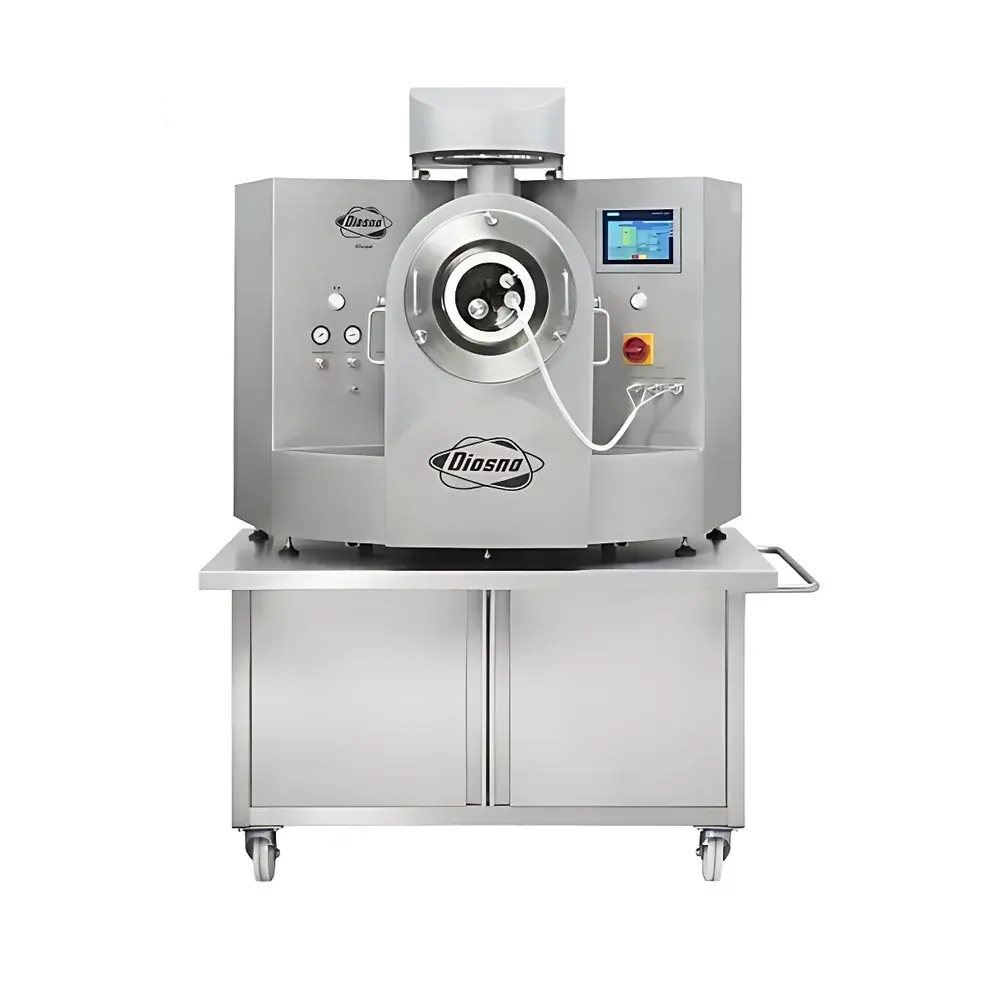
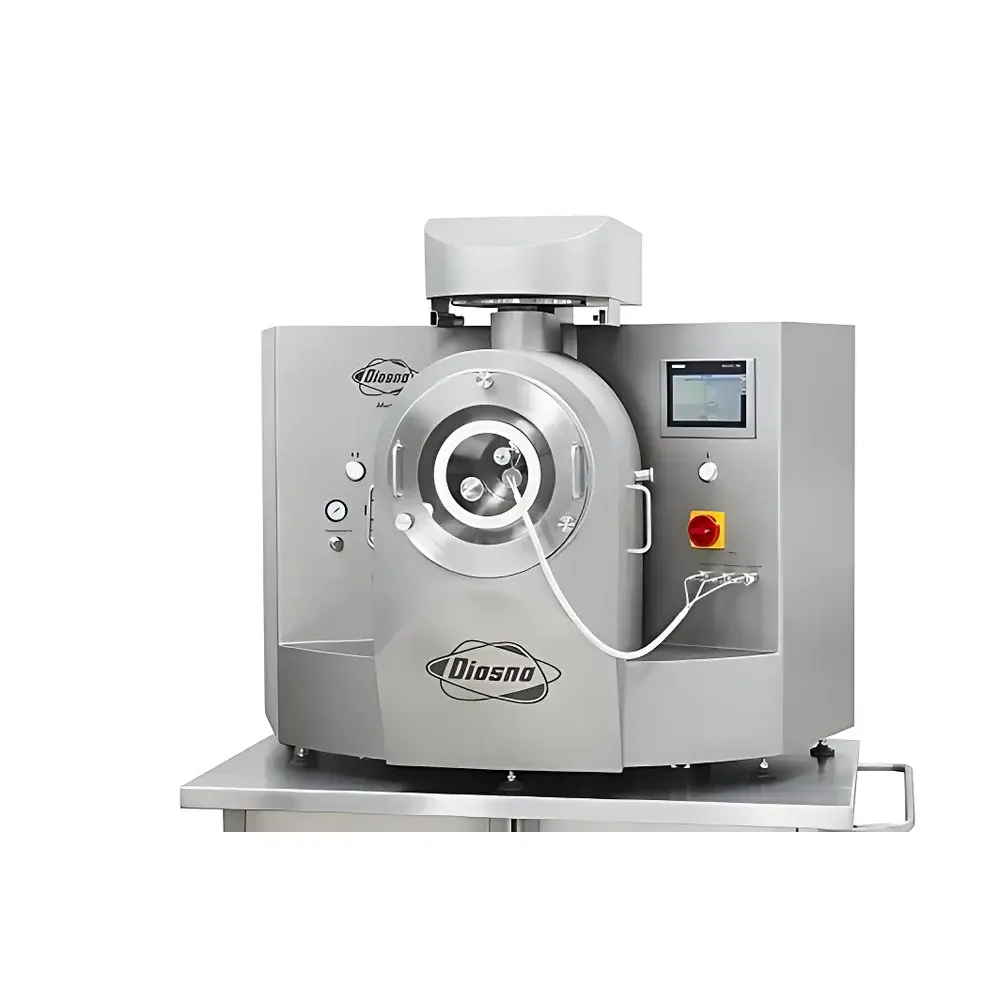
Diosna MiniLab XP Laboratory High-Efficiency Tablet Coater
| Brand | Diosna |
|---|---|
| Origin | Germany |
| Model | MiniLab XP |
| Batch Capacity | 50–1,000 g (expandable to 3 kg) |
| Inlet Air Temperature Range | Up to 100 °C (digital display) |
| Temperature Monitoring | Inlet & outlet air |
| Spray System | Dual-fluid high-pressure nozzle with adjustable atomization and fan-air pressure |
| Power Supply | 380 V / 50 Hz, 7.5 kW |
| Dimensions (W×D×H) | 1290 × 890 × 1100 mm |
| Weight | 200 kg |
| Construction | 316L stainless steel contact parts, 304 stainless steel non-contact structural components |
| Control System | Siemens PLC with HMI touchscreen interface |
| Compliance | Designed to support GMP, ISO 9001, and FDA 21 CFR Part 11–ready data integrity workflows |
Overview
The Diosna MiniLab XP Laboratory High-Efficiency Tablet Coater is a precision-engineered, benchtop-scale coating system designed for pharmaceutical and nutraceutical R&D laboratories requiring full process scalability, reproducible film formation, and strict adherence to regulatory design principles. Based on Diosna’s proven fluidized-bed and pan-coating architecture, the MiniLab XP operates on the bottom-spray Wurster principle—optimized for uniform suspension, controlled droplet deposition, and rapid solvent evaporation under negative-pressure airflow. Thermal energy is introduced tangentially at the upper right quadrant of the coating drum and exhausted from the lower left, establishing a consistent, laminar thermal gradient across the tablet bed. This configuration ensures homogeneous heat transfer, minimizes thermal stress on thermolabile actives, and supports robust film integrity for aqueous, organic, enteric, sustained-release, and taste-masking formulations. The system is not a scaled-down production unit but a purpose-built development platform engineered for method transfer to Diosna’s PilotLab and production-scale systems (e.g., P10, P30), enabling seamless progression from formulation screening to clinical batch manufacturing.
Key Features
- Modular drum design with quick-release mounting system—enables tool-free interchange of coating pans (standard 1 L, optional 3 L) in under 90 seconds without recalibration.
- Dual-fluid spray nozzle with independent pressure regulation for atomizing air and shaping air—permits precise control over droplet size distribution (Sauter mean diameter adjustable between 30–120 µm) and spray pattern geometry.
- Integrated temperature monitoring at both inlet and exhaust ducts, with PID-controlled heating and real-time thermal profiling—ensures compliance with ICH Q5C stability requirements during process development.
- Full-view borosilicate glass viewport with anti-fog heating element—provides unobstructed visual assessment of tablet motion, film uniformity, and agglomeration behavior without interrupting operation.
- Siemens SIMATIC S7-1200 PLC with 10.1″ capacitive touchscreen HMI—supports recipe management, parameter logging, alarm history, and audit-trail-enabled user access levels per ALCOA+ principles.
- GMP-compliant construction: All product-contact surfaces fabricated from electropolished ASTM A276 Type 316L stainless steel (Ra ≤ 0.4 µm); non-contact frame from 304 stainless steel; IP54-rated enclosure for laboratory environments.
Sample Compatibility & Compliance
The MiniLab XP accommodates tablets (round, oval, biconvex), pellets, granules, and mini-tablets ranging from 2 mm to 12 mm in diameter. It supports all major coating excipients—including hydroxypropyl methylcellulose (HPMC), ethylcellulose, Eudragit® series (L100, S100, RL/RS), shellac, and polyvinyl alcohol—under both aqueous and organic solvent systems. Process validation documentation aligns with ASTM E2500-22 (Guide for Specification, Design, and Verification of Pharmaceutical and Biopharmaceutical Manufacturing Systems) and supports qualification protocols per EU Annex 15 and USP . Data integrity features include electronic signatures, time-stamped event logs, and exportable CSV/Excel reports compatible with LIMS integration. The system meets mechanical safety standards per EN 61000-6-2/6-4 and is CE-marked for use in Class D cleanrooms when installed with appropriate HVAC interfaces.
Software & Data Management
The embedded control software provides real-time visualization of critical process parameters—including drum rotation speed (0.5–20 rpm), inlet/exhaust temperature (±0.3 °C accuracy), spray rate (0.5–15 g/min, gravimetrically verified), and relative humidity (optional sensor). All parameters are logged at 1-second intervals and stored with cryptographic hash integrity. Export functions support raw .csv, PDF summary reports, and XML-formatted data packages compliant with FDA 21 CFR Part 11 Annex 11 requirements. Optional OPC UA server enables bidirectional communication with MES platforms (e.g., Siemens Opcenter, Werum PAS-X) for centralized batch record compilation and deviation tracking.
Applications
- Early-phase formulation screening for immediate-release, delayed-release, and extended-release solid oral dosage forms.
- Process parameter optimization (e.g., spray rate vs. inlet temperature vs. drum speed) using Design of Experiments (DoE) frameworks.
- Stability-indicating coating studies under accelerated conditions (40 °C/75% RH) per ICH Q1A(R2).
- Excipient compatibility testing with APIs prone to hydrolysis or oxidation during film application.
- GMP-compliant clinical trial material (CTM) manufacturing up to Phase IIb scale.
- Training platform for operator qualification in cGMP coating operations.
FAQ
What is the minimum batch size supported for reliable coating uniformity?
The validated lower limit is 50 g of tablets (≥6 mm diameter) with coefficient of variation (CV) for weight gain ≤3.5% across three replicate runs.
Can the MiniLab XP be integrated into an existing facility’s SCADA system?
Yes—via standard Ethernet/IP or Modbus TCP protocols; optional Siemens S7-PLCSIM Advanced license enables virtual commissioning prior to physical installation.
Is cleaning validation support provided?
Diosna supplies a comprehensive CIP/SIP protocol package including swab recovery studies, rinse water analysis templates, and residue acceptance criteria aligned with EMA CHMP/Q5C guidance.
Does the system support nitrogen inerting for oxygen-sensitive formulations?
An optional nitrogen purge module (with O₂ sensor feedback loop and automatic flow modulation) is available as a factory-installed add-on.
What documentation is included for regulatory submissions?
IQ/OQ/PQ protocols, FAT/SAT reports, material traceability dossiers, and 21 CFR Part 11 compliance evidence are delivered with each system.
Related Products



