
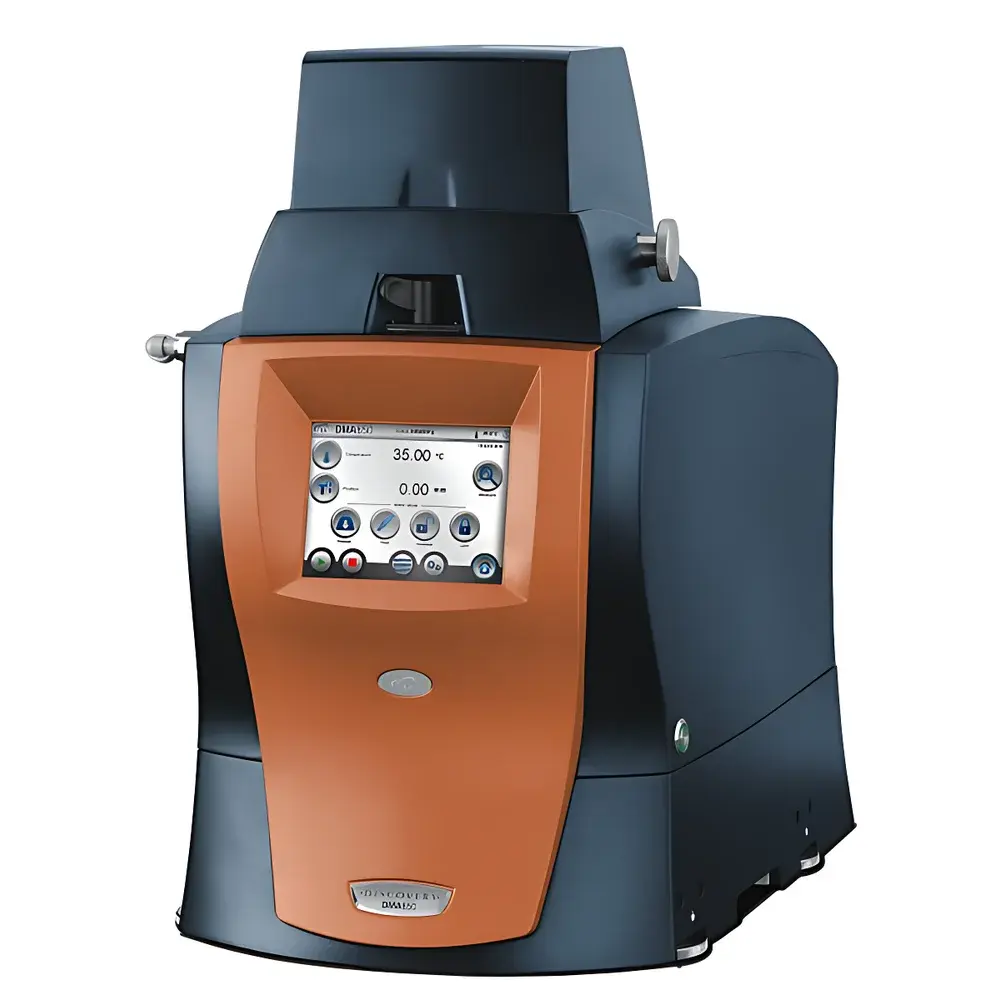
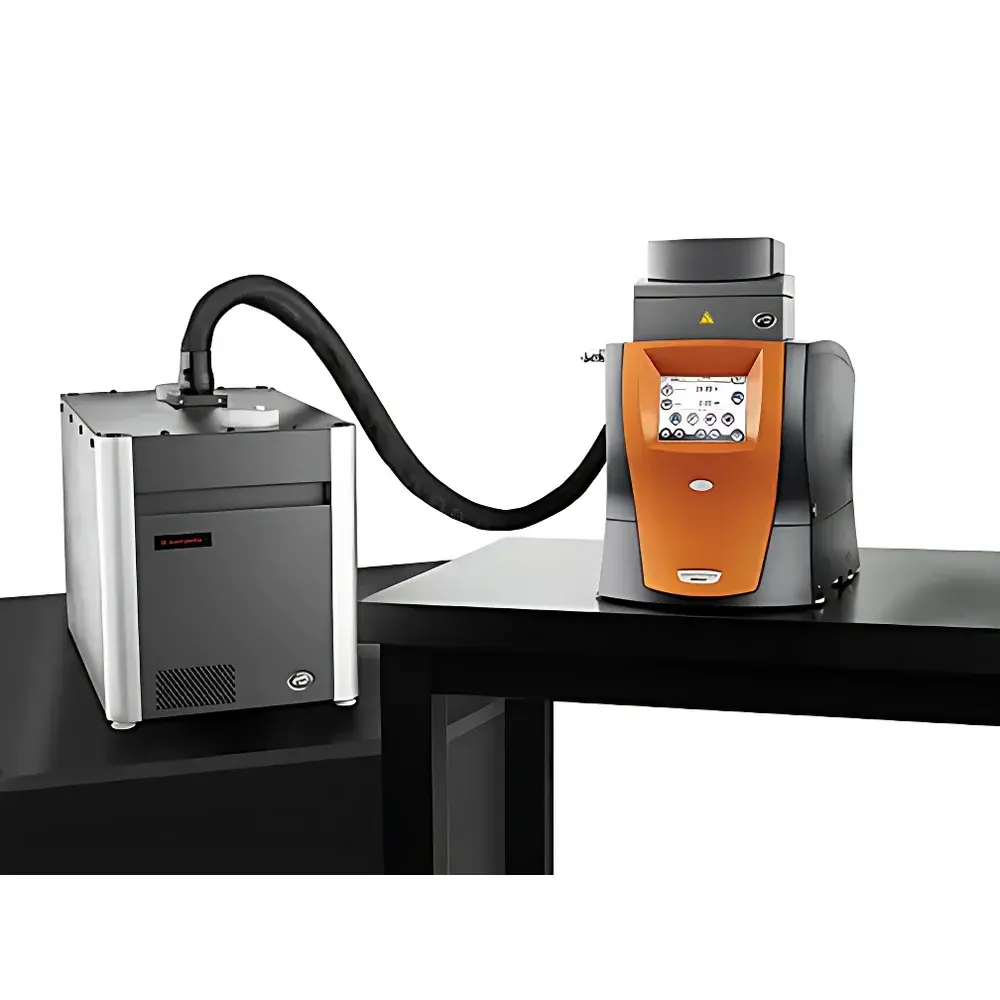
Discovery DMA 850 by TA Instruments
| Brand | TA Instruments |
|---|---|
| Origin | USA |
| Model | Discovery DMA 850 |
| Instrument Type | Dynamic Mechanical Analyzer (DMA/DMTA) |
| Temperature Range | –160 to 600 °C |
| Force Range | 0.0001–18 N |
| Resolution (Displacement) | 0.1 nm over 25 mm travel |
| Bearing Type | Frictionless air bearing |
| Actuation | Non-contact lightweight motor |
| Control Technology | DirectStrain™, Auto-Ranging |
| Cooling | Integrated mechanical refrigeration (down to –100 °C without LN₂) |
| Software | TRIOS™ |
| Warranty | 5-year furnace warranty |
Overview
The Discovery DMA 850 is a high-performance dynamic mechanical analyzer engineered for precision viscoelastic characterization of polymeric, composite, ceramic, and biomaterial systems across extreme thermal conditions. Operating on the fundamental principle of forced oscillatory deformation—applying controlled sinusoidal stress or strain while measuring the resulting in-phase (storage modulus, E′) and out-of-phase (loss modulus, E″) responses—the instrument quantifies time-temperature-dependent mechanical behavior including glass transitions, cure kinetics, relaxation spectra, and damping properties. Its modular architecture integrates a thermally isolated, low-inertia drive system with a frictionless air-bearing displacement sensor and non-contact electromagnetic actuator, enabling stable, high-fidelity measurement from ultra-soft elastomers (E′ 10 GPa) without mechanical recalibration.
Key Features
- Non-contact lightweight electromagnetic motor delivering continuous force control from 0.0001 N to 18 N—ensuring minimal thermal drift and zero stiction artifacts during low-force measurements.
- Frictionless air-bearing stage with sub-nanometer resolution: optical encoder technology achieves 0.1 nm displacement resolution over 25 mm linear travel, critical for detecting subtle transitions in thin films or low-modulus hydrogels.
- DirectStrain™ control architecture—eliminates traditional strain amplification hardware and enables true closed-loop strain control across all frequencies (0.01–100 Hz) and temperatures, improving reproducibility in multi-frequency sweeps.
- Intelligent Auto-Ranging functionality automatically selects optimal force/stress range and frequency settings based on real-time sample response—reducing operator dependency and minimizing setup errors.
- Dual environmental chamber options: standard convection furnace (–160 to 600 °C, compatible with liquid nitrogen cooling) and integrated mechanical cryocooler (–100 to 600 °C, LN₂-free operation), both featuring rapid ramp rates (up to 60 °C/min) and ±0.1 °C temperature stability.
- Modular, lightweight high-stiffness fixtures—including dual-cantilever, 3-point bending, tension, compression, and shear geometries—designed for minimal thermal expansion mismatch and consistent clamping force, ensuring inter-laboratory data comparability.
- 10.1-inch industrial-grade capacitive touchscreen with “APP-style” interface and One-Touch-Away™ workflow navigation—supporting intuitive method creation, real-time curve overlay, and context-sensitive parameter guidance.
Sample Compatibility & Compliance
The Discovery DMA 850 accommodates specimens ranging from 0.1 mm thick polymer films to 25 mm long fiber-reinforced composites, with standardized geometries compliant with ASTM D4065, ASTM D7028, ISO 6721-1/-4, and ISO 11357-2. All thermal modules meet IEC 61000-4 EMC requirements and are CE-marked. Data acquisition and instrument control adhere to GLP/GMP principles: TRIOS software supports 21 CFR Part 11-compliant electronic signatures, audit trails, user access levels, and secure data archiving—validated for regulated environments in pharmaceutical, aerospace, and medical device development.
Software & Data Management
TRIOS software provides role-based interfaces: “QuickStart” mode guides novice users through ASTM-aligned test templates (e.g., “Glass Transition Screening”, “Cure Monitoring”), while “Expert Mode” offers full scripting (Python API), custom frequency-temperature protocols, and advanced modeling (Williams-Landel-Ferry, Arrhenius, Boltzmann superposition). Raw data (stress, strain, phase angle, temperature, time) are stored in vendor-neutral HDF5 format with embedded metadata (instrument ID, calibration history, environmental logs). Batch analysis tools enable automated Tg detection per ASTM D7028 Annex A1, modulus mapping across thermal ramps, and master curve construction using time-temperature superposition (TTS).
Applications
- Quantifying α-, β-, and γ-relaxations in amorphous and semi-crystalline polymers under variable humidity and thermal cycling.
- Monitoring crosslink density evolution during UV/thermal curing of epoxies, acrylates, and silicone elastomers.
- Evaluating interfacial adhesion loss in multilayer packaging films via interlaminar shear modulus decay.
- Characterizing viscoelastic recovery and creep compliance of shape-memory alloys and hydrogels at physiological temperatures.
- Validating thermal stability of battery separator membranes under simulated charge-discharge thermal profiles (–20 to 80 °C).
- Supporting failure analysis of solder joints and underfill materials in microelectronics packaging per IPC-TM-650 2.6.25.
FAQ
What is the lowest measurable storage modulus achievable with the Discovery DMA 850?
The system achieves reliable E′ measurements down to ~100 Pa using the dual-cantilever geometry and low-force mode—enabled by the air-bearing’s nanoscale resolution and noise floor of <0.5 µN.
Can the mechanical cryocooler replace liquid nitrogen for all low-temperature applications?
Yes—the integrated single-stage Stirling cooler reaches –100 °C with ±0.3 °C stability; for tests below –100 °C (e.g., cryogenic polymer transitions), the optional LN₂-compatible furnace extends range to –160 °C.
Is TRIOS software validated for FDA-regulated submissions?
TRIOS v5.5+ includes full 21 CFR Part 11 validation documentation, IQ/OQ/PQ protocols, and change control records—available upon request for audit-ready deployment.
How does DirectStrain™ improve measurement accuracy compared to conventional DMA strain control?
By eliminating analog strain amplifiers and mechanical levers, DirectStrain™ removes hysteresis, creep, and thermal drift sources—delivering true digital strain feedback with <0.05% linearity error across the full 25 mm range.
What maintenance is required to sustain the 5-year furnace warranty?
Warranty coverage requires annual calibration verification by TA Instruments Field Service Engineers and adherence to recommended purge gas protocols (dry N₂ or compressed air ≥99.995% purity) during high-temperature operation above 400 °C.



