
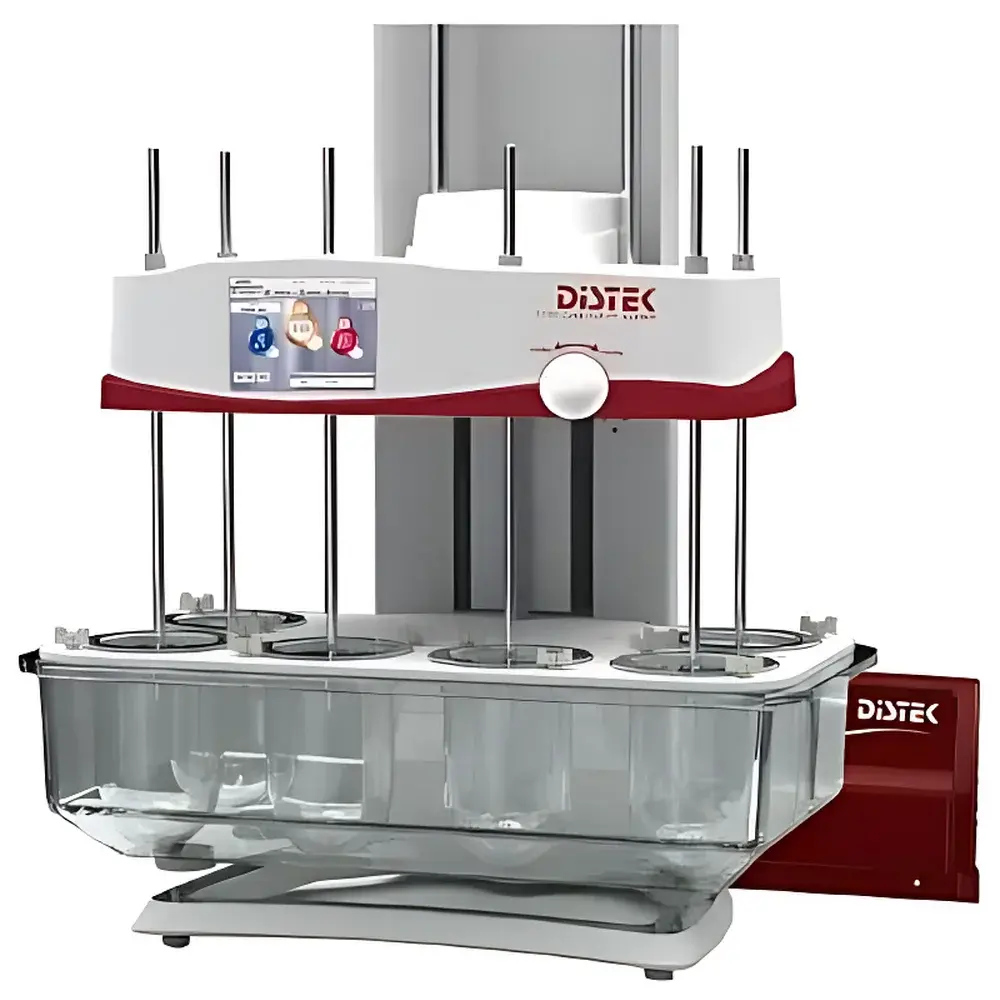
Distek 2500 Dissolution Tester
| Brand | Distek |
|---|---|
| Origin | USA |
| Model | 2500 |
| Instrument Type | Offline Dissolution Tester |
| Vessel Configuration | 6, 7, or 8 vessels |
| Vessel Volume Range | 100–4000 mL |
| Temperature Range | Ambient to 65 °C |
| Temperature Accuracy | ±0.2 °C |
| Temperature Resolution | 0.1 °C |
| Bath Volume | 18 L |
| Rotational Speed Range | 25–300 RPM |
| Speed Resolution | 0.1 RPM |
| Speed Accuracy | ±0.2 RPM |
| Paddle Wobble | < 0.010″ (0.254 mm) |
| Basket Wobble | < 0.010″ (0.254 mm) |
| Bath Temperature Control System | Microprocessor-Controlled Self-Priming TCS |
Overview
The Distek 2500 Dissolution Tester is a fully compliant, offline pharmaceutical dissolution system engineered for precision, regulatory traceability, and operational robustness in QC laboratories, contract research organizations (CROs), and formulation development units. Designed in accordance with USP <711>, <724>, <1092>, and ISO 19002 standards, the 2500 employs a calibrated paddle or basket apparatus operating under controlled hydrodynamic conditions to quantitatively assess the rate and extent of drug release from solid oral dosage forms—including tablets, capsules, and modified-release products—into a defined dissolution medium. Its modular architecture supports 6-, 7-, or 8-vessel configurations, enabling parallel testing across multiple formulations or time points while maintaining strict adherence to pharmacopeial vessel geometry, positioning tolerances, and fluid dynamics requirements.
Key Features
- Intuitive 7-inch full-color capacitive touchscreen interface with graphical navigation, built-in electronic user manual, and on-screen validation status indicators
- Automated height calibration system: eliminates re-alignment after switching between paddle and basket assemblies—ensures consistent 25 mm immersion depth per USP
- Self-priming, microprocessor-regulated Thermal Control System (TCS): delivers stable bath temperature control within ±0.2 °C across the full 18 L reservoir, with 0.1 °C resolution and uniform heating profiles
- Low-profile, split-chassis design minimizes mechanical coupling between the water bath and vessel deck—reducing vibration transmission and improving dissolution profile reproducibility
- Scheduled wake/sleep mode: programmable activation/deactivation of bath heating to align with lab schedules and reduce energy consumption without compromising thermal stability
- Electronic validation reminder: configurable alerts for scheduled performance qualification (PQ), operational qualification (OQ), and preventative maintenance intervals
- Optional automated drug delivery system (DDS): integrates with timer-controlled solenoid dispensers for synchronized, operator-independent dosing at t = 0
Sample Compatibility & Compliance
The Distek 2500 accommodates standard USP Apparatus 1 (basket) and Apparatus 2 (paddle) configurations, with optional support for Apparatus 3 (reciprocating cylinder) and Apparatus 4 (flow-through cell) via third-party adapters. Vessel volumes range from 100 mL to 4000 mL, permitting method development for low-volume pediatric suspensions, high-volume extended-release systems, and sink condition validation studies. All mechanical tolerances—including paddle/basket concentricity (±0.5 mm), wobble (<0.254 mm), and rotational axis verticality—are factory verified and documented per ASTM E2503 and USP General Chapter <1092>. The system meets FDA 21 CFR Part 11 requirements when paired with Distek’s validated software suite, supporting audit trails, electronic signatures, and role-based access control for GLP/GMP environments.
Software & Data Management
Control and data acquisition are managed through Distek’s proprietary Dissolution Pro™ software (v5.2+), which provides method-driven workflow automation, real-time dissolution curve visualization, and integrated reporting templates compliant with ICH M4 and FDA submission guidelines. Up to 100 pre-defined methods can be stored onboard, each with customizable sampling schedules, temperature ramp profiles, and agitation parameters. Experimental results—including raw absorbance/peak area values, calculated % dissolved, and statistical summaries (mean, SD, RSD)—are automatically timestamped and archived with full metadata (operator ID, instrument serial number, environmental logs). Data export supports CSV, PDF, and XML formats; audit trails record all user actions, parameter changes, and system events with immutable timestamps—fully satisfying ALCOA+ principles for data integrity.
Applications
- QC release testing of immediate- and extended-release oral solid dosage forms per compendial monographs
- Comparative dissolution profiling for bioequivalence assessment (e.g., f2 similarity factor calculation)
- Formulation optimization during preclinical and clinical development stages
- Stability-indicating method development under varying pH, surfactant, or enzymatic conditions
- Excipient interaction studies and dissolution-enabling technology evaluation (e.g., amorphous solid dispersions, lipid-based systems)
- Regulatory submission support—including ANDA, NDA, and MA dossier generation with full traceability
FAQ
Is the Distek 2500 compliant with USP <711> and <724>?
Yes—the system meets all mechanical, dimensional, and operational specifications outlined in USP General Chapters <711> (Dissolution) and <724> (Drug Release), including vessel geometry, shaft alignment, wobble limits, and temperature uniformity requirements.
Can the 2500 be integrated into a laboratory information management system (LIMS)?
Yes—via secure ODBC or HL7-compliant API interfaces, enabling bidirectional transfer of test methods, sample IDs, and dissolution results into enterprise LIMS or ERP platforms.
What validation documentation is provided with the instrument?
Each unit ships with a Factory Acceptance Test (FAT) report, IQ/OQ protocol templates, and a Certificate of Conformance referencing ASTM E2503, ISO 19002, and USP <1092> verification criteria.
Does the system support non-standard dissolution media, such as simulated gastric/intestinal fluids?
Yes—temperature and agitation parameters remain stable across viscous or surfactant-containing media; optional corrosion-resistant vessel liners and shaft coatings are available for aggressive solvents.
How is data integrity ensured during long-duration dissolution runs (e.g., 24+ hours)?
The embedded controller maintains continuous logging independent of PC connectivity; power-fail recovery preserves timestamps and ongoing measurements, and all data are written to redundant internal storage with SHA-256 checksum verification.
Related Products




