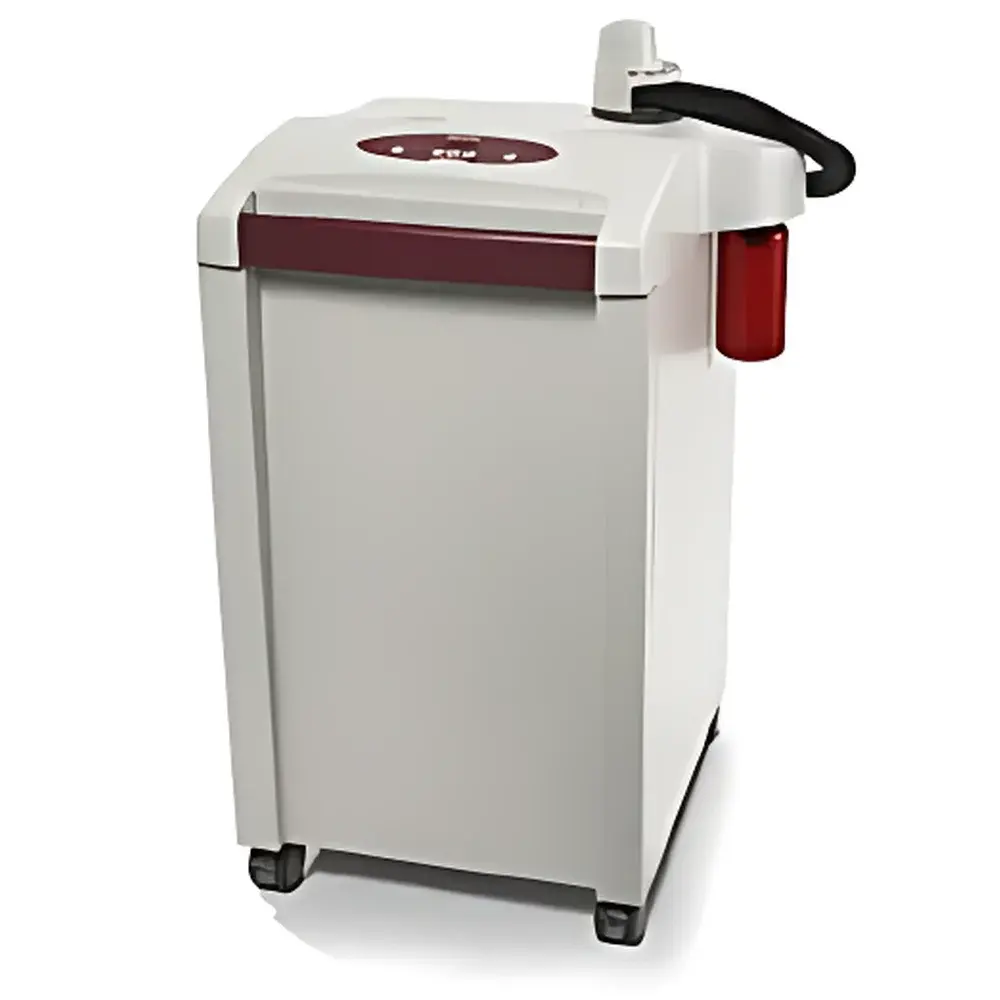
Distek VIP 4400 Dissolution Vessel Cleaning System
| Brand | Distek |
|---|---|
| Origin | USA |
| Model | VIP 4400 |
| Heating Capability | External heater connection (25–60 °C) |
| Cycle Time per Vessel | 30–45 s |
| Total Batch Cleaning Time | ~3–4 min (mode-dependent) |
| Cleaning Modes | 3 selectable intensity levels (gentle to aggressive) |
| Noise Level | Low |
| Drain Control | Automatic adjustment |
| Core Technology | Patented cyclonic rinse mechanism |
Overview
The Distek VIP 4400 Dissolution Vessel Cleaning System is an engineered solution designed specifically for high-throughput, reproducible cleaning of USP Apparatus 1 (basket) and Apparatus 2 (paddle) dissolution vessels. It operates on a patented cyclonic rinse principle—generating controlled, rotational fluid dynamics within each vessel to ensure complete 360° coverage of interior surfaces without mechanical contact or abrasive action. This non-destructive, validated cleaning methodology eliminates residual drug substance, excipients, or media carryover that may compromise subsequent dissolution test integrity. The system integrates seamlessly into regulated pharmaceutical QC/QA laboratories where adherence to ICH Q5C, USP <711>, and FDA guidance on dissolution method validation demands rigorous control over vessel cleanliness as a critical process parameter.
Key Features
- Patented Cyclonic Rinse Technology: Delivers uniform, turbulence-driven fluid motion inside each vessel—no brushes, no jets, no blind spots—ensuring consistent removal of both hydrophilic and hydrophobic residues across all vessel geometries (e.g., 1000 mL, 900 mL, and custom formats).
- Three Programmable Cleaning Intensities: Operators select from gentle, standard, or aggressive rinse profiles based on formulation viscosity, coating stability, or historical residue analysis—enabling risk-based cleaning validation per ASTM E2656 and ISO 15223-1.
- Automated Drain Management: Integrated level-sensing and adaptive drain timing prevent overflow or premature termination, maintaining precise dwell time during final rinse and minimizing water consumption by up to 35% compared to manual or fixed-timer systems.
- Low-Acoustic Operation: Acoustic emissions remain below 58 dB(A) at 1 m distance—compliant with OSHA 29 CFR 1910.95 workplace noise exposure limits—supporting continuous operation in open-lab environments without hearing protection requirements.
- External Temperature Integration: Compatible with external recirculating chillers or heaters (25–60 °C range), allowing thermal-assisted cleaning for temperature-sensitive APIs or high-melting-point excipients, supporting cold-water rinse protocols required under USP <1058> Analytical Instrument Qualification.
Sample Compatibility & Compliance
The VIP 4400 accommodates standard USP-compliant dissolution vessels (glass or stainless-steel baskets/paddles) and supports optional fixtures for extended-use accessories such as sinker weights, conical-bottom vessels, or fiber-optic probe mounts. All wetted components are constructed from 316L stainless steel and PTFE-lined manifolds, meeting USP Class VI biocompatibility standards. The system is fully compatible with laboratory-wide cleaning validation documentation workflows—including IQ/OQ/PQ execution—and supports audit-ready electronic records when interfaced with compliant LIMS or ELN platforms. Its design aligns with FDA 21 CFR Part 11 requirements for electronic signatures and audit trails when used with validated software extensions.
Software & Data Management
While the base VIP 4400 operates via intuitive front-panel controls, optional Ethernet-enabled firmware allows integration into centralized lab automation networks. Cleaning cycles are timestamped, logged with mode selection, duration, and external temperature input (when active), and exportable in CSV or XML format for inclusion in batch production records. All logs retain full traceability—including operator ID, date/time, and cycle verification status—to support GLP/GMP compliance and regulatory inspections. No proprietary database is required; raw log files conform to ASTM E2500-21 data interchange specifications.
Applications
- Routine cleaning between dissolution runs in QC release testing (e.g., tablet, capsule, extended-release formulations)
- Pre-validation cleaning of vessels prior to method transfer or requalification
- Residue removal studies supporting cleaning validation protocols (e.g., swab recovery, rinse sampling)
- Supporting automated dissolution systems (e.g., Distek 2500/4300 series) in fully integrated workflows
- Maintenance of vessel surface integrity—avoiding micro-scratching from brush-based cleaners that may affect dissolution hydrodynamics
FAQ
Does the VIP 4400 require calibration or periodic performance verification?
Yes—annual operational qualification (OQ) is recommended per USP <1058>, including verification of cycle timing accuracy, temperature consistency (when external heater is engaged), and rinse uniformity using dye-tracing or residue-spiking protocols.
Can the system clean vessels with adherent film coatings or sustained-release polymers?
The aggressive rinse mode, combined with elevated temperature (up to 60 °C), has demonstrated efficacy against common film-coating residues (e.g., HPMC, Eudragit®) in comparative residue studies; however, formulation-specific validation remains the responsibility of the user.
Is the VIP 4400 compatible with distilled, deionized, or purified water only?
It is validated for use with Purified Water (PW) per USP <1231>; use of WFI or solvents requires modification of wetted materials and is not supported under standard configuration.
What maintenance is required beyond routine cleaning of the rinse manifold?
Annual inspection of the cyclonic nozzle alignment, drain valve seal integrity, and sensor calibration is advised; no consumables or scheduled part replacements are specified in the manufacturer’s maintenance schedule.