
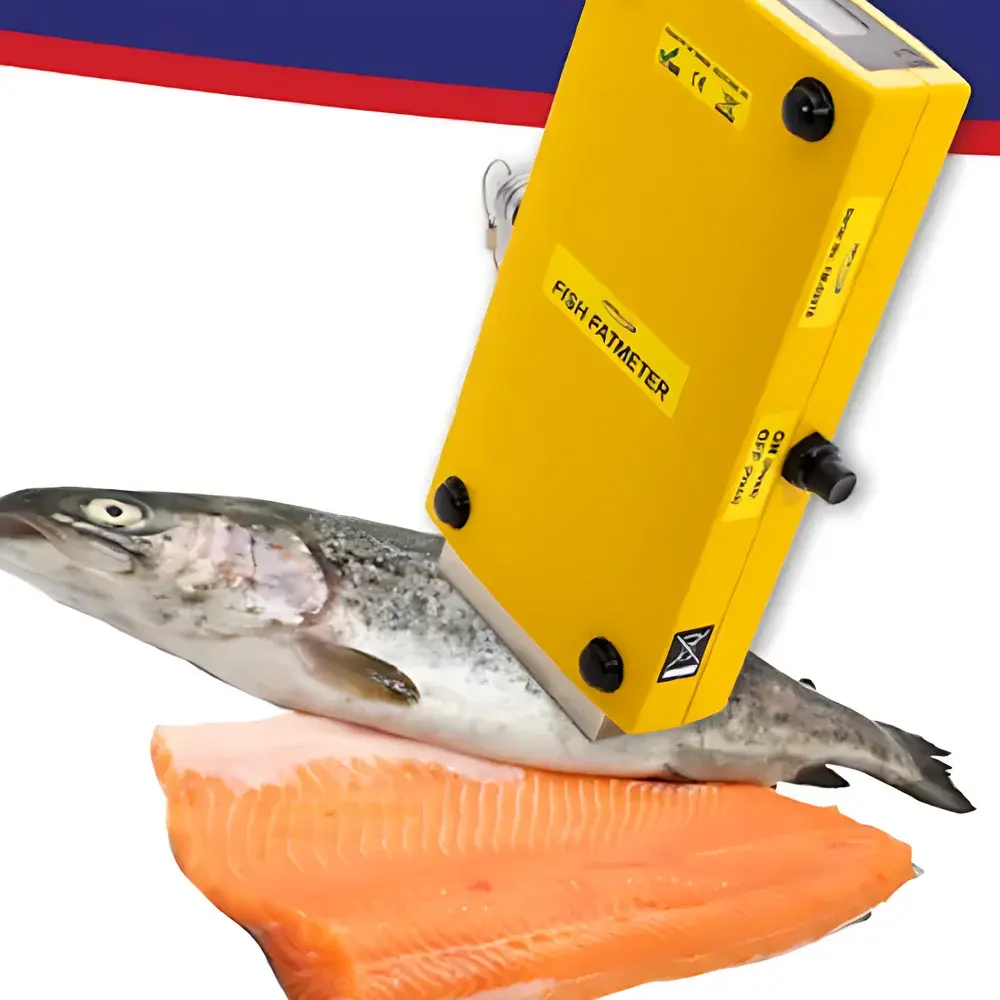
Distell FFM-992 Fish Fat Analyzer
| Brand | Distell |
|---|---|
| Origin | United Kingdom |
| Model | FFM-992 |
| Measurement Principle | Microwave Dielectric Sensing (2.0 GHz ±20 MHz, 2 mW) |
| Sensor Dimensions | 195 × 100 × 40 mm (housing), 80 × 25 × 10 mm (electrode probe) |
| Electrode Material | Carbon outer electrode, stainless steel inner electrode |
| Display | 2-line × 12-character LCD |
| Processor | Embedded microprocessor with firmware supporting up to 80 user-defined calibrations |
| Battery | Rechargeable NiMH pack (integrated, no external connectors) |
| Weight | 725 g (including battery) |
| Enclosure Material | ABS plastic |
| Ingress Protection | IP65 |
| Fat/Oil Measurement Range | 1–80% (w/w, species-dependent) |
| Preloaded Calibrations | >60 standard marine and farmed fish species |
| Data Modes | Real-time measurement mode & research mode with audit-ready logging |
| Software | PC-based data management suite for batch analysis, statistical reporting, and calibration file export |
| Compliance | Designed for GLP-compliant field and lab use |
Overview
The Distell FFM-992 Fish Fat Analyzer is a portable, non-destructive microwave dielectric sensor engineered for rapid, in-situ quantification of total fat/oil content in whole fish, fillets, and minced samples. Operating at a stable 2.0 GHz ±20 MHz frequency with 2 mW output power, the instrument measures the dielectric response of biological tissue—primarily driven by water-fat phase contrast—and converts it into calibrated fat mass fraction (w/w %) using empirically validated regression models. Its foundational methodology was developed at the MAFF Torry Research Station in Aberdeen, Scotland, where decades of comparative fish composition studies established the correlation between microwave attenuation and lipid concentration across diverse taxa. Unlike destructive solvent-extraction methods (e.g., AOAC 991.36), the FFM-992 delivers repeatable results within seconds without sample preparation, homogenization, or chemical reagents—making it suitable for quality control on processing lines, aquaculture harvest assessment, and field-based nutritional surveys.
Key Features
- True portability: Integrated rechargeable NiMH battery eliminates dependency on AC power or external cables—enabling operation in docks, cold rooms, boats, or remote hatcheries.
- Robust industrial design: IP65-rated ABS housing withstands humidity, salt spray, and routine washdown; carbon/stainless steel electrode assembly ensures long-term stability in high-moisture environments.
- Species-specific calibration library: Pre-loaded with over 60 validated calibrations covering commercially significant marine (e.g., Atlantic salmon, cod, herring) and freshwater/farmed species (e.g., tilapia, carp, rainbow trout), each traceable to reference gravimetric data.
- Dual operational modes: Real-time mode provides immediate single-point readings; research mode logs timestamped measurements with metadata (operator ID, location tag, calibration ID) for regulatory traceability.
- On-device firmware: Supports up to 80 custom calibrations—enabling users to develop and store new models for novel species or hybrid strains using reference laboratory data.
Sample Compatibility & Compliance
The FFM-992 accommodates intact fish (up to 30 cm length), skin-on/skin-off fillets, and ground mince—requiring only consistent probe contact pressure and minimal surface moisture control. It is not intended for bone-in samples or highly heterogeneous composites (e.g., mixed-species blends). While not certified to a specific ISO standard as a standalone device, its measurement protocol aligns with principles outlined in ISO 1442 (meat/fish fat determination) and supports compliance with EU Regulation (EC) No 853/2004 for aquatic product labeling accuracy. Calibration files include uncertainty estimates derived from inter-laboratory validation studies conducted under GLP conditions, and raw data exports meet minimum requirements for FDA 21 CFR Part 11–aligned audit trails when used with validated software workflows.
Software & Data Management
The companion Windows-based Data Manager software enables secure import of measurement logs via USB. Users can generate batch reports with descriptive statistics (mean, SD, CV%), apply filtering by species/calibration group, and export CSV or PDF outputs for QA documentation. Calibration files are digitally signed and version-controlled; modification history is logged with timestamps and operator credentials. The software supports integration with LIMS platforms via standardized XML schema—facilitating automated data ingestion into enterprise quality systems. All calibration coefficients and regression parameters remain editable only by authorized personnel with administrative privileges, satisfying internal audit requirements for method control.
Applications
- Aquaculture feed optimization: Monitor seasonal fat deposition in broodstock and market-sized fish to adjust dietary lipid levels.
- Processing plant QC: Verify label claims for omega-3 content (as proxy for total fat) in smoked, frozen, or canned products prior to release.
- Research & breeding programs: Track phenotypic lipid variation across genetic lines or environmental treatments without sacrificing experimental animals.
- Fisheries management: Conduct rapid stock assessments during at-sea surveys to estimate energy reserves and reproductive readiness.
- Regulatory verification: Support official controls for mislabeling disputes under national food authenticity frameworks (e.g., UK Food Standards Agency guidelines).
FAQ
How does the FFM-992 achieve non-destructive measurement?
It employs low-power microwave dielectric sensing: the 2 GHz signal interacts differentially with water (high dielectric constant) and lipids (low dielectric constant), generating a composite response proportional to fat mass fraction—no tissue disruption is required.
Can I validate the instrument against reference methods?
Yes. Each calibration is traceable to gravimetric Soxhlet or Mojonnier extractions performed per AOAC 991.36 or ISO 1442; users may perform parallel testing and update calibration slopes using the software’s linear regression tool.
Is temperature compensation built into the sensor?
The microprocessor applies real-time thermal drift correction based on integrated thermistor readings, maintaining accuracy across ambient ranges of 5–35°C.
What maintenance is required?
No routine calibration drift correction is needed; periodic verification using supplied reference phantoms (certified dielectric standards) every 6 months is recommended for GLP adherence.
Does the software support multi-user environments with role-based access?
Yes—administrator, analyst, and viewer roles are configurable, with password protection and encrypted local database storage compliant with GDPR data handling requirements.





