
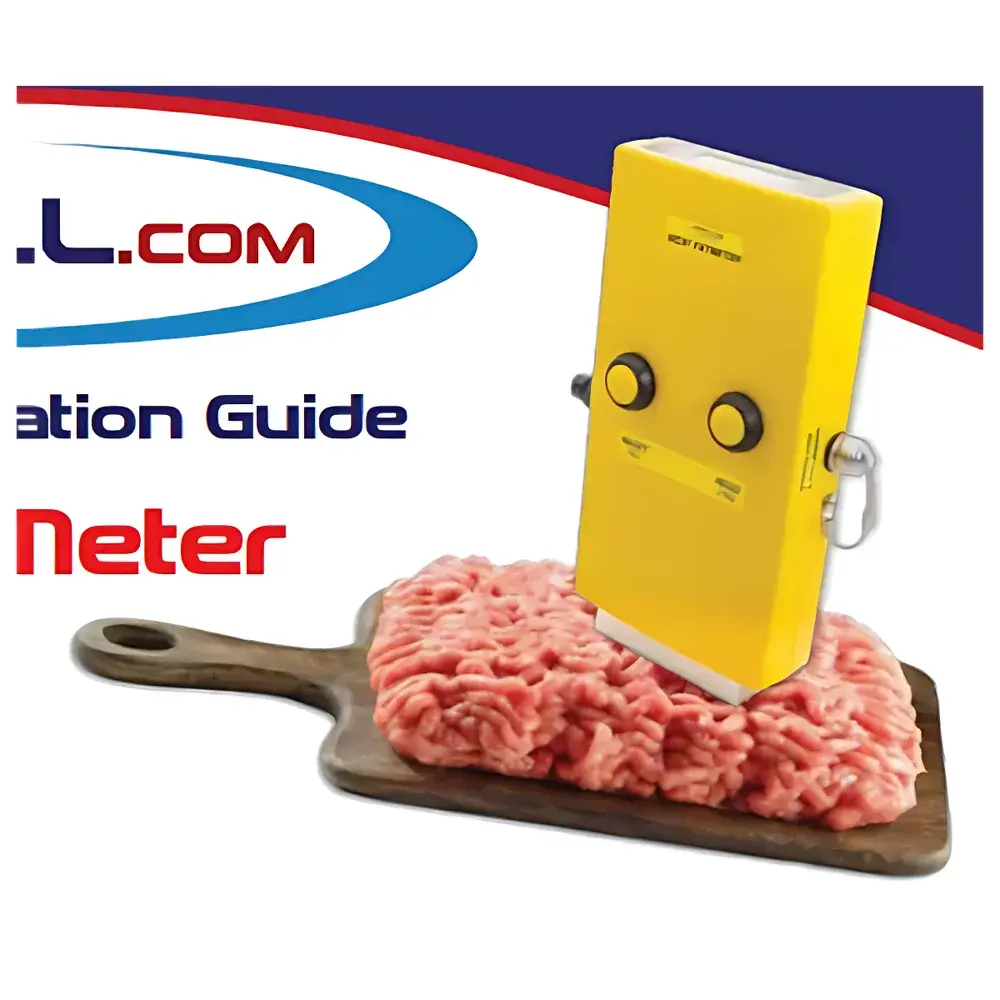
Distell MFM-992/1092 Microwave-Based Meat Fat Content Analyzer
| Brand | Distell |
|---|---|
| Origin | United Kingdom |
| Model | MFM-992/1092 |
| Sensor Type | Microstrip Transmission Microwave |
| Frequency | 2.0 GHz (±20 MHz) |
| Microwave Power | 2 mW |
| Display | LCD, 2×12 characters |
| Housing Material | Stainless steel & PTFE sensor head |
| IP Rating | IP65 |
| Dimensions | 195 mm × 100 mm × 40 mm |
| Weight | 725 g (with NiMH battery) |
| Onboard Memory | Up to 80 calibration sets |
| Data Interface | RS-232 serial port for real-time and historical data transfer |
| Software | Dedicated FatMeter Data Management Suite |
| Power Supply | 9 V DC, 1.2 A (via universal AC adapter: 110 V AC, 50–60 Hz) |
| Battery | Rechargeable NiMH |
Overview
The Distell MFM-992/1092 Microwave-Based Meat Fat Content Analyzer is a portable, non-destructive, and field-deployable instrument engineered for rapid, in-line quantification of fat (lipid) content in raw and processed meat products—including beef, pork, lamb, poultry, and fish fillets. Its operational principle relies on microwave transmission spectroscopy at 2.0 GHz, exploiting the dielectric contrast between water and lipid molecules. Since fat and moisture exhibit inverse volumetric relationships in biological tissues, the instrument measures bulk dielectric permittivity via a microstrip transmission line sensor, then applies empirically validated, tissue-specific calibration models to derive fat concentration as a mass percentage (%, w/w). This methodology was originally developed at the MAFF Torry Research Station in Aberdeen, Scotland, where decades of collaborative work with fisheries and livestock scientists established traceable, matrix-matched calibrations across species, cuts, and processing states—ensuring analytical continuity from research lab to abattoir floor.
Key Features
- Non-invasive measurement: No sample homogenization, solvent extraction, or chemical reagents required—preserves sample integrity and eliminates hazardous waste.
- Microstrip transmission sensor: Engineered stainless steel and PTFE probe ensures mechanical durability, corrosion resistance, and consistent electromagnetic coupling across variable surface textures and temperatures (operational range: 0–40 °C).
- IP65-rated enclosure: Fully sealed against dust ingress and low-pressure water jets—suitable for wet processing environments including chill rooms, cutting lines, and mobile inspection units.
- Dedicated microprocessor architecture: Real-time signal conditioning, temperature-compensated algorithm execution, and dual-mode operation (single-point reading or continuous monitoring).
- On-device memory: Stores up to 80 independent calibration profiles—enabling seamless switching between species (e.g., porcine loin vs. bovine brisket), product forms (ground vs. intact muscle), and regulatory reporting formats.
- Integrated NiMH rechargeable battery: Provides >8 hours of continuous operation; supports hot-swap capability when used with optional desktop power supply.
Sample Compatibility & Compliance
The MFM-992/1092 is validated for use with uncooked, chilled, frozen-thawed, and minimally processed meat matrices. It accommodates heterogeneous samples—including marbled beef, skin-on poultry portions, and mechanically deboned meat—with no requirement for standardized geometry or pre-conditioning. Calibration models are traceable to reference methods per ISO 1442 (meat moisture) and AOAC 992.16 (fat in meat by solvent extraction), and support compliance with EU Regulation (EC) No 853/2004 (hygiene rules for food of animal origin) and USDA FSIS Directive 7120.1 (in-plant verification of lean/fat ratios). Instrument firmware maintains full audit trail functionality, supporting GLP-aligned data integrity requirements under FDA 21 CFR Part 11 when paired with validated software workflows.
Software & Data Management
The included FatMeter Data Management Suite provides secure bidirectional communication via RS-232 interface. It enables configuration of user-defined calibration tables, batch-level metadata tagging (operator ID, lot number, timestamp), export of CSV-formatted datasets for LIMS integration, and graphical trend analysis across production shifts. All data transfers are logged with immutable timestamps and checksum validation. The software supports electronic signature capture and configurable report templates compliant with internal QA protocols and third-party certification audits (e.g., BRCGS, IFS Food).
Applications
- Real-time lean/fat ratio verification during carcass grading and primal cut classification.
- In-process quality control of ground meat formulations (e.g., burger patties, sausages) to ensure label compliance per EU Regulation 1169/2011.
- Raw material acceptance testing at slaughterhouse receiving docks.
- Research applications in animal nutrition trials assessing dietary impacts on intramuscular fat deposition.
- Validation of near-infrared (NIR) or Raman calibration models using MFM-992/1092 as a primary reference method.
FAQ
Does the MFM-992/1092 require daily recalibration?
No—calibration stability is verified over 72-hour continuous operation under ambient conditions; field recalibration is recommended only after mechanical impact, extreme thermal cycling, or when switching between markedly divergent species matrices.
Can it measure fat in cooked or cured meats?
Yes, provided dedicated calibration models are developed and validated for those specific thermal or chemical treatments; standard factory calibrations cover raw and chilled states only.
Is the instrument suitable for GMP-regulated environments?
Yes—when deployed with documented SOPs, version-controlled firmware, and the validated Data Management Suite, it meets foundational data integrity requirements for pharmaceutical-grade excipient testing (e.g., collagen-based meat analogs) under Annex 11 guidelines.
What maintenance is required?
Annual verification against NIST-traceable dielectric standards; biannual cleaning of the PTFE sensor face with isopropyl alcohol; no consumables or optical alignment procedures are necessary.
Related Products





