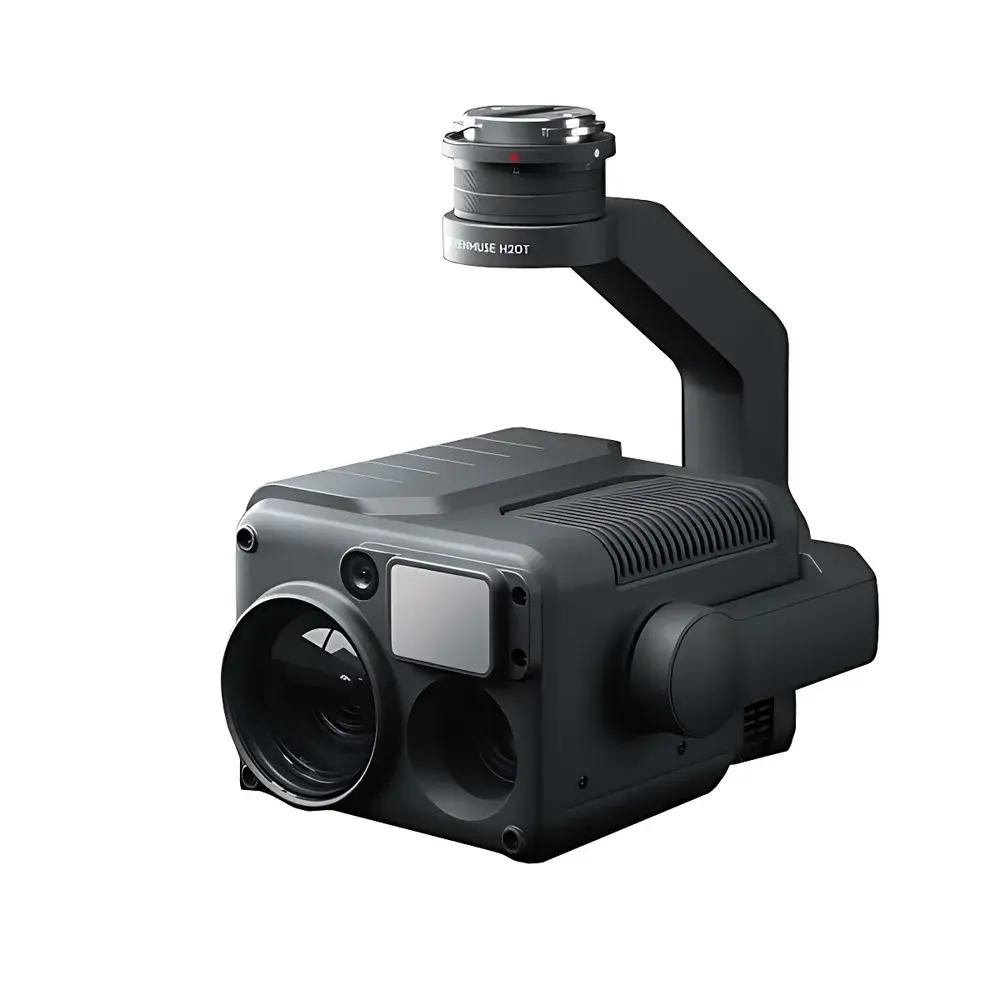
DJI Zenmuse H20T Thermal Imaging Camera
| Brand | DJI |
|---|---|
| Origin | Shenzhen, China |
| Manufacturer Type | Authorized Distributor |
| Origin Category | Domestic (China) |
| Model | H20T |
| Price Range | USD 8,500 – 11,500 |
Overview
The DJI Zenmuse H20T is an integrated multi-sensor payload engineered for professional aerial inspection and situational awareness in demanding operational environments. Designed for integration with DJI Matrice 300 RTK and M30 series platforms, it combines four independent imaging modalities—high-resolution optical zoom, wide-angle visible-light, uncooled vanadium oxide (VOx) thermal imaging, and a Class 1 eye-safe pulsed laser rangefinder—within a single, stabilized gimbal assembly. Its measurement principle relies on passive infrared radiation detection (7.5–13.5 µm spectral band) for thermal contrast analysis, complemented by active time-of-flight (ToF) distance measurement and high-fidelity visible-spectrum photogrammetry. This architecture enables synchronized data acquisition across modalities, supporting rapid scene assessment under low-visibility conditions—including smoke, darkness, fog, or light foliage—without requiring platform repositioning or sensor switching delays.
Key Features
- Uncooled VOx microbolometer thermal sensor with 640 × 512 resolution, f/1.0 aperture, and 13.5 mm focal length (58 mm equivalent), delivering high thermal sensitivity (<50 mK NETD) and stable focus from 5 m to infinity.
- 20-megapixel optical zoom camera featuring a 1/1.7″ CMOS sensor, 17.5× optical zoom (6.83–119.94 mm, 31.7–556.2 mm equivalent), variable aperture (f/2.8–f/11 standard; f/1.6–f/11 night mode), and dual-range autofocus (1–∞ m wide-angle; 8–∞ m telephoto).
- 12-megapixel wide-angle camera with 1/2.3″ CMOS sensor, 82.9° diagonal field of view (24 mm equivalent), f/2.8 fixed aperture, and full-range autofocus (1 m to infinity).
- Laser rangefinder operating at 905 nm wavelength, compliant with IEC 60825-1:2014 Class 1 safety requirements; measures distances from 3 m to 1200 m (at 20% reflectivity, full-spot condition) with accuracy of ±(0.2 m + D × 0.15%), where D is the perpendicular distance to the target surface.
- Real-time sensor fusion engine enabling pixel-level alignment between thermal, zoom, and wide-angle imagery; supports synchronized timestamping, geo-tagging, and embedded metadata per frame per modality.
Sample Compatibility & Compliance
The Zenmuse H20T is designed for non-contact remote sensing of static and dynamic targets across industrial, public safety, and infrastructure domains. It complies with FCC Part 15 Subpart C, CE RED Directive 2014/53/EU, and RoHS 2011/65/EU. While not certified as medical or laboratory-grade instrumentation, its thermal output meets ASTM E1934-19 guidelines for qualitative thermographic survey applications. The system supports export-controlled configurations aligned with EAR99 classification and adheres to DJI’s enterprise firmware security framework—including encrypted telemetry, secure boot, and hardware-based key storage. No calibration certificate is supplied by default; users are advised to perform periodic verification using NIST-traceable blackbody sources per ISO/IEC 17025-aligned internal procedures.
Software & Data Management
Data acquisition and post-processing are managed via DJI Pilot 2 (v4.0+), a mission-planning and real-time visualization application compatible with Windows and Android. All captured streams—including radiometric thermal video (.RJPEG), georeferenced stills (.JPG/.TIFF), and synchronized multi-modal timelines—are stored on removable microSD cards (up to 256 GB). The SDK supports third-party integration through DJI Mobile SDK v4 and Payload SDK v3, enabling custom analytics pipelines for temperature anomaly detection, hotspot tracking, and GIS-aligned reporting. Exported thermal data retains embedded calibration parameters and emissivity settings (default ε = 0.95), facilitating quantitative analysis in external tools such as FLIR Tools+, ThermaCAM Researcher, or MATLAB-based thermal modeling workflows. Audit trails, user access logs, and firmware update history are retained locally and exportable for GLP/GMP-aligned documentation.
Applications
- Firefighting & Emergency Response: Rapid identification of hotspots behind walls, ceiling voids, or within smoke-obscured structures; personnel location via thermal signature differentiation; structural integrity assessment during overhaul.
- Power Transmission Inspection: Detection of abnormal heating at insulators, connectors, transformers, and conductor splices; comparative thermal analysis across three-phase systems per IEEE C57.12.90 standards.
- Oil & Gas Infrastructure Monitoring: Leak detection via evaporative cooling signatures on pipelines and flanges; tank level estimation; flare stack performance evaluation.
- Law Enforcement & Border Patrol: Covert surveillance in total darkness; suspect tracking across varied terrain; evidence documentation with geotagged thermal metadata.
- Search & Rescue (SAR): Human subject detection at extended ranges (>800 m) under adverse lighting or weather; integration with DJI’s AI-powered Spotlight feature for automated target highlighting.
FAQ
Is the H20T suitable for quantitative thermography in compliance with ISO 18436-7?
The H20T provides radiometric thermal video with embedded temperature data but lacks factory-certified traceable calibration reports required for formal ISO 18436-7 Level III certification. Users must implement secondary calibration protocols using reference blackbodies.
Can thermal images be exported with raw sensor data (e.g., 14-bit digital counts)?
No. Only calibrated temperature matrices (16-bit TIFF or RJPEG format) are exported. Raw digital counts are not accessible via standard SDK or file system interfaces.
Does the laser rangefinder meet FDA 21 CFR Part 1040.10 requirements for Class I devices?
Yes—the 905 nm emitter is classified as Class 1 per IEC 60825-1:2014 and satisfies equivalent U.S. FDA laser product safety requirements under 21 CFR 1040.10/1040.11 when operated within specified environmental and usage constraints.
What is the maximum operating altitude and ambient temperature range?
The payload is rated for operation up to 5000 m ASL and ambient temperatures from –20°C to +50°C, consistent with Matrice 300 RTK airframe specifications.
Is firmware update support available beyond the initial warranty period?
Yes—DJI provides ongoing firmware updates for all enterprise payloads via DJI Assistant 2 (Enterprise Edition), including security patches, stability improvements, and new feature rollouts, regardless of warranty status.