
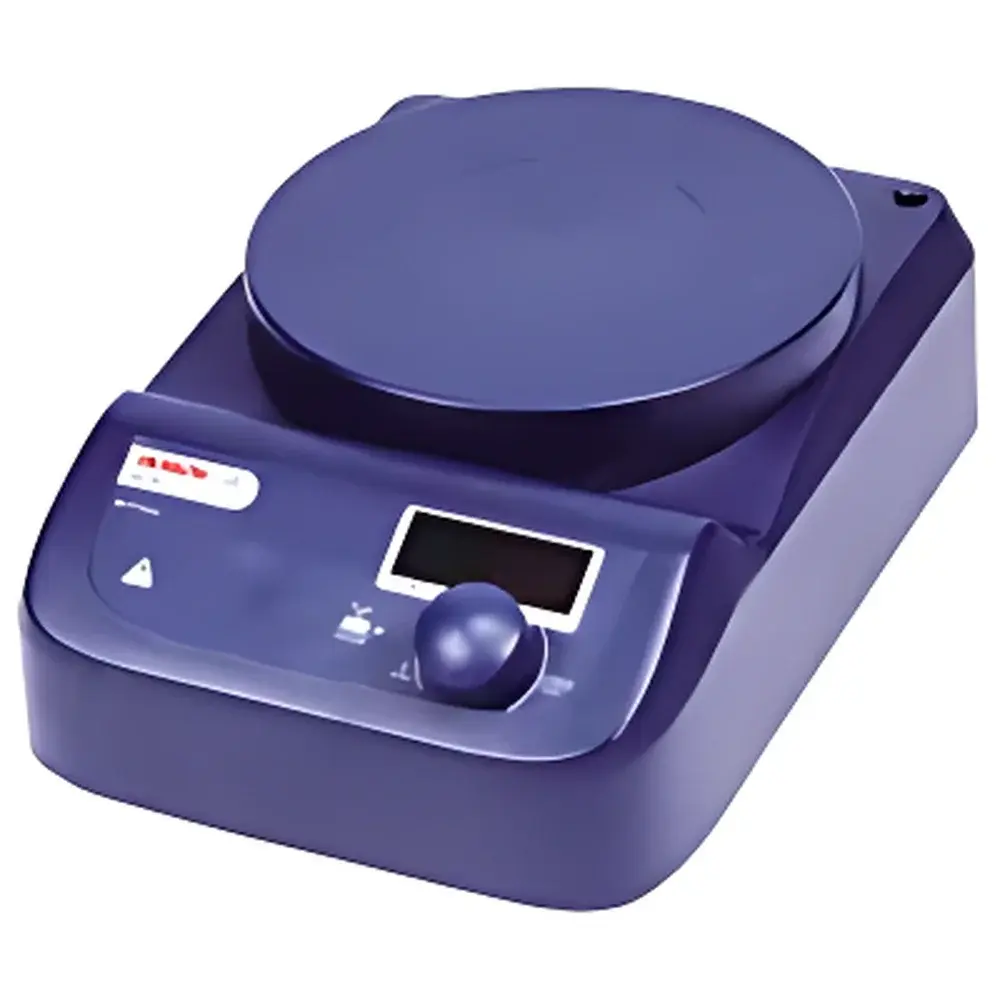
DLAB BlueSpin LED Digital Magnetic Stirrer MS-PA
| Brand | DLAB |
|---|---|
| Origin | Beijing, China |
| Model | MS-PA |
| Stirring Capacity | 3 L (H₂O) |
| Speed Range | 100–1500 rpm |
| Speed Display | Dual LED (Set & Actual) |
| Control System | Microprocessor-Based Closed-Loop Feedback |
| Housing | Flame-Retardant Fully Enclosed Plastic Enclosure |
| Plate Diameter | Ø135 mm (5") |
| Plate Material | High-Impact Polymer |
| Motor Type | Brushed DC Motor |
| Input Power | 5 W |
| Output Power | 3 W |
| Rated Power Consumption | 15 W |
| Voltage | 100–240 VAC, 50/60 Hz |
| IP Rating | IP42 (per DIN EN 60529) |
| Dimensions (W×D×H) | 150 × 260 × 80 mm |
| Weight | 1.8 kg |
| Operating Ambient | 5–40 °C, ≤80% RH |
| Max Stir Bar Length | 50 mm |
| Stirring Positions | 1 |
Overview
The DLAB BlueSpin LED Digital Magnetic Stirrer MS-PA is an entry-level yet precision-engineered benchtop magnetic stirrer designed for routine mixing, dissolution, and homogenization tasks in academic teaching labs, QC/QA environments, and small-scale R&D settings. It operates on the principle of electromagnetic induction: a rotating permanent magnet beneath the polymer-coated stirring plate generates a time-varying magnetic field that couples with ferromagnetic stir bars immersed in the sample vessel, inducing controlled rotational motion. Unlike analog or open-loop stirrers, the MS-PA integrates a microprocessor-based closed-loop feedback control system that continuously monitors motor back-EMF and adjusts drive current in real time—ensuring stable speed maintenance across varying load conditions (e.g., viscosity changes, vessel geometry, or ambient temperature fluctuations). Its compact footprint, universal AC input compatibility (100–240 VAC), and IP42-rated enclosure make it suitable for shared lab spaces where electrical safety, dust resistance, and operational reliability are prioritized.
Key Features
- Dual-line LED display showing both set speed (rpm) and real-time actual speed—enabling immediate verification of process fidelity without manual tachometer calibration.
- Stable speed regulation across the full 100–1500 rpm range, with typical speed deviation ≤±3% under constant load (tested with 1 L water in standard 1000 mL beaker).
- Flame-retardant, fully enclosed plastic housing compliant with IEC 61010-1 for laboratory electrical equipment safety—reducing risk of accidental ingress or thermal exposure.
- Optimized 135 mm Ø polymer-coated stirring plate offering uniform magnetic field distribution and minimizing vortex asymmetry during high-speed operation.
- Low-noise brushed DC motor with 3 W mechanical output power—engineered for continuous duty cycles up to 8 hours at mid-range speeds (600–1000 rpm).
- Compact dimensions (150 × 260 × 80 mm) and lightweight design (1.8 kg) facilitate easy relocation between fume hoods, biosafety cabinets, or modular lab benches.
Sample Compatibility & Compliance
The MS-PA supports single-vessel mixing of aqueous and low-viscosity organic solutions up to 3 L volume (measured with deionized water in cylindrical glassware). Compatible stir bars include standard PTFE- or glass-coated magnets up to 50 mm in length; optimal performance is achieved using bar-to-volume ratios recommended by ASTM E2913–22 (Standard Guide for Selection of Magnetic Stir Bars). The unit complies with DIN EN 60529 (IP42) for protection against solid objects ≥1 mm and vertically falling water droplets. While not certified for use in explosion-proof or Class I Div 1 environments, its non-sparking motor design and absence of exposed conductive surfaces align with general-purpose lab safety protocols per ISO/IEC 17025:2017 clause 5.3.2 for equipment suitability assessment.
Software & Data Management
The MS-PA is a standalone hardware device with no embedded firmware update capability or digital connectivity (e.g., USB, Bluetooth, or RS-232). All operational parameters—including speed setpoint and real-time feedback—are managed locally via front-panel push-button interface. As such, it does not generate electronic records or audit trails; users requiring GLP/GMP-compliant documentation must implement external logging (e.g., manual entry into lab notebooks or integration with LIMS via timed photographic capture of LED display). No software installation, driver dependencies, or cybersecurity controls apply—minimizing validation burden for regulated environments where simplicity and traceability are valued over automation.
Applications
- Routine buffer and reagent preparation in molecular biology and clinical chemistry workflows.
- Dissolution testing of pharmaceutical excipients under USP preliminary screening conditions.
- pH adjustment and titrant homogenization prior to potentiometric analysis.
- Cell culture media conditioning (pre-warming and gas equilibration) when used with temperature-controlled platforms.
- Supporting gravimetric standardization procedures where consistent agitation prevents sedimentation of calibration standards.
- Teaching laboratories demonstrating Newtonian fluid behavior, Reynolds number effects, and shear-dependent mixing efficiency.
FAQ
Is the MS-PA compatible with corrosive solvents such as concentrated HCl or acetone?
The polymer-coated plate surface resists mild chemical exposure, but prolonged contact with strong acids, halogenated solvents, or bases may degrade the coating. Use chemically inert stir bars and place secondary containment beneath vessels.
Can the unit maintain speed when heating is applied externally?
The MS-PA itself has no integrated heating function. When paired with external hot plates, ensure thermal expansion of the vessel base does not compromise magnetic coupling—stir bar slippage may occur above 60 °C without active speed compensation.
Does the LED display retain settings after power interruption?
No. The MS-PA lacks non-volatile memory; all parameters reset to factory default (100 rpm) upon power cycle.
What is the expected service life of the DC motor under continuous operation?
Rated for ≥10,000 hours of cumulative runtime under nominal load (≤1000 rpm, 25 °C ambient), assuming periodic visual inspection of brush wear and ventilation clearance.
Is calibration required before first use or at regular intervals?
DLAB does not specify mandatory calibration; however, users in ISO/IEC 17025-accredited labs should verify speed accuracy annually using a NIST-traceable optical tachometer per internal SOPs.



