
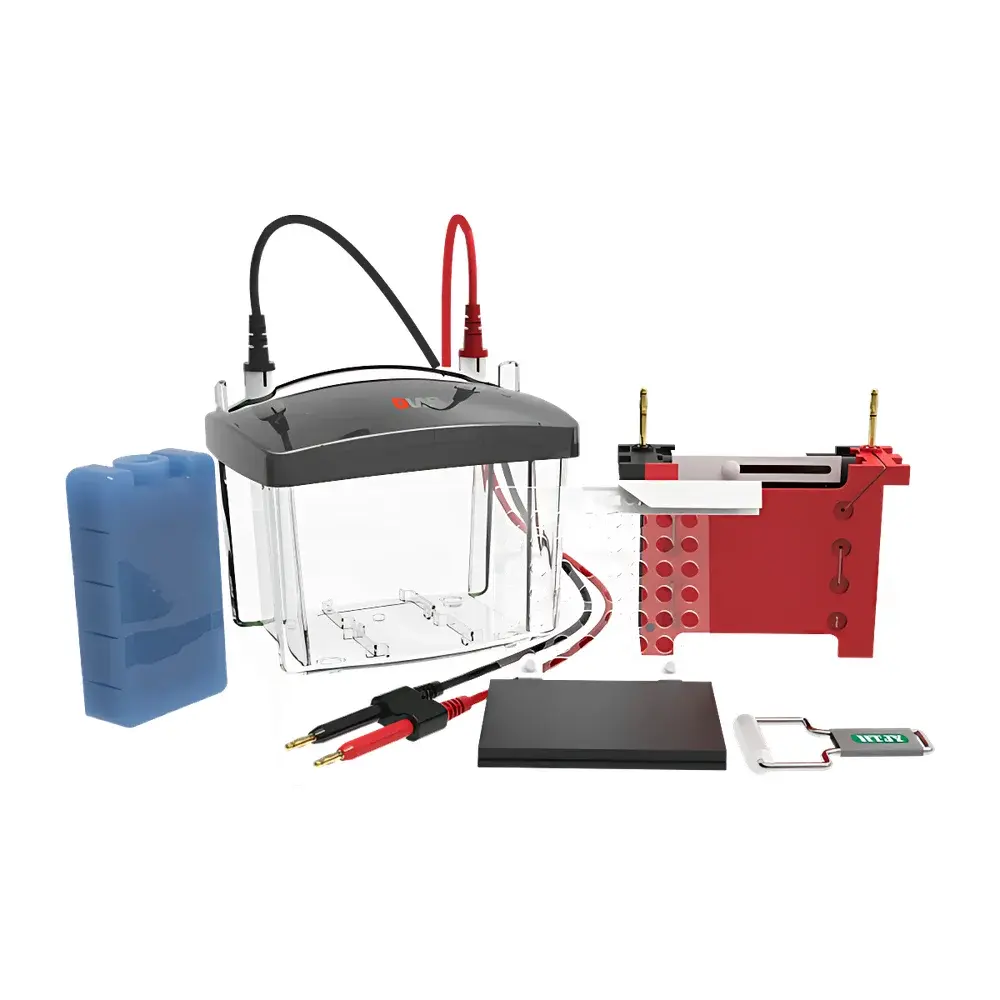
DLAB DL-ZY03 Mini Transfer Electrophoresis Cell
| Brand | DLAB |
|---|---|
| Origin | Beijing, China |
| Manufacturer Type | Original Equipment Manufacturer (OEM) |
| Product Origin | Domestic (China) |
| Model | DL-ZY03 |
| Pricing | Available Upon Request |
| Chamber Material | High-Transparency Polycarbonate |
| Electrode Spacing | 4 cm |
| Electrode Material | 99.99% Pure Platinum Wire |
| Transfer Area | 110 × 90 mm |
| Integrated Cooling | Built-in Ice Pocket |
| Accessory Included | Bubble Removal Roller |
| Orientation Aid | Color-Coded Transfer Clamps and Electrodes |
Overview
The DLAB DL-ZY03 Mini Transfer Electrophoresis Cell is a compact, benchtop electrophoretic transfer system engineered for rapid, reproducible semi-dry or wet-style protein blotting from polyacrylamide or agarose gels to nitrocellulose or PVDF membranes. Designed in accordance with standard Western blotting workflows, the unit operates on the principle of electrophoretic mobility under a direct current (DC) electric field—where charged proteins migrate from the gel matrix toward the oppositely charged electrode and are simultaneously captured by the immobilizing membrane. Its optimized 4 cm inter-electrode distance ensures uniform field distribution across the entire 110 × 90 mm transfer area, minimizing edge effects and enhancing transfer efficiency—particularly critical for low-abundance or high-molecular-weight proteins. Constructed entirely from high-transparency, impact-resistant polycarbonate via precision injection molding, the cell provides full visual monitoring during operation while maintaining chemical resistance to common electrophoresis buffers (e.g., Tris-glycine, CAPS, and SDS-containing solutions).
Key Features
- Compact footprint (ideal for shared core facilities and teaching labs where space is constrained)
- 4 cm fixed electrode spacing—engineered to generate a stable, high-field-strength gradient without arcing or localized overheating
- 99.99% pure platinum wire electrodes—ensuring minimal electrochemical degradation, long-term conductivity stability, and compatibility with both acidic and alkaline transfer buffers
- Integrated ice pocket cavity—designed to accommodate standard laboratory ice packs (up to 80 mL volume), enabling passive thermal management during extended transfers (e.g., overnight or high-current protocols)
- Color-coded clamping system (red/black polarity markers on both transfer夹 and electrode terminals)—reducing orientation errors that lead to reversed or failed blots
- Included bubble removal roller—fabricated from chemically inert stainless steel with ergonomic handle, facilitating complete interfacial contact between gel, membrane, and filter paper stacks
Sample Compatibility & Compliance
The DL-ZY03 supports standard mini-gel formats including 8.3 × 7.3 cm (Mini-PROTEAN®), 10 × 10 cm, and custom-cut gels up to 110 × 90 mm. It accommodates both single- and multi-gel configurations using optional stacking spacers. The polycarbonate housing complies with ISO 10993-5 (biological evaluation of medical devices — tests for cytotoxicity) and meets RoHS Directive 2011/65/EU requirements for restricted hazardous substances. While not certified for GLP or GMP environments per se, its design facilitates audit-ready documentation when used within validated Western blotting SOPs aligned with ICH Q5E and USP <1043> guidelines for analytical method transfer.
Software & Data Management
As a standalone electrophoretic transfer cell, the DL-ZY03 does not incorporate embedded microcontrollers or digital interfaces. It is intended for use with external DC power supplies (e.g., DLAB PS-303, Bio-Rad PowerPac Basic, or Thermo Fisher Ettan™ EPS) capable of delivering stable 10–100 V or 0.1–1.5 A output. Users are advised to log voltage, current, time, buffer composition, and ambient temperature manually—or integrate with LIMS-compatible power supplies supporting RS-232/USB data export and 21 CFR Part 11-compliant electronic signatures for regulated laboratories.
Applications
- Routine Western blotting in academic and industrial research settings
- Validation of recombinant protein expression and purification steps
- Quality control of monoclonal antibody production (e.g., heavy/light chain integrity assessment)
- Teaching laboratory instruction in molecular biology and biochemistry courses
- Preparative transfer prior to membrane-based enzymatic assays (e.g., ELISPOT, activity staining)
- Compatibility testing of novel membrane materials and transfer buffers
FAQ
What power supply specifications are recommended for optimal performance?
A programmable DC power supply with adjustable constant-voltage (15–30 V) or constant-current (0.3–1.0 A) modes is recommended. Avoid unregulated supplies; voltage fluctuations >±2% may compromise transfer homogeneity.
Can the DL-ZY03 be used for nucleic acid transfer?
Yes—though primarily optimized for proteins, it supports Southern/Northern blotting of DNA/RNA when paired with appropriate positively charged nylon membranes and alkaline or neutral transfer buffers.
Is the ice pocket compatible with dry ice or chilled ethanol baths?
No. The cavity is dimensioned for standard ice cubes or pre-chilled gel packs only; sub-zero cryogenic media may induce polycarbonate embrittlement or dimensional warping.
How frequently should platinum electrodes be cleaned?
Electrodes require cleaning with 70% ethanol and lint-free wipes after each use; periodic immersion in 10% nitric acid (15 min) followed by thorough DI water rinse is advised every 20 runs to remove oxide buildup.
Does DLAB provide application notes or protocol templates?
Yes—DLAB’s technical support portal offers downloadable PDF protocols for PVDF activation, methanol-free transfer, and high-MW protein optimization, all referencing peer-reviewed literature (e.g., Towbin et al., PNAS 1979; Burnette, Anal. Biochem. 1981).
Related Products




