
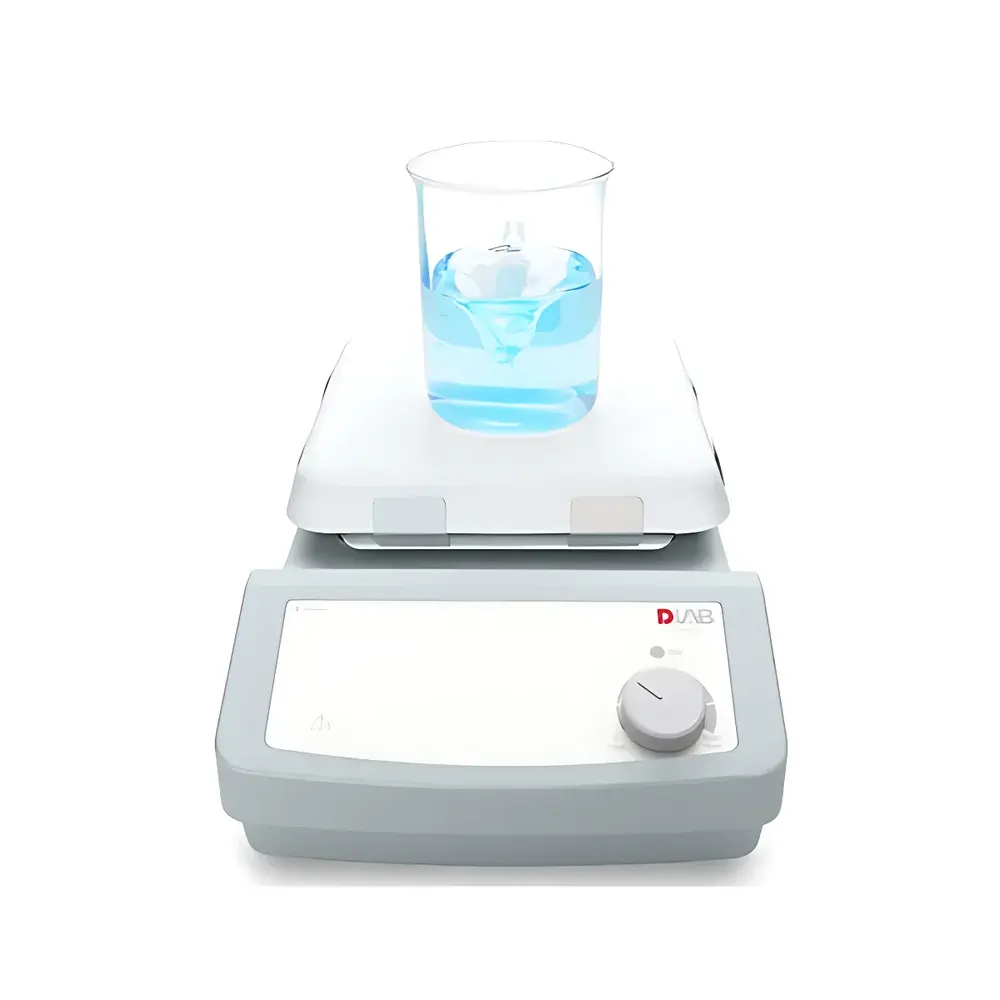
DLAB MS7-S 7-Inch Square Ceramic-Plate Magnetic Stirrer
| Brand | DLAB |
|---|---|
| Origin | Beijing, China |
| Manufacturer Type | Direct Manufacturer |
| Product Category | Domestic (China-Made) |
| Model | MS7-S |
| Instrument Type | Magnetic Stirrer |
| Max Stirring Volume (Water) | 10 L |
| Speed Range | 0–1500 rpm |
| Temperature Control | Ambient Only |
| Workplate Dimensions | 184 × 184 mm |
| Plate Material | Glass-Ceramic |
| Motor Type | Shaded-Pole |
| Input Power | 15 W |
| Output Power | 1.5 W |
| Total Power Consumption | 30 W |
| Voltage | 100–120 V / 200–240 V, 50/60 Hz |
| Stirring Position | Single |
| Max Stir Bar Length | 80 mm |
| Speed Display | Analog Scale |
| Enclosure IP Rating | IP21 |
| Dimensions (L×W×H) | 215 × 360 × 112 mm |
| Weight | 3.8 kg |
| Operating Environment | 5–40 °C, ≤80% RH |
| Safety Certifications | CE, cTUVus, FCC, Compliant with DIN/EN 60529 |
Overview
The DLAB MS7-S is a compact, single-position magnetic stirrer engineered for precision and reliability in routine laboratory mixing tasks. It operates on the principle of rotating magnetic fields generated by a permanent magnet array beneath a non-magnetic, chemically inert glass-ceramic work surface—inducing synchronous rotation of a magnetic stirring bar immersed in the sample vessel. Designed for applications involving low-to-medium viscosity liquids and solid-liquid suspensions, the MS7-S delivers stable rotational motion without mechanical contact between drive mechanism and sample, eliminating contamination risk and enabling operation under sealed or inert-atmosphere conditions. Its fixed ambient-temperature operation makes it suitable for room-temperature reactions, dissolution testing, buffer preparation, and pre-analytical sample homogenization where active heating is unnecessary or undesirable.
Key Features
- 7-inch square glass-ceramic workplate (184 × 184 mm) offering exceptional resistance to acids, alkalis, solvents, and thermal shock—ideal for aggressive reagent handling and long-term durability.
- Wide speed range of 0–1500 rpm with analog scale calibration, enabling fine-tuned control for gentle suspension dispersion or vigorous vortexing of aqueous solutions up to 10 L volume.
- Shaded-pole motor architecture ensures consistent torque delivery across the full speed spectrum, with low electromagnetic interference and minimal acoustic noise—critical in shared lab environments.
- Compliance with international safety standards including CE, cTUVus, and FCC; certified to DIN/EN 60529 for ingress protection (IP21), safeguarding against vertically falling solids and limited operator access to hazardous internal components.
- Energy-efficient design: 30 W total power consumption with only 1.5 W mechanical output—optimized for continuous unattended operation during overnight protocols or extended QC workflows.
- Compact footprint (215 × 360 × 112 mm) and lightweight construction (3.8 kg) facilitate easy relocation between fume hoods, biosafety cabinets, and analytical workstations without compromising structural stability.
Sample Compatibility & Compliance
The MS7-S accommodates standard laboratory glassware including beakers (up to 10 L capacity), Erlenmeyer flasks, and jacketed reactors—provided the vessel base is flat and non-ferromagnetic. Compatibility extends to common magnetic stir bars up to 80 mm in length, supporting both PTFE- and PTFE/glass-coated configurations for chemical inertness. The device does not incorporate temperature regulation; therefore, it is intended for use with externally controlled heating mantles or water baths when thermal input is required. From a regulatory standpoint, its safety certifications align with IEC 61010-1 requirements for electrical equipment used in laboratory settings. While not equipped with audit-trail or user-access controls, its passive operation meets GLP documentation requirements for non-critical mixing steps in method validation protocols compliant with ISO/IEC 17025 and USP <1058>.
Software & Data Management
The DLAB MS7-S is a standalone analog instrument with no embedded microprocessor, digital interface, or data logging capability. Speed adjustment is performed manually via a calibrated rotary knob, and real-time feedback is provided exclusively through a printed analog scale. This design philosophy prioritizes operational simplicity, electromagnetic compatibility, and long-term serviceability—eliminating firmware dependencies, cybersecurity vulnerabilities, or obsolescence risks associated with embedded electronics. For laboratories requiring traceable speed records, external recording devices (e.g., calibrated tachometers or video-based motion analysis) may be employed in conjunction with documented SOPs.
Applications
- Chemical synthesis: Homogenization of catalyst suspensions, reagent dissolution, and post-reaction quenching mixtures.
- Pharmaceutical QA/QC: Preparation of standard solutions, buffer dilution series, and excipient dispersion prior to HPLC or dissolution testing.
- Materials science: Dispersion of nanoparticles in aqueous or organic media for rheological or spectroscopic characterization.
- Environmental testing: Mixing of soil leachates, wastewater samples, and standardized reference materials per EPA Method 9045D and ASTM D5233.
- Academic teaching labs: Demonstrating fluid dynamics principles, stoichiometric mixing, and safe handling of corrosive reagents in undergraduate chemistry curricula.
FAQ
Does the MS7-S include a built-in heater or temperature control function?
No. The MS7-S is a non-heating magnetic stirrer designed for ambient-temperature operation only. External heating sources must be used if thermal activation is required.
Can the MS7-S be used with plastic or metal containers?
Only non-ferromagnetic, flat-bottomed containers are compatible. Most plastics (e.g., PP, PC) and borosilicate glass are suitable. Ferrous metals will interfere with magnetic coupling and must be avoided.
What is the maximum recommended stir bar size for optimal performance?
Stir bars up to 80 mm in length are supported. Longer bars may cause instability at high speeds or exceed the magnetic coupling efficiency of the drive system.
Is the glass-ceramic plate resistant to hydrofluoric acid (HF)?
No. While highly resistant to most mineral acids, organic solvents, and alkalis, glass-ceramic surfaces are vulnerable to etching by HF and concentrated phosphoric acid. Appropriate containment and procedural safeguards are required when handling such reagents.
Does the unit support dual-voltage input automatically?
Yes. The MS7-S features universal voltage compatibility (100–120 V / 200–240 V, 50/60 Hz) with auto-sensing circuitry—no manual switch or configuration is needed for global deployment.



