
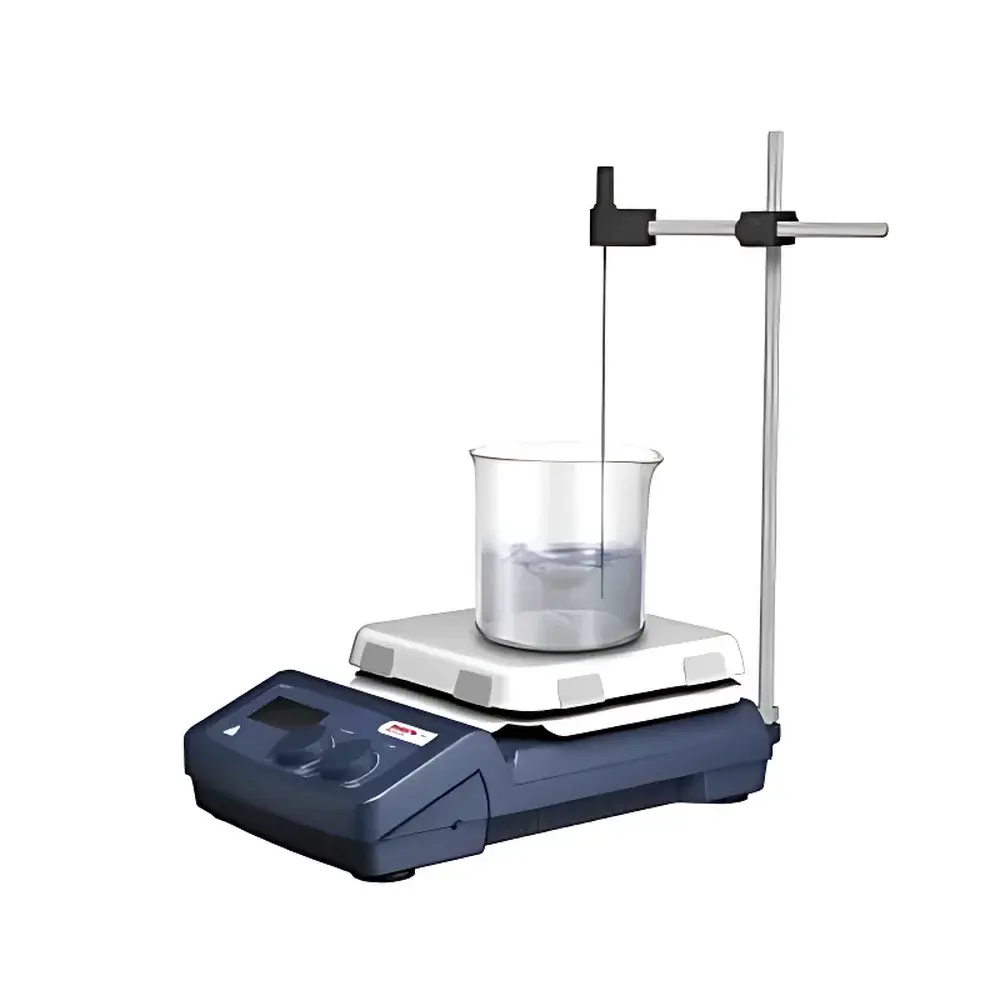
DLAB MS7-H550-Pro 7-inch Square-Plate Magnetic Stirrer with Heating
| Brand | DLAB |
|---|---|
| Origin | Beijing, China |
| Model | MS7-H550-Pro |
| Stirrer Type | Magnetic Stirrer |
| Max Stirring Volume (H₂O) | 20 L |
| Speed Range | 100–1500 rpm |
| Display | LCD (Speed & Temperature) |
| Plate Material | Glass-Ceramic |
| Plate Dimensions | 184 × 184 mm |
| Heating Power | 1000 W |
| Temperature Range | Ambient to 550 °C |
| Plate Safety Cut-off | 580 °C |
| Motor | Brushless DC |
| Input/Output Power | 18 W / 10 W |
| Dimensions (W × D × H) | 215 × 360 × 112 mm |
| Protection Rating | IP21 |
| Interface | RS232 |
Overview
The DLAB MS7-H550-Pro is a high-performance, square-format magnetic stirrer with integrated heating, engineered for precision mixing and temperature-controlled sample preparation in research laboratories, quality control environments, and industrial R&D settings. It operates on the principle of magnetic coupling—rotating a magnetic stir bar immersed in a vessel via a rotating magnetic field generated beneath a thermally stable glass-ceramic plate. Unlike hotplate stirrers with coil-based heating, this unit employs resistive heating elements embedded within a homogeneous glass-ceramic surface, enabling uniform thermal distribution and rapid response across the full 184 × 184 mm active area. Its brushless DC motor ensures consistent torque delivery over the entire speed range (100–1500 rpm), eliminating carbon brush wear and minimizing electromagnetic interference—critical for long-duration, unattended experiments. Designed for reproducible operation under GLP-compliant workflows, the MS7-H550-Pro supports method-driven protocols where both mechanical agitation intensity and thermal profile must be independently controlled and documented.
Key Features
- 7-inch (184 × 184 mm) flat glass-ceramic heating plate with high thermal conductivity and chemical resistance—resistant to common solvents, acids, and alkalis under standard operating conditions
- Independent dual-display LCD interface showing real-time speed (rpm) and plate surface temperature (°C) with 1 °C resolution
- Brushless DC motor delivering stable rotational output up to 1500 rpm, optimized for viscous media (up to 20 L water-equivalent volume) without speed drift or torque drop
- 1000 W heating capacity supporting rapid ramping to 550 °C, with programmable temperature hold and safety cut-off at 580 °C to prevent thermal runaway
- RS232 serial interface compliant with standard ASCII command protocol—enables remote parameter setting, data logging, and integration into automated lab systems (e.g., LIMS or SCADA)
- IP21-rated enclosure providing protection against vertically falling solid objects and limited ingress of moisture—suitable for standard laboratory benchtop use
Sample Compatibility & Compliance
The MS7-H550-Pro accommodates a broad range of vessel geometries—including round-bottom flasks (up to 5 L), beakers (up to 10 L), and custom reaction vessels—provided magnetic stir bars are appropriately sized (e.g., 30–60 mm PTFE-coated bars for volumes >5 L). Its flat, chemically inert plate surface allows direct placement of borosilicate glass, stainless steel, or ceramic containers. While not certified for explosive atmospheres (ATEX) or cleanroom ISO Class 5 environments, the unit meets IEC 61010-1:2010 safety requirements for electrical equipment used in laboratory applications. Its temperature and speed control architecture supports traceability under ISO/IEC 17025-accredited testing laboratories when paired with external calibration records (e.g., NIST-traceable thermometer and tachometer verification).
Software & Data Management
The built-in RS232 port supports bidirectional communication using ASCII-based commands (e.g., “SPEED=1200”, “TEMP=325”, “QUERY?”), allowing integration with third-party software such as LabVIEW, MATLAB, or Python-based automation scripts. Users can log time-stamped speed and temperature values at user-defined intervals (1–60 s), export CSV-formatted datasets for post-hoc analysis, and implement conditional triggers (e.g., pause stirring if temperature exceeds setpoint by ±5 °C). Though no proprietary PC software is bundled, DLAB provides an open command reference manual and sample Python drivers upon request—facilitating compliance with FDA 21 CFR Part 11 requirements when deployed with validated electronic record systems.
Applications
- Controlled synthesis of metal-organic frameworks (MOFs) requiring precise thermal ramping and homogeneous nucleation
- Preparation of polymer solutions and nanocomposite dispersions where shear history directly impacts particle agglomeration
- Standardized dissolution testing per USP , particularly for extended-release formulations requiring sustained 50–550 °C bath-equivalent conditions
- Accelerated stability studies (ICH Q1A) involving elevated-temperature stress testing of APIs in solvent matrices
- Buffer equilibration and reagent pre-warming prior to HPLC or ICP-MS analysis
FAQ
What is the maximum recommended viscosity for reliable stirring at 1500 rpm?
For optimal performance and motor longevity, continuous operation above 1500 rpm is not advised for media exceeding 1000 mPa·s (e.g., 30% w/v CMC solution); lower speeds (600–1000 rpm) are recommended for viscosities >500 mPa·s.
Does the unit support external temperature probe input for solution-phase feedback control?
No—the MS7-H550-Pro regulates only plate surface temperature; it does not accept Pt100 or thermocouple inputs for internal solution sensing. For bath-temperature-critical applications, users should employ an external PID controller with probe feedback.
Is the RS232 interface optically isolated?
No—RS232 communication is electrically coupled; galvanic isolation requires an external USB-to-RS232 adapter with isolation rating (e.g., ADUM series isolators) when interfacing with sensitive instrumentation.
Can the device maintain ±1 °C temperature stability at 500 °C?
At 500 °C, typical steady-state deviation is ±3–5 °C due to ambient heat loss and vessel thermal mass effects; for tighter control, consider adding an insulating sleeve around the vessel or reducing setpoint to ≤400 °C.
What calibration documentation is provided with the instrument?
DLAB supplies a factory calibration certificate verifying speed accuracy (±2 rpm) and plate temperature indication (±5 °C at 100/300/500 °C), traceable to national standards. Full metrological recalibration is recommended annually or after 500 operational hours.



