
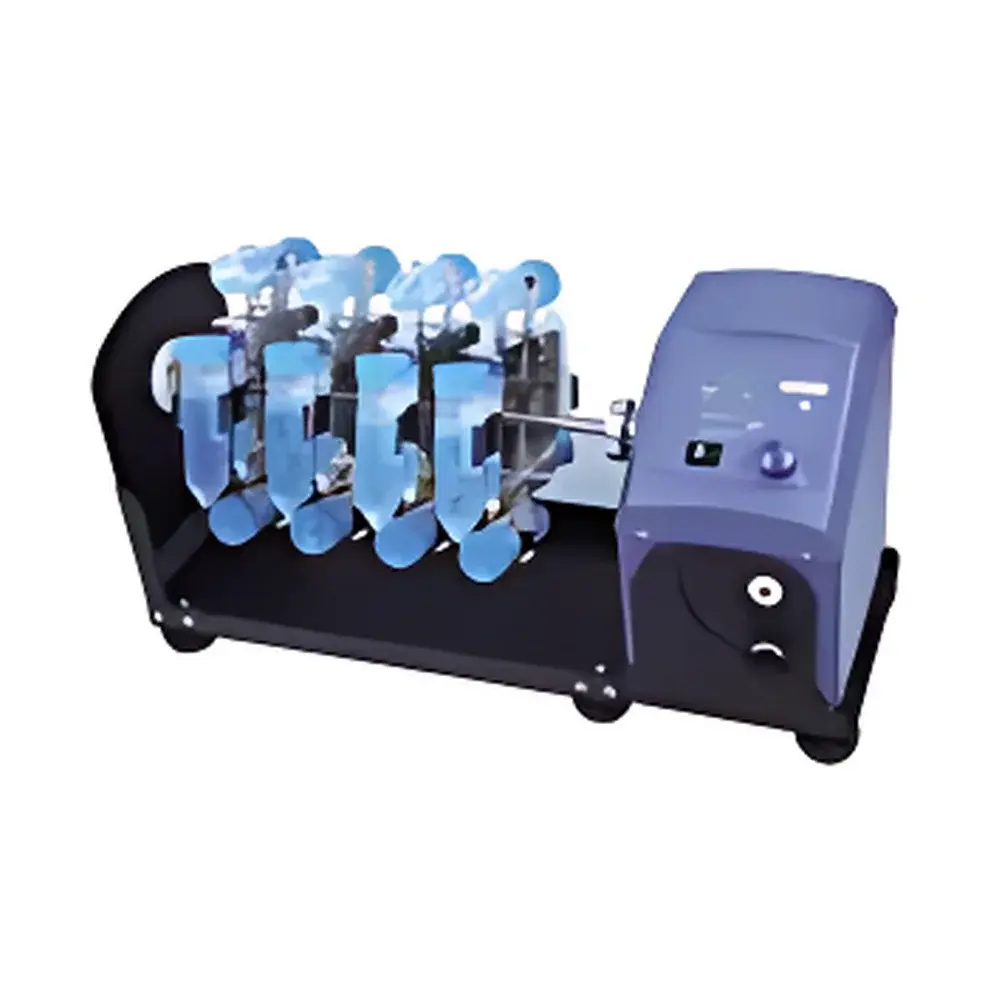
DLAB MX-RL-Pro Rotary Mixer
| Brand | DLAB |
|---|---|
| Model | MX-RL-Pro |
| Type | Rotary Mixer |
| Speed Range | 10–70 rpm |
| Adjustable Tilt Angle | 0–90° |
| Timer Range | 1–1199 min |
| Display | LCD (speed & time) |
| Power Supply | 100–240 VAC, 50/60 Hz |
| Power Consumption | 40 W |
| Motor Type | DC motor |
| Dimensions (D×W×H) | 510×190×260 mm |
| Weight | 8 kg |
| Operating Environment | 5–40 °C, ≤80% RH |
| Ingress Protection | IP21 |
| Sample Capacity | 1.5–50 mL tubes |
| Operation Modes | Timed or Continuous |
| Tube Holder Compatibility | Interchangeable fixtures for 1.5–50 mL centrifuge tubes |
Overview
The DLAB MX-RL-Pro Rotary Mixer is an engineered solution for consistent, low-shear sample homogenization in life science and clinical laboratories. Based on controlled orbital rotation combined with adjustable tilt geometry, it generates gentle yet effective mixing action ideal for suspending particulates, preventing sedimentation, and maintaining sample integrity during pre-analytical processing. Unlike vortexers or shakers that induce high shear or turbulent flow, the MX-RL-Pro employs a precisely regulated rotational motion—where the tube holder rotates around a central axis while simultaneously tilting within a defined angular range (0–90°). This dual-axis motion ensures uniform fluid displacement without foaming, cell lysis, or thermal buildup, making it especially suitable for sensitive biological matrices such as whole blood, antibody-antigen complexes, latex reagents, and immunoprecipitation buffers.
Key Features
- Programmable dual-parameter control: Independent adjustment of rotational speed (10–70 rpm) and tilt angle (0–90°) enables method optimization across diverse viscosity and density profiles.
- LCD interface with simultaneous real-time display of speed (rpm) and elapsed/remaining time (min), supporting full traceability during GLP-compliant workflows.
- Timer function with 1–1199 minute range (19h 59min), plus continuous operation mode for extended incubation-mixing protocols.
- Modular tube holder system: Interchangeable fixtures accommodate standard microcentrifuge tubes from 1.5 mL to 50 mL—including conical-bottom and round-bottom formats—ensuring compatibility with common labware without adapters.
- Robust DC motor architecture delivering stable torque output across the full speed range, minimizing speed drift under load and ensuring reproducibility between runs.
- Compact benchtop footprint (510×190×260 mm) and lightweight design (8 kg) facilitate integration into biosafety cabinets, cold rooms, or shared instrumentation spaces.
- Compliance-ready construction: IP21-rated enclosure provides protection against vertically falling drips and solid objects >12.5 mm; meets IEC 61010-1 safety requirements for laboratory electrical equipment.
Sample Compatibility & Compliance
The MX-RL-Pro is validated for use with aqueous, buffered, and viscous biological suspensions—including anticoagulated whole blood, serum/plasma dilutions, latex agglutination reagents, and protein A/G-based immunoprecipitation lysates. Its low-speed, non-impact mixing mechanism preserves cellular morphology and antigen epitopes, supporting applications referenced in CLSI EP12-A2 (evaluation of qualitative immunoassays) and ISO 15189:2022 (medical laboratories — requirements for quality and competence). The device operates within ambient conditions compliant with ISO 17025 environmental monitoring guidelines (5–40 °C, ≤80% RH), and its timer functionality supports audit-ready recordkeeping when paired with laboratory information management systems (LIMS).
Software & Data Management
While the MX-RL-Pro operates as a standalone instrument without proprietary software, its LCD interface supports manual parameter logging and protocol replication. All settings—including speed, angle, and timer duration—are retained after power cycling, eliminating reconfiguration between shifts. For regulated environments, users may document operational parameters in electronic lab notebooks (ELN) or LIMS using the displayed values. The device does not incorporate network connectivity or FDA 21 CFR Part 11-compliant electronic signatures; however, its deterministic behavior and mechanical simplicity support validation per GMP Annex 15 and ISO/IEC 17025 clause 5.5.2 (equipment verification).
Applications
- Prevention of in vitro blood coagulation during sample transport and storage prior to hematological analysis.
- Uniform resuspension of latex particle-based diagnostic reagents used in rapid immunoassays.
- Enhancing antigen-antibody binding kinetics in immunoprecipitation and chromatin immunoprecipitation (ChIP) protocols.
- Homogenizing low-volume tissue lysates and nucleic acid extraction buffers without introducing air bubbles or shearing DNA.
- Equilibrating calibration standards and quality control materials for clinical chemistry analyzers.
- Maintaining suspension stability of magnetic bead-conjugated antibodies in automated ELISA and lateral flow assay development.
FAQ
What types of tubes are supported by the MX-RL-Pro?
The instrument accepts standard polypropylene and polycarbonate centrifuge tubes ranging from 1.5 mL microtubes to 50 mL conical tubes, using optional, tool-free interchangeable holders.
Is the MX-RL-Pro suitable for use inside a refrigerated environment?
Yes—it is rated for operation between 5 °C and 40 °C, making it compatible with cold room installations (e.g., 4 °C sample preparation areas), provided ambient humidity remains below 80% RH.
Does the device meet international electrical safety standards?
Yes—the MX-RL-Pro conforms to IEC 61010-1:2010 for laboratory electrical equipment and carries CE marking under the Low Voltage Directive (2014/35/EU) and EMC Directive (2014/30/EU).
Can the tilt angle be locked at intermediate positions?
Yes—the angular adjustment mechanism features detent stops at 0°, 30°, 45°, 60°, and 90°, allowing repeatable positioning without continuous manual calibration.
How is maintenance performed?
No routine lubrication or internal servicing is required. Cleaning is limited to external surfaces using 70% ethanol or isopropanol; avoid submerging or spraying liquid directly onto the LCD panel or base housing.



