
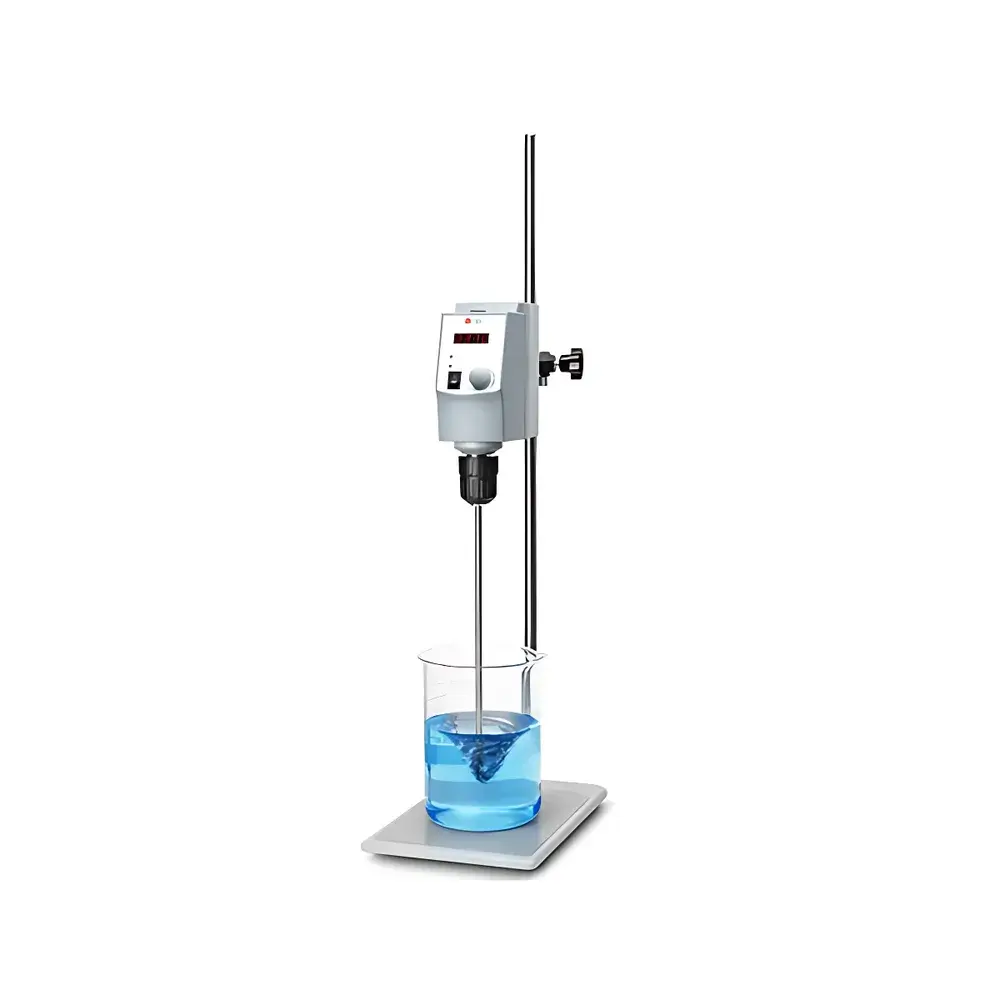
DLAB OS20-S LED-Display Overhead Electronic Stirrer
| Brand | DLAB |
|---|---|
| Origin | Beijing, China |
| Manufacturer Type | Direct Manufacturer |
| Product Category | Domestic (China-Made) |
| Model | OS20-S |
| Instrument Type | Electric Overhead Stirrer |
| Max. Stirring Volume | 20 L (Water) |
| Speed Range | 50–2200 rpm |
| Temperature Control | Not Applicable |
| Motor Type | Brushless DC Motor |
| Input Power | 60 W |
| Output Power | 50 W |
| Rated Voltage | 100–240 V AC, 50/60 Hz |
| Power Consumption | 70 W |
| Speed Accuracy | ±3 rpm |
| Display | LED |
| Overload Indication | LED |
| Max. Torque | 40 N·cm |
| Max. Viscosity | 10,000 mPa·s |
| Chuck Capacity | 0.5–10 mm |
| Dimensions (W×H×D) | 83 × 220 × 186 mm |
| Weight | 2.8 kg |
| IP Rating | IP42 |
| Operating Ambient | 5–40 °C, ≤80% RH |
| Safety Certifications | CE, cTUVus, FCC, Compliant with DIN/EN 60529 |
Overview
The DLAB OS20-S LED-Display Overhead Electronic Stirrer is an engineered solution for precise, reliable, and safe mechanical agitation of medium-to-high viscosity liquids and heterogeneous suspensions in laboratory and pilot-scale settings. Utilizing a brushless DC motor architecture, it delivers consistent rotational torque across its full speed range (50–2200 rpm), enabling stable mixing performance under variable load conditions—such as those encountered during polymer dissolution, catalyst suspension, or viscous emulsion preparation. Unlike magnetic stirrers limited by heat generation and coupling efficiency, the overhead configuration eliminates bottom-heating interference and supports open-vessel operation with full visibility and accessibility. Its robust mechanical design—including integrated thermal and current monitoring—ensures uninterrupted operation during extended synthesis cycles, making it suitable for GLP-compliant process development and QC workflows in regulated environments.
Key Features
- Brushless DC motor with 50 W continuous output power and 40 N·cm maximum torque—engineered for high reproducibility and maintenance-free service life exceeding 10,000 hours.
- LED digital display showing real-time rotational speed with ±3 rpm accuracy, eliminating parallax error and enabling traceable parameter recording.
- Top-entry “through-head” impeller mounting system facilitating rapid vessel interchange without disassembly of drive components.
- Self-locking, tool-free chuck accommodating shaft diameters from 0.5 to 10 mm—compatible with standard ISO 868–compliant stir bars and custom agitators.
- Intelligent overload protection: automatic circuit cutoff and audible/visual alarm activation upon detection of stall, short-circuit, or abnormal deceleration.
- Integrated silicone protective sleeve on chuck assembly prevents solvent-induced corrosion and oxidation of stainless-steel components—critical for long-term use with halogenated or acidic media.
- IP42-rated housing provides protection against solid objects >1 mm and vertically falling water droplets—suitable for general-purpose fume hood and benchtop deployment.
- Wide-input universal voltage compatibility (100–240 V AC, 50/60 Hz) ensures stable operation across global laboratory power infrastructures without external transformers.
Sample Compatibility & Compliance
The OS20-S accommodates a broad spectrum of sample types including aqueous and organic solutions, colloidal dispersions, slurries, gels, and thermosensitive suspensions up to 20 L (water-equivalent volume). Compatible impeller materials include ASTM F899-grade 316 stainless steel and PTFE-coated variants compliant with USP Class VI biocompatibility requirements. All electrical and mechanical safety functions conform to IEC 61010-1:2010 (Measurement, Control and Laboratory Equipment – Safety Requirements), supported by third-party certification to CE, cTUVus, and FCC standards. The device meets enclosure integrity requirements per DIN/EN 60529 (IP42) and is validated for continuous-duty operation within ambient conditions of 5–40 °C and ≤80% relative humidity.
Software & Data Management
While the OS20-S operates as a standalone instrument without embedded connectivity, its analog-friendly design supports integration into automated lab environments via optional analog voltage input/output modules (0–10 V or 4–20 mA). The LED display enables manual logging of setpoints and actual speeds for audit-ready documentation. When deployed in FDA-regulated facilities, users may incorporate the device into 21 CFR Part 11–compliant workflows using external electronic lab notebooks (ELNs) that capture timestamped speed entries and operator IDs. Firmware-level parameters are non-user-modifiable, preserving calibration integrity and supporting GMP-aligned change control procedures.
Applications
- Chemical synthesis: Homogenization of Grignard reagents, palladium-catalyzed cross-coupling slurries, and viscous polycondensation intermediates.
- Pharmaceutical manufacturing: Wet granulation support, API suspension stabilization, and excipient dispersion in oral solid dosage development.
- Food & cosmetic R&D: Emulsification of oil-in-water systems, thickener hydration (e.g., xanthan, carrageenan), and pigment dispersion in liposomal formulations.
- Materials science: Exfoliation of 2D nanomaterials in NMP or DMF, carbon nanotube dispersion, and ceramic slurry deagglomeration.
- Environmental testing: Preparation of standardized sediment suspensions for EPA Method 1669 compliance studies.
FAQ
Is the OS20-S compatible with glass reactors equipped with standard NS29/32 or NS45/50 joints?
Yes—the unit’s adjustable height and universal chuck design allow secure mounting on common lab reactor stands; optional clamping adapters are available for direct NS-thread integration.
Can the stirrer maintain set speed when viscosity increases during polymerization?
Yes—its closed-loop torque compensation algorithm dynamically adjusts motor current to sustain programmed rpm within ±3 rpm tolerance up to 10,000 mPa·s.
Does the device support external speed control via analog signal?
Not natively—but analog I/O expansion modules (sold separately) enable 0–10 V remote speed modulation and feedback signal output.
What maintenance is required for the brushless DC motor?
None—sealed rotor construction eliminates bearing lubrication needs; routine cleaning of chuck and housing suffices for multi-year operation.
Is calibration documentation provided with the instrument?
A factory-verified speed calibration certificate (traceable to NIM, China) is included; users may perform periodic verification using a certified optical tachometer per ISO/IEC 17025 guidelines.



