
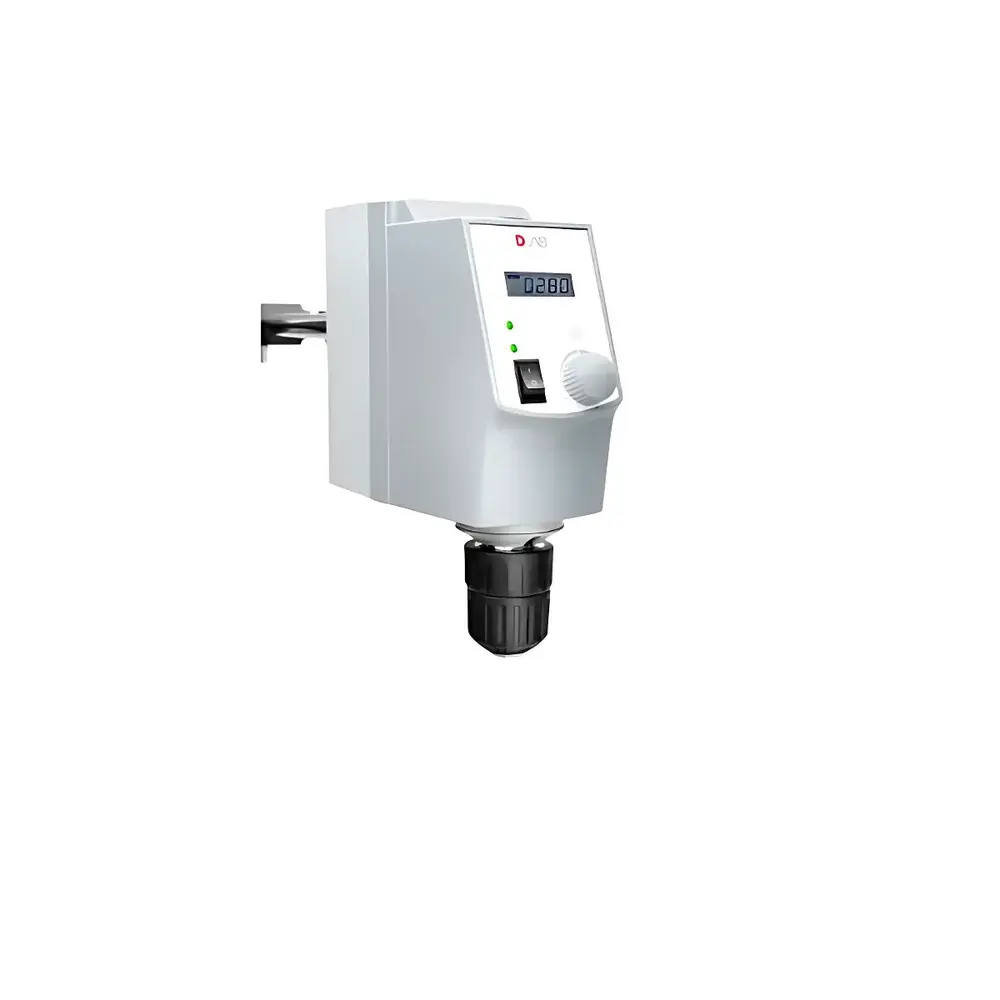
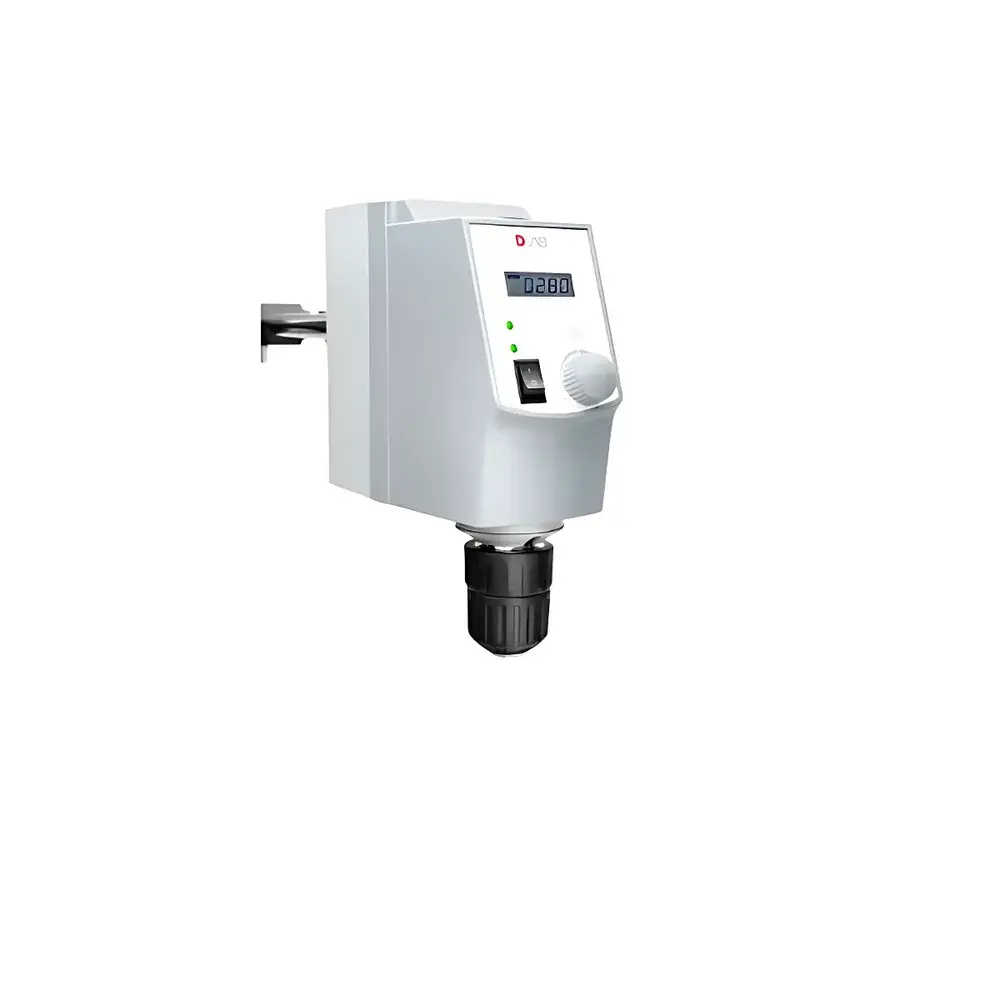
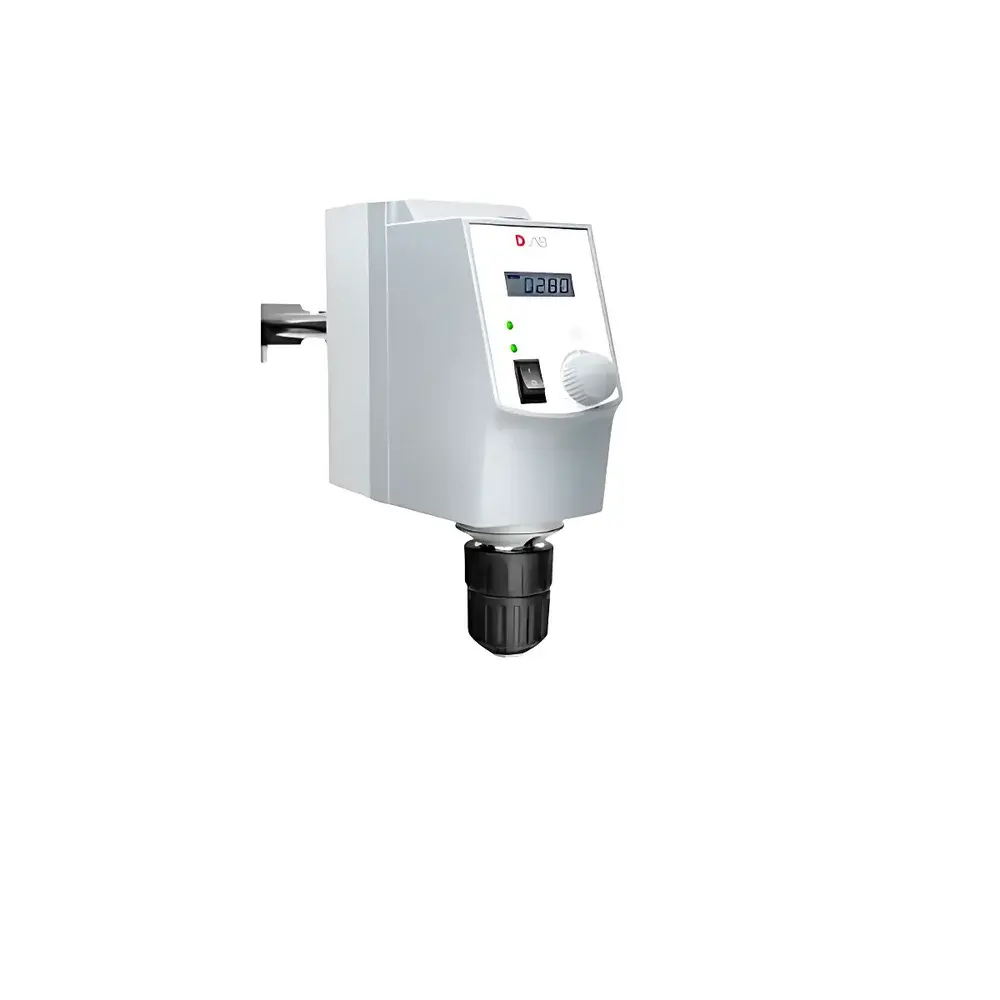
DLAB OS20-Pro LCD Overhead Digital Stirrer
| Brand | DLAB |
|---|---|
| Origin | Beijing, China |
| Model | OS20-Pro LCD |
| Maximum Stirring Volume (Water) | 20 L |
| Speed Range | 50–2200 rpm |
| Speed Accuracy | ±3 rpm |
| Maximum Torque | 40 N·cm |
| Maximum Viscosity | 10,000 mPa·s |
| Motor Type | Brushless DC Motor |
| Input Power | 60 W |
| Output Power | 50 W |
| Total Power Consumption | 70 W |
| Temperature Operating Range | 5–40 °C |
| Relative Humidity Limit | ≤80% RH |
| Protection Rating | IP21 |
| Chuck Capacity | 0.5–10 mm |
| Display | Dual-mode LCD (speed setpoint/actual value & torque) |
| Interface | RS232 |
| Certifications | CE, cTUVus, FCC, DIN/EN 60529 compliant |
Overview
The DLAB OS20-Pro LCD Overhead Digital Stirrer is an engineered solution for precise, reproducible, and safe mechanical agitation in research laboratories, quality control environments, and pilot-scale process development. Designed around a robust brushless DC motor architecture, it delivers consistent rotational motion under variable load conditions—critical for applications involving non-Newtonian fluids, high-viscosity suspensions, or temperature-sensitive formulations. Its overhead configuration eliminates immersion-related contamination risks and enables unobstructed access to reaction vessels during operation. The device operates on the principle of torque-compensated speed regulation: real-time feedback from the motor’s encoder allows dynamic adjustment of driving current to maintain the user-defined rotational speed—even as sample viscosity or density changes—ensuring kinetic consistency across experimental replicates.
Key Features
- Brushless DC motor with 50 W continuous output power, delivering extended service life (>20,000 h), zero carbon brush wear, and intrinsic spark-free operation suitable for low-hazard environments.
- LCD display with dual-mode readout: simultaneous visualization of setpoint vs. actual speed (in rpm), and real-time torque (in N·cm), enabling immediate assessment of fluid resistance and mixing efficiency.
- Integrated overload protection system: automatically interrupts power and triggers audible/visual alarm upon detection of excessive torque, motor stall, short circuit, or abnormal rotational behavior—fully compliant with IEC 61800-5-1 functional safety guidelines.
- Self-locking, tool-free chuck with 0.5–10 mm clamping range; precision-machined jaws ensure concentricity and minimize vibration-induced wobble at high speeds.
- “Top-entry” impeller mounting design facilitates rapid vessel exchange without repositioning the unit—ideal for sequential batch processing or multi-vessel screening protocols.
- Silicone-coated chuck housing resists solvent permeation and inhibits corrosion of metallic components, extending maintenance intervals and preserving dimensional stability over time.
- RS232 serial interface supports bidirectional communication with laboratory PCs or LIMS platforms for remote parameter setting, real-time data logging, and audit-trail generation—compatible with GLP/GMP-compliant data integrity workflows.
Sample Compatibility & Compliance
The OS20-Pro LCD accommodates standard laboratory glassware (e.g., beakers, flasks, jacketed reactors) up to 20 L volume (water-equivalent). Compatible impellers include 316 stainless steel shafts for general-purpose use and PTFE-coated variants for aggressive solvents or pH-extreme media. Its IP21-rated enclosure provides protection against vertically falling solid objects and limited ingress of moisture—suitable for ambient lab environments per ISO 15190:2020. Certified to EN 61000-6-3 (EMC emission), EN 61000-6-2 (immunity), and DIN/EN 60529 for mechanical safety. Meets essential requirements of Directive 2014/30/EU (EMC), 2014/35/EU (LVD), and FCC Part 15 Subpart B—verified by TÜV SÜD (cTUVus mark).
Software & Data Management
While the OS20-Pro LCD does not include proprietary software, its RS232 interface conforms to standard ASCII command protocols (e.g., “SPEED=1500”, “TORQUE?”, “ALARM?”), enabling integration with third-party scripting environments (Python, LabVIEW, MATLAB) or custom-built SCADA modules. Logged parameters—including timestamped speed, torque, and fault codes—can be exported in CSV format for traceability. When deployed in regulated settings, the device supports 21 CFR Part 11-aligned electronic record practices when paired with validated acquisition software featuring user authentication, audit trail, and electronic signature capabilities.
Applications
- Homogenization of polymer solutions, colloidal dispersions, and emulsions in materials science labs.
- Controlled dissolution testing per USP and Ph. Eur. 2.9.3, where constant shear rate is critical for release profile reproducibility.
- Buffer and media preparation in biopharmaceutical upstream processing, including cell culture supplement blending.
- Viscosity mapping of temperature-dependent fluids using synchronized thermal baths and torque profiling.
- Stability studies requiring long-duration, unattended agitation under defined environmental conditions (5–40 °C).
FAQ
What is the maximum viscosity this stirrer can handle?
It supports samples up to 10,000 mPa·s at 50 rpm—performance verified with calibrated silicone oil standards per ASTM D2196.
Does the unit support programmable ramping or multi-step protocols?
No—the OS20-Pro LCD implements fixed-speed control only; programmable profiles require external automation via RS232.
Is calibration required before use?
Speed and torque readings are factory-calibrated; no user calibration is necessary, though periodic verification against NIST-traceable tachometers is recommended per ISO/IEC 17025.
Can it operate continuously for 24/7 applications?
Yes—brushless motor design and thermal management enable uninterrupted operation within specified ambient conditions (5–40 °C, ≤80% RH).
What impeller geometries are compatible?
Standard configurations include paddle, propeller, and anchor types with 316 SS or PTFE-coated shafts; custom geometries may be mounted if shank diameter falls within 0.5–10 mm tolerance.



