
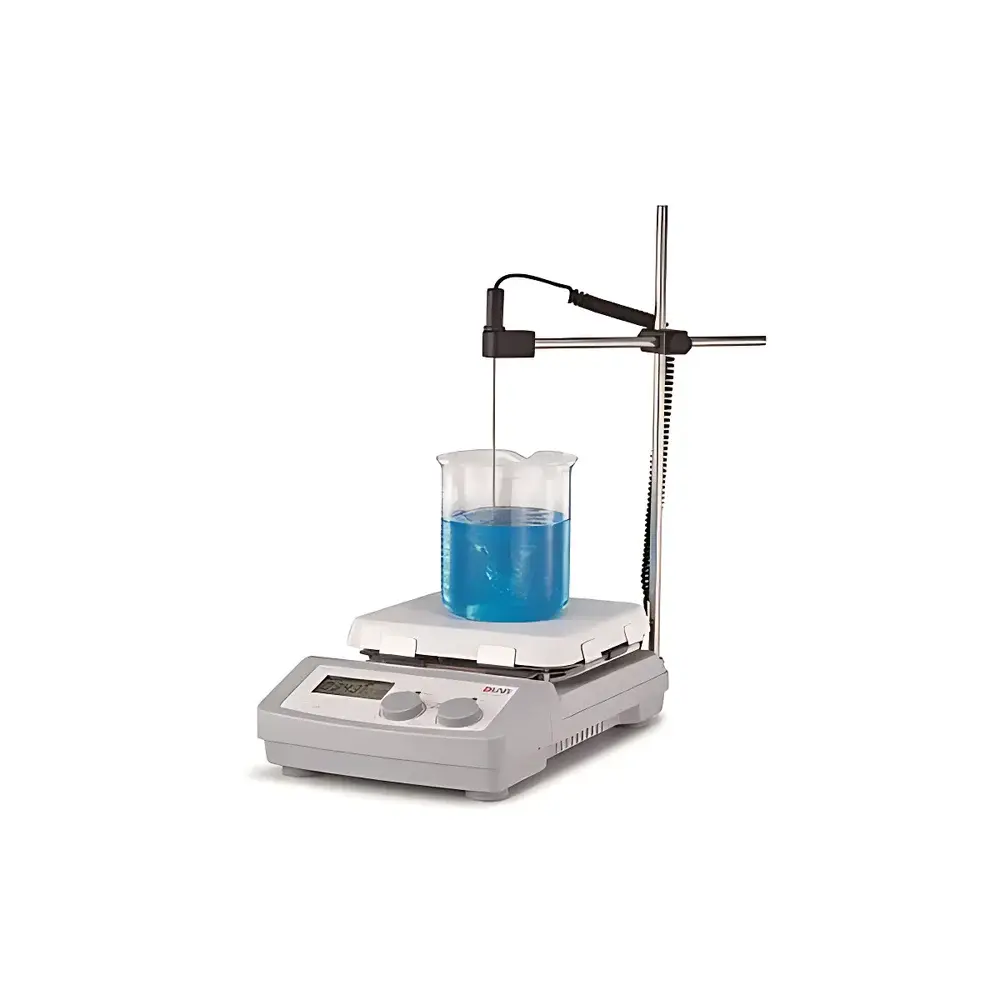
DLAB Scientific MS7-H550-Pro Heating Magnetic Stirrer
| Brand | DLAB |
|---|---|
| Origin | Beijing, China |
| Model | MS7-H550-Pro |
| Instrument Type | Heating Magnetic Stirrer |
| Max. Stirring Volume | 20 L (H₂O) |
| Speed Range | 100–1500 rpm |
| Temperature Control Range | Ambient to 550 °C (1 °C increment) |
| Heating Plate Material | Glass-Ceramic |
| Heating Area | 176 × 176 mm |
| Heating Power | 1000 W |
| Total Power Consumption | 1050 W |
| Safety Cut-off Temperature | 580 °C |
| External Temperature Sensor | PT1000 |
| Temp. Control Accuracy | ±0.2 °C (with PT1000) |
| Plate Temp. Accuracy | ±1 °C (>100 °C), ±1 °C (<100 °C) |
| Temp. Display Resolution | 0.1 °C |
| Speed Display Resolution | ±1 rpm |
| Motor Type | Brushless DC |
| Max. Stir Bar Size | 80 × 10 mm |
| Residual Heat Warning Threshold | 50 °C |
| Interface | RS232 for PC connectivity |
| Voltage | 100–120 / 200–240 VAC, 50/60 Hz |
Overview
The DLAB Scientific MS7-H550-Pro is a high-performance heating magnetic stirrer engineered for precision temperature-controlled mixing in research laboratories, quality control environments, and industrial R&D settings. It operates on the principle of magnetic coupling—where a rotating permanent magnet beneath the glass-ceramic plate induces rotation in a magnetic stir bar immersed in the sample—combined with resistive heating of the plate surface. Its dual-control architecture integrates microprocessor-based feedback loops for both speed and temperature regulation, enabling stable, reproducible operation across demanding applications such as polymer dissolution, catalyst activation, buffer preparation, and high-temperature synthesis. Designed for continuous-duty use, the unit complies with IEC 61010-1 safety standards for laboratory electrical equipment and features independent thermal monitoring circuits to prevent overheating under variable load conditions.
Key Features
- Glass-ceramic heating plate (176 × 176 mm) offering chemical resistance, thermal shock tolerance, and uniform heat distribution
- Precision temperature control from ambient to 550 °C in 1 °C increments, with real-time feedback via integrated PT1000 sensor port
- Brushless DC motor delivering consistent torque across the full speed range (100–1500 rpm), minimizing mechanical wear and electromagnetic interference
- Dual-display LCD interface showing simultaneous setpoints and actual values for both temperature and rotational speed
- Independent safety circuit with fixed cut-off at 580 °C, decoupled from the main control loop to ensure fail-safe thermal protection
- Residual heat warning system: “Hot” indicator activates when plate surface exceeds 50 °C—even after power-off—and auto-clears only upon cooling below threshold
- RS232 serial interface supporting bidirectional communication with host PCs for automated data logging, remote parameter adjustment, and audit-trail generation
Sample Compatibility & Compliance
The MS7-H550-Pro accommodates vessels up to 20 L capacity (water-equivalent), compatible with standard borosilicate glass beakers, round-bottom flasks, and stainless-steel reactors. Its wide temperature range supports protocols requiring extended thermal exposure—including ASTM D1298 (density of crude oil), ISO 6297 (viscosity of resins), and USP compounding workflows where controlled heating precedes sterile filtration. The device meets CE marking requirements under the Low Voltage Directive (2014/35/EU) and EMC Directive (2014/30/EU). While not intrinsically rated for hazardous locations, its sealed electronics and non-sparking motor design align with general laboratory safety best practices per ANSI Z535.4 and CLSI GP26-A3 guidelines.
Software & Data Management
Through the RS232 interface, the MS7-H550-Pro interfaces with third-party data acquisition software or custom LabVIEW/Python scripts. Logged parameters include timestamped temperature (setpoint and PT1000-measured), speed (setpoint and actual), and operational status flags (e.g., heating active, safety lockout triggered). Data export formats support CSV and ASCII for integration into LIMS or ELN platforms. When deployed in regulated environments, the system supports 21 CFR Part 11-compliant configurations via external validation of the host software—enabling electronic signatures, audit trails, and user-access controls aligned with GLP and GMP documentation requirements.
Applications
- High-temperature solubility studies of pharmaceutical excipients and APIs in organic solvents
- Controlled-rate heating during catalyst slurry homogenization in fine chemical synthesis
- Preparation of viscous polymer solutions prior to rheological characterization
- Standardized buffer equilibration for HPLC mobile phase preparation
- Accelerated stability testing of emulsions and colloidal dispersions
- Calibration verification of temperature probes using traceable reference standards
FAQ
Does the MS7-H550-Pro support external temperature feedback during stirring?
Yes—it features a dedicated PT1000 input port enabling closed-loop temperature control based on actual sample temperature rather than plate surface temperature.
Can the unit maintain ±0.5 °C stability at 400 °C?
While plate accuracy is specified as ±1 °C above 100 °C, using an immersed PT1000 probe improves effective control stability to ±0.2 °C at target temperatures, provided vessel geometry and thermal mass permit adequate response time.
Is the RS232 interface optically isolated?
No—the interface is electrically isolated via onboard galvanic separation, but optical isolation requires an external USB-to-RS232 converter with built-in optocouplers.
What is the maximum recommended stir bar length for 20 L volumes?
For optimal vortex formation and torque transfer in large-volume containers, DLAB recommends stir bars up to 80 mm in length and 10 mm in diameter; longer bars may cause wobble or reduced efficiency due to magnetic field decay.
How often should the glass-ceramic plate be calibrated?
Periodic verification using a NIST-traceable infrared thermometer or contact probe is advised every 6 months in routine use, or before critical qualification runs—especially when operating above 300 °C for extended durations.



