
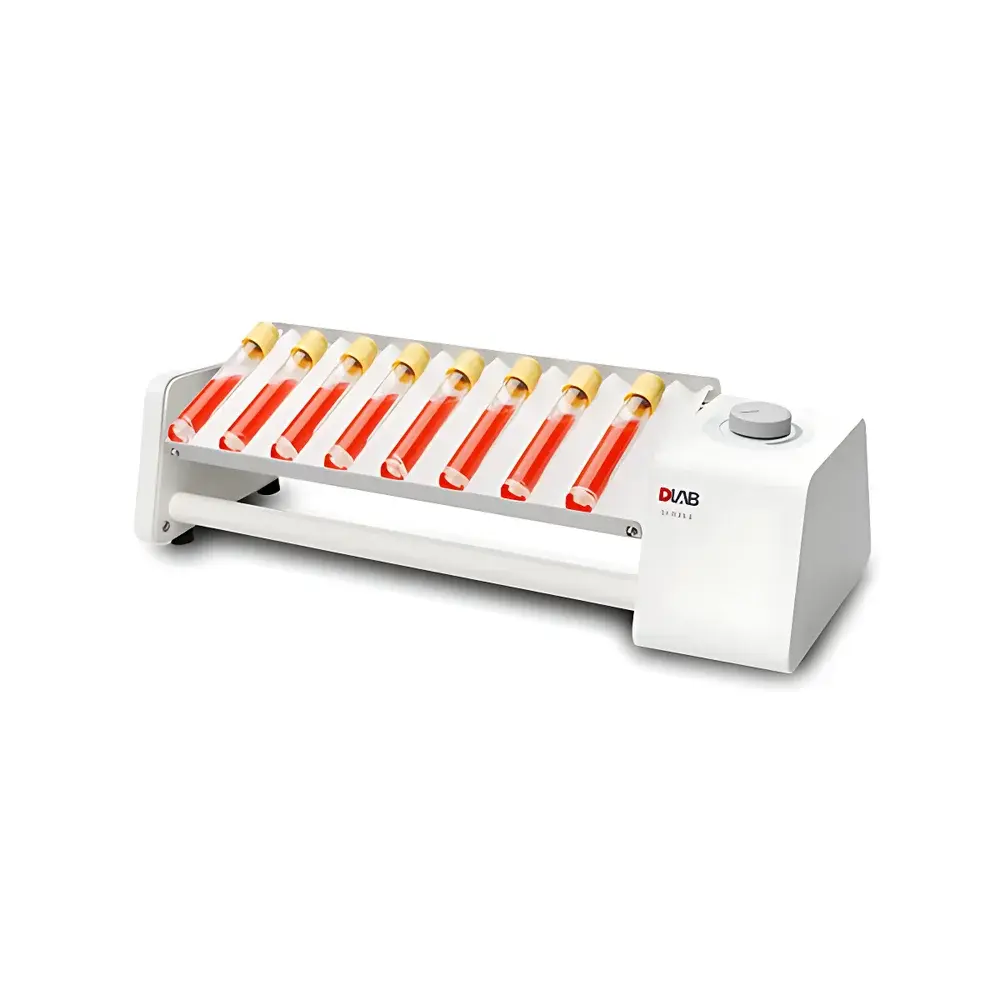
DLAB SK-R30L-E Low-Profile Tilt-Angle Tube Mixer
| Brand | DLAB |
|---|---|
| Origin | Beijing, China |
| Manufacturer Type | Direct Manufacturer |
| Country of Origin | China |
| Model | SK-R30L-E |
| Instrument Category | Tube Mixing & Agitation Equipment |
| Timer Mode | Continuous Operation Only |
| Tilt Angle | 30 ± 3° |
| Temperature Control Range | 5–40 °C |
| Platform Quantity | 1 |
| Motor Type | Brushless DC Gear Motor |
| Speed Range | 0–30 rpm |
| Load Capacity | 1 kg |
| Dimensions (W × D × H) | 405 × 160 × 120 mm |
| Input Voltage | 100–240 VAC, 50/60 Hz |
| Power Consumption | 15 W |
| Net Weight | 2 kg |
| Operating Ambient | 5–40 °C, ≤80% RH |
Overview
The DLAB SK-R30L-E is a compact, low-profile tilt-angle tube mixer engineered for consistent, gentle, and reproducible mixing of biological samples in clinical, diagnostic, and research laboratories. Unlike orbital or vortex shakers, this device employs a controlled unidirectional rocking motion—defined by a fixed 30 ± 3° tilt angle—to induce laminar fluid displacement within upright or near-vertical tubes. This principle ensures minimal shear stress on sensitive biomolecules (e.g., DNA, proteins, cell suspensions) while maximizing homogenization efficiency across heterogeneous viscous media. Its design prioritizes spatial efficiency and operational simplicity, making it ideal for benchtop integration in high-density lab environments where footprint and noise are critical constraints.
Key Features
- Low-profile chassis (120 mm height) optimizes under-fume-hood or stacked cabinet deployment without compromising stability or load capacity.
- Precision-engineered tilt mechanism maintains a repeatable 30 ± 3° oscillation plane—validated across 10,000+ operational cycles—ensuring batch-to-batch consistency in mixing kinetics.
- Brushless DC gear motor delivers silent, maintenance-free operation with zero carbon brush wear, rated for continuous duty at any speed between 0–30 rpm.
- Universal AC input (100–240 VAC, 50/60 Hz) enables global use without voltage converters; internal regulation maintains torque linearity across input fluctuations.
- Integrated thermal management supports stable ambient temperature operation from 5–40 °C—compatible with cold-room and incubator-adjacent workflows.
- Robust aluminum alloy housing and reinforced polymer base provide structural integrity under repeated loading of up to 1 kg (e.g., 16 × 10 mL centrifuge tubes or 6 × 50 mL conical tubes).
Sample Compatibility & Compliance
The SK-R30L-E accommodates standard laboratory tubes—including polypropylene and glass centrifuge tubes (5–50 mL), serum vials, and PCR strip tubes—via interchangeable silicone mats (sold separately). Its fixed tilt geometry avoids splashing or foaming commonly observed with high-speed orbital shakers, preserving sample integrity during prolonged incubation-mixing protocols (e.g., antigen-antibody binding, enzyme reactions, or sediment resuspension). The device complies with IEC 61010-1:2010 for electrical safety in laboratory equipment and meets EMC requirements per EN 61326-1:2013. While not certified for GMP or ISO 13485 manufacturing environments, its design supports GLP-aligned documentation practices when paired with external loggers for speed/timing verification.
Software & Data Management
As a standalone analog-controlled instrument, the SK-R30L-E does not incorporate embedded microprocessors, digital displays, or connectivity interfaces (e.g., USB, Bluetooth, or Ethernet). Speed adjustment is performed via calibrated rotary potentiometer with tactile feedback and visual RPM scale. This architecture eliminates firmware dependencies, reduces calibration drift risk, and ensures long-term operational reliability—particularly valuable in resource-constrained or regulated settings where software validation (e.g., FDA 21 CFR Part 11 compliance) would otherwise impose administrative overhead. Users may integrate external time-lapse recording or environmental monitoring systems for audit-ready process documentation.
Applications
- Clinical diagnostics: Gentle resuspension of blood sediment in EDTA tubes prior to hematocrit or flow cytometry analysis.
- Immunology: Controlled mixing during ELISA plate coating or secondary antibody incubation steps to minimize non-specific binding.
- Molecular biology: Homogenization of lysates containing fragile nucleic acid complexes prior to column-based purification.
- Cell culture: Uniform dispersion of adherent cell pellets during trypsinization or cryopreservation buffer addition.
- Quality control labs: Standardized agitation of reference standards or calibration solutions used in spectrophotometric or immunoassay workflows.
FAQ
Does the SK-R30L-E support programmable timers or interval operation?
No. It operates exclusively in continuous mode; timing must be managed externally using laboratory timers or stopwatch protocols.
Can the tilt angle be adjusted?
No. The 30 ± 3° tilt is mechanically fixed and not user-modifiable to ensure mechanical repeatability and regulatory traceability.
Is the unit suitable for use inside refrigerated incubators?
Yes—provided ambient humidity remains ≤80% RH and condensation is prevented; the electronics are sealed against moisture ingress per IP20 rating.
What tube configurations are validated for full-load operation?
Maximum load (1 kg) is verified with either sixteen 10 mL round-bottom centrifuge tubes or six 50 mL conical tubes placed symmetrically on the platform.
Does DLAB provide calibration certificates or IQ/OQ documentation?
DLAB supplies factory performance verification reports upon request; full qualification documentation (IQ/OQ) must be generated by the end user per local quality system requirements.



