
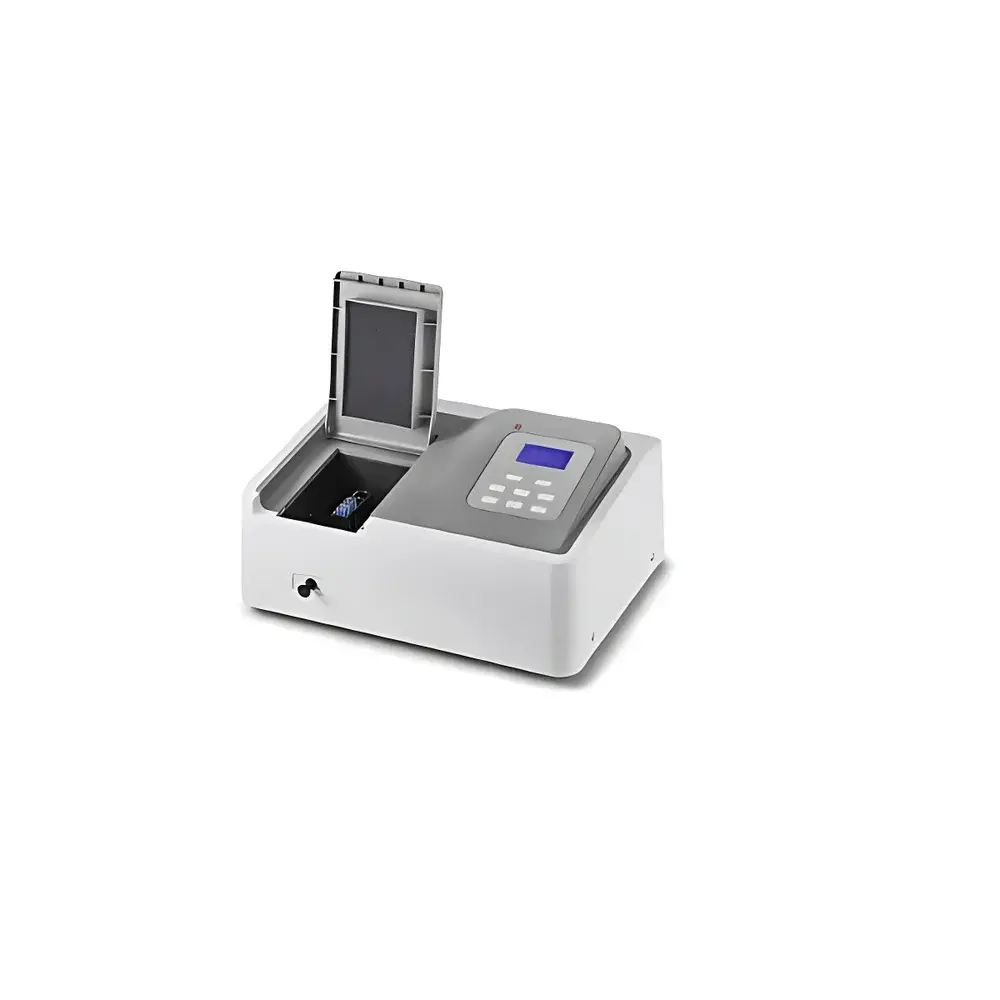
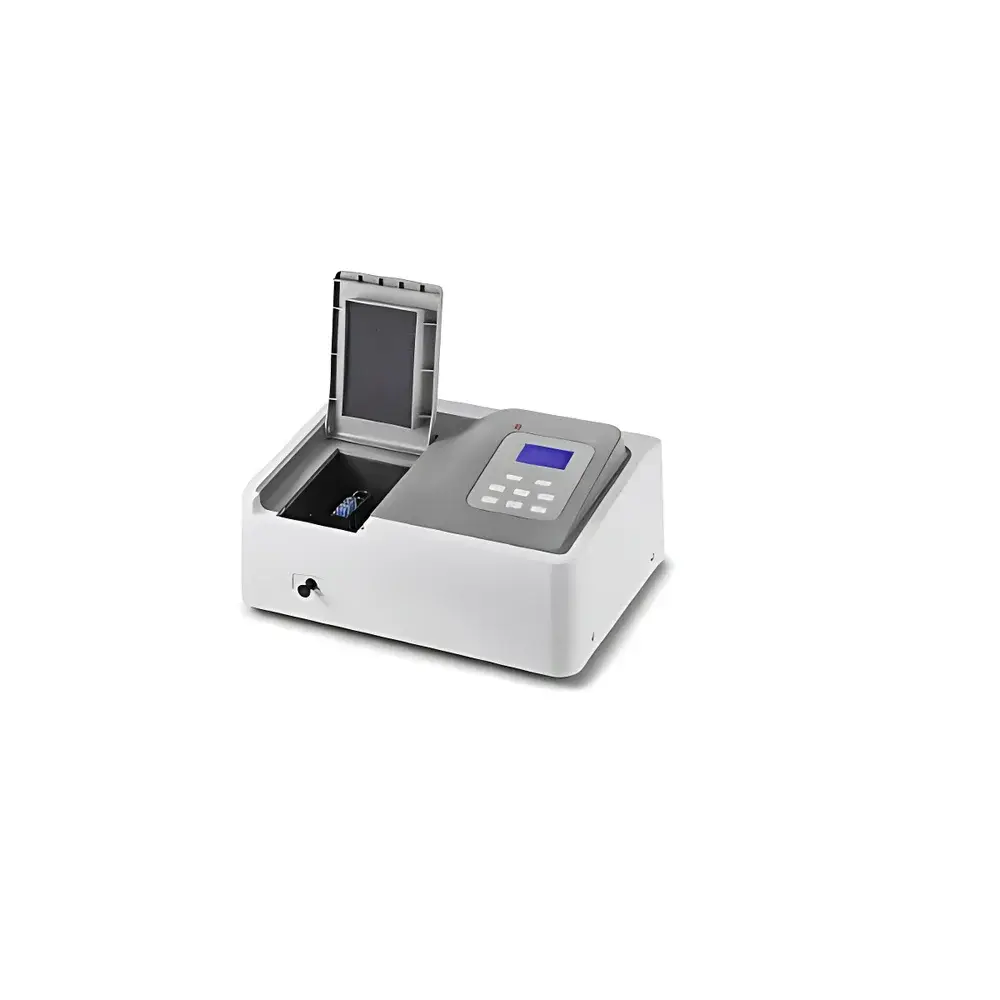
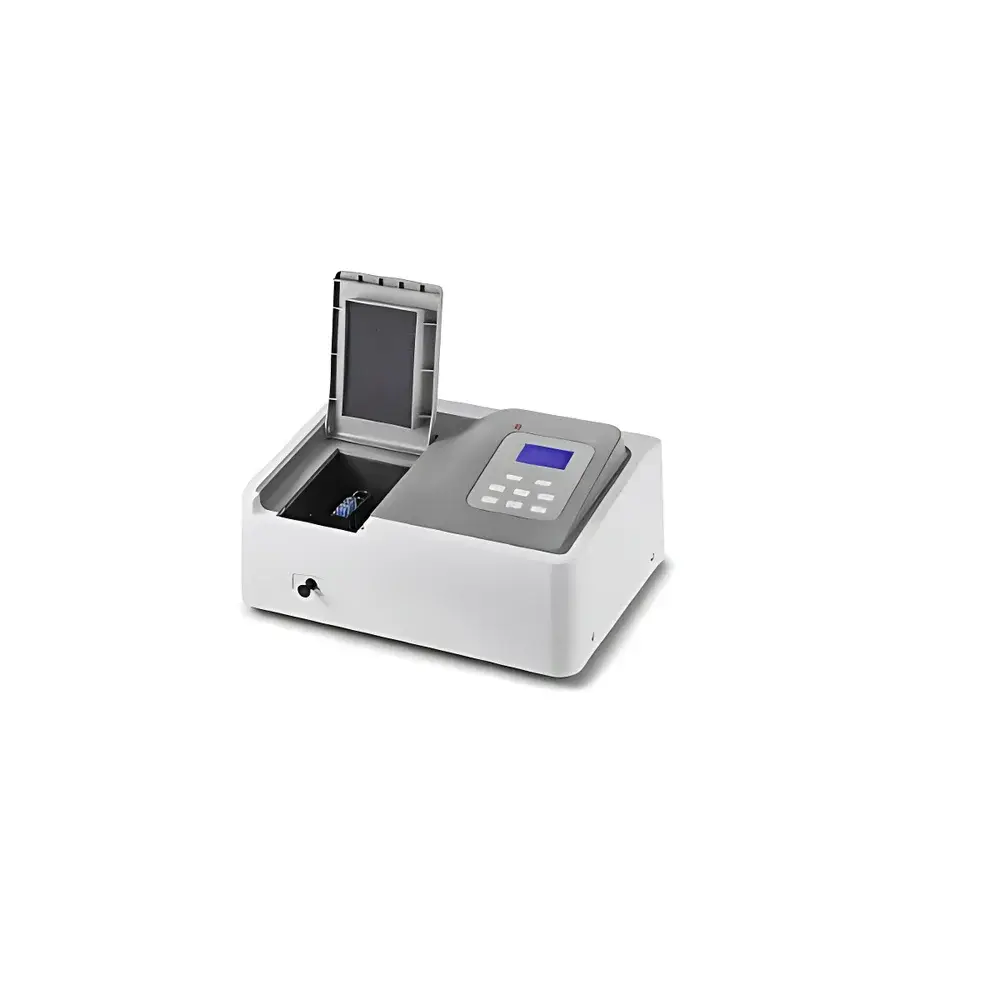
DLAB SP-V1000 Ultraviolet-Visible Spectrophotometer
| Brand | DLAB |
|---|---|
| Origin | Beijing, China |
| Instrument Type | Single-beam UV-Vis Spectrophotometer |
| Model | SP-V1000 |
| Wavelength Range | 325–1000 nm |
| Spectral Bandwidth | 4.0 nm |
| Wavelength Accuracy | ±2 nm |
| Wavelength Repeatability | ≤1 nm |
| Stray Light | ≤0.2%T @ 360 nm |
| Photometric Range | –0.3 to 3.0 A, 0–200%T |
| Photometric Accuracy | ±0.003 A @ 0.5 A, ±0.006 A @ 1.0 A, ±0.5%T @ 100%T |
| Photometric Repeatability | ≤0.0015 A @ 0.5 A, ≤0.003 A @ 1.0 A, ≤0.25%T @ 100%T |
| Baseline Stability | ≤0.002 A/h @ 500 nm (after 2 h warm-up) |
| Sample Holder | 4-position cuvette holder (10 mm pathlength) |
| Display | Dot-matrix LCD |
| Interface | USB port |
| Power Supply | 110/220 V, 50/60 Hz, 80 W |
| Dimensions (L×W×H) | 475 × 360 × 225 mm |
| Weight | 11 kg |
Overview
The DLAB SP-V1000 Ultraviolet-Visible Spectrophotometer is a precision-engineered single-beam optical instrument designed for routine quantitative analysis and photometric measurement in the 325–1000 nm spectral range. It operates on the fundamental principle of Beer–Lambert law-based absorbance spectroscopy, where incident light from a stabilized tungsten halogen lamp (imported HYBEC source) passes through a sample and is detected by a silicon photodiode. The fixed 4.0 nm spectral bandwidth ensures consistent resolution across the visible and near-UV region, supporting reliable concentration determination, kinetic monitoring, and spectral profiling in regulated and academic environments. Its single-beam architecture—while requiring manual reference blanking—delivers high optical throughput, mechanical robustness, and cost-effective operational integrity ideal for laboratories prioritizing reproducibility over automated scanning capability.
Key Features
- Stabilized tungsten-halogen lamp (HYBEC, Japan) with >2,000-hour service life and low thermal drift, optimized for stable intensity output in the 325–1000 nm range
- Precision monochromator with grating optics and fixed slit geometry, delivering nominal 4.0 nm spectral bandwidth with minimal wavelength-dependent deviation
- High-stability photometric performance: baseline drift ≤0.002 A/h at 500 nm after 2-hour warm-up; photometric repeatability ≤0.0015 A at 0.5 A absorbance
- Four-position manually indexed cuvette holder accommodating standard 10 mm pathlength quartz or glass cells—compatible with aqueous, organic, and mildly corrosive solvents
- Integrated dot-matrix LCD display with real-time A/T/%T readout and intuitive soft-key navigation—no external PC required for basic operation
- USB interface compliant with USB 2.0 standards for data export to Windows-based PCs; supports CSV-formatted transmittance/absorbance logs for traceable recordkeeping
- Compact footprint (475 × 360 × 225 mm) and reinforced ABS housing engineered for vibration resistance and long-term dimensional stability in shared lab environments
Sample Compatibility & Compliance
The SP-V1000 accommodates standard 10 mm square cuvettes made from optical-grade quartz (for UV transmission below 350 nm), borosilicate glass (visible range only), or disposable plastic (for non-critical teaching applications). Its optical path design minimizes stray light (<0.2%T @ 360 nm), enabling accurate quantitation of low-transmittance samples such as colored dyes, enzyme reaction mixtures, and diluted pharmaceutical solutions. While not equipped with automated compliance features (e.g., electronic audit trail or user role management), the instrument’s photometric accuracy (±0.003 A @ 0.5 A) and repeatability meet minimum performance thresholds outlined in ASTM E275, ISO 6059, and USP for spectrophotometric validation in non-GMP educational, QC, and environmental screening contexts. Routine verification using NIST-traceable holmium oxide and neutral density filters is recommended per ISO/IEC 17025 internal quality control protocols.
Software & Data Management
Data acquisition and reporting are managed via optional DLAB UV-Vis Control Software (v3.2+), compatible with Windows 10/11. The software enables time-scan mode (for kinetic assays), multi-wavelength quantitation, and calibration curve generation (linear, quadratic, or 4-parameter logistic). All measurements include embedded metadata: date/time stamp, operator ID (manually entered), wavelength setting, and cuvette position. Exported CSV files retain full photometric context and support import into LIMS platforms or statistical analysis tools (e.g., JMP, GraphPad Prism). Though the SP-V1000 does not natively support FDA 21 CFR Part 11-compliant electronic signatures or audit trails, its USB logging functionality satisfies GLP-aligned documentation requirements when paired with controlled laboratory procedures and version-controlled SOPs.
Applications
- Quantitative analysis of active pharmaceutical ingredients (APIs) and excipients in visible-range UV-Vis assays per pharmacopeial monographs (e.g., USP , EP 2.2.25)
- Determination of nitrate, phosphate, and heavy metal concentrations (via colorimetric reagents) in environmental water samples per EPA Method 353.2 and ISO 15681
- Protein quantification using Bradford or BCA assays in academic and industrial bioscience labs
- Food additive analysis (e.g., tartrazine, sunset yellow) and pigment stability testing under accelerated light exposure
- Teaching core spectroscopic concepts—including Beer’s law verification, molar absorptivity calculation, and spectral interference assessment—in undergraduate chemistry and biochemistry curricula
FAQ
Is the SP-V1000 suitable for UV-range measurements below 350 nm?
Yes—when used with quartz cuvettes, it delivers reliable absorbance data down to 325 nm. However, extended use below 340 nm requires periodic lamp intensity verification due to natural tungsten spectral roll-off.
Does the instrument support automatic wavelength scanning?
No—the SP-V1000 is a fixed-wavelength or step-scan instrument; continuous spectral scanning is not implemented. Users select discrete wavelengths manually via keypad or remote software command.
Can the USB interface be used for real-time data streaming?
The USB port supports batch transfer of stored measurement sets only; real-time streaming is not supported. For kinetic monitoring, users must rely on manual interval recording or third-party serial-to-USB polling scripts.
What maintenance is required for long-term photometric stability?
Annual verification of wavelength accuracy (using holmium oxide filter), quarterly cleaning of optical windows with spectroscopic-grade methanol, and biannual lamp replacement (or sooner if output drops >15% at 546 nm) are recommended.
Is technical documentation available in English with calibration procedures?
Yes—DLAB provides an English-language Operation Manual (Rev. E) including factory calibration certificates, traceable verification protocols, and preventive maintenance checklists aligned with ISO/IEC 17025 clause 6.4.





