
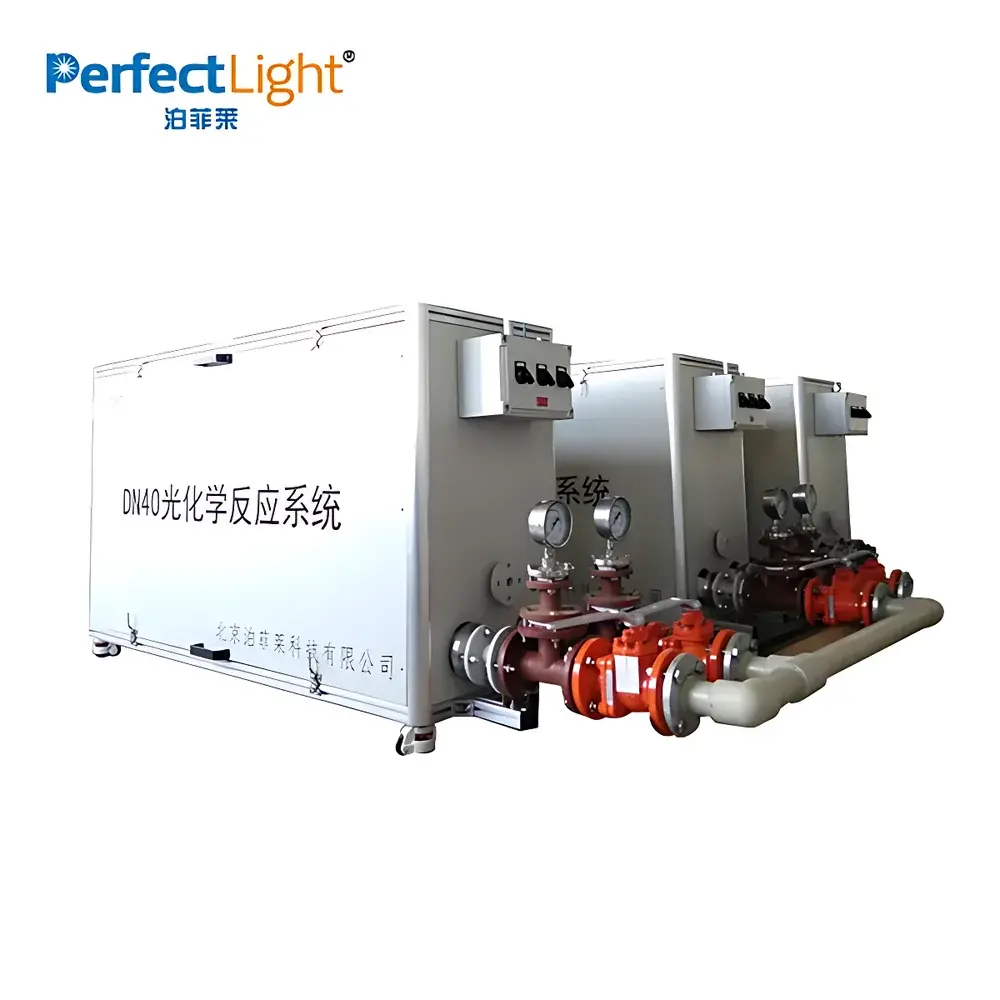
DN40 Photocatalytic Flow Reactor System by PerfectLight
| Brand | PerfectLight |
|---|---|
| Origin | Beijing, China |
| Model | DN40 |
| Reactor Type | Tubular Continuous-Flow Photoreactor |
| Light Source | Tunable Flexible LED Array (365–760 nm) |
| Total Optical Power | 2 kW (adjustable) |
| Volumetric Throughput | 4 L/h (up to 42.2 L/min peak flow rate) |
| Effective Irradiation Volume | 10 L/day processing capacity |
| Operating Temperature Range | Ambient to low-temperature compatible |
| Reactor Tube Material | Borosilicate glass or fused quartz (customizable per chemical compatibility) |
| Footprint | 1500 mm × 480 mm × 800 mm |
| Mixing | Integrated static mixer for enhanced mass/heat transfer |
| Reaction Modes | Continuous-flow and semi-batch |
| Compliance | Designed for GLP-aligned lab-scale process development and photochemical reaction screening |
Overview
The DN40 Photocatalytic Flow Reactor System by PerfectLight is an engineered platform for scalable, reproducible photochemical synthesis under controlled irradiation conditions. Based on the principles of continuous-flow photochemistry, the system leverages high-intensity, spectrally tunable LED illumination (365–760 nm) coupled with a transparent tubular reactor geometry to maximize photon flux delivery and quantum yield. Unlike batch photochemical reactors limited by light penetration depth and thermal gradients, the DN40’s axial-flow design ensures uniform residence time distribution, consistent photon exposure per unit volume, and improved control over radical initiation kinetics—critical for reactions involving UV- or visible-light-triggered homolytic bond cleavage, photocatalyst-mediated electron transfer (e.g., Ru(bpy)₃²⁺, Ir(ppy)₃), or solar-spectrum simulation studies. Its modular architecture supports both laboratory-scale optimization (4 L/h nominal throughput) and pilot-scale feasibility assessment (up to 10 L/day processed volume), making it suitable for method development in pharmaceutical photoredox catalysis, fine chemical synthesis, and environmental photocatalytic degradation studies.
Key Features
- Tunable multi-wavelength LED array (365–760 nm) with independent optical power regulation—enabling precise spectral matching to absorption maxima of photocatalysts or substrates.
- Optically transparent tubular reactor with customizable tube material: standard borosilicate glass for general organic photochemistry; optional fused quartz for deep-UV transmission (<220 nm) or aggressive solvent compatibility.
- Integrated static mixing elements upstream of the irradiation zone—enhancing radial mass transfer and mitigating concentration boundary layers that limit photon-driven reaction efficiency.
- Modular, mobile chassis (1500 × 480 × 800 mm) with casters and standardized fluidic interfaces—facilitating reconfiguration between single-unit operation and parallelized multi-reactor arrays.
- Scalable flow control: calibrated liquid delivery from 0.1 to 42.2 L/min, supporting variable residence times (seconds to minutes) without hardware modification.
- Ambient-temperature operational envelope with optional external chiller integration—maintaining thermal stability during exothermic photoredox cycles or low-temperature radical trapping protocols.
Sample Compatibility & Compliance
The DN40 accommodates homogeneous liquid–liquid and liquid–solid photochemical systems, including suspensions of heterogeneous photocatalysts (e.g., TiO₂, g-C₃N₄) and soluble transition-metal complexes. All wetted materials comply with USP Class VI and ISO 10993-5 standards for laboratory-grade chemical resistance. The system supports reaction protocols aligned with ASTM E2500-13 (verification of laboratory equipment) and ICH Q5C (stability testing of biopharmaceuticals under light stress). While not inherently 21 CFR Part 11-compliant, its digital I/O interface enables integration with validated SCADA or LIMS platforms for audit-trail-capable data capture in GMP-adjacent R&D environments.
Software & Data Management
The DN40 operates via a local HMI panel with real-time display of flow rate, LED intensity (% of max), and cumulative irradiation dose (J/cm²). Optional RS485/Modbus TCP connectivity allows synchronization with third-party data acquisition systems (e.g., LabVIEW, MATLAB, or ELN-integrated platforms). All operational parameters—including timestamped setpoints, actuator feedback, and manual override logs—are stored in CSV format for traceability. No proprietary cloud service or vendor-hosted software is required; raw log files are fully exportable for statistical process analysis (SPC) or DOE-based reaction optimization.
Applications
- Photoredox C–X bond formation (C–N, C–O, C–S) using Ir/Ru/Ni dual-catalytic manifolds.
- Solar-spectrum simulation for accelerated weathering studies and photocatalytic water splitting feasibility screening.
- Continuous-flow [2+2] cycloadditions, Norrish-type I/II cleavages, and singlet oxygen-mediated ene reactions.
- Scale-up of API photostability testing per ICH Q1B guidelines using controlled irradiance profiles.
- Heterogeneous photocatalysis with immobilized or suspended semiconductors under laminar or transitional flow regimes.
FAQ
Can the DN40 be used for reactions requiring inert atmosphere control?
Yes—standard configuration includes gas-tight Swagelok®-type inlet/outlet ports compatible with nitrogen or argon sparging; optional integrated pressure-regulated gas dosing modules are available.
Is quartz tubing included as standard or optional?
Borosilicate glass tubing is supplied as standard; fused quartz is a configurable option selected at order stage based on spectral and chemical requirements.
What safety certifications does the system carry?
The electrical enclosure meets CE marking requirements per EN 61010-1:2019 for laboratory equipment; laser safety classification is exempt as the LED source emits non-coherent radiation within Class 1 limits per IEC 62471.
How is residence time calculated and controlled?
Residence time τ (min) = reactor internal volume (L) ÷ volumetric flow rate (L/min); users calibrate flow rate via built-in Coriolis or gear pump feedback and adjust accordingly to target kinetic windows.
Does PerfectLight provide application support for reaction optimization?
Yes—application notes, irradiance mapping reports, and protocol templates for common photoredox transformations are provided with system commissioning; remote technical consultation is included for 12 months post-installation.
Related Products



