
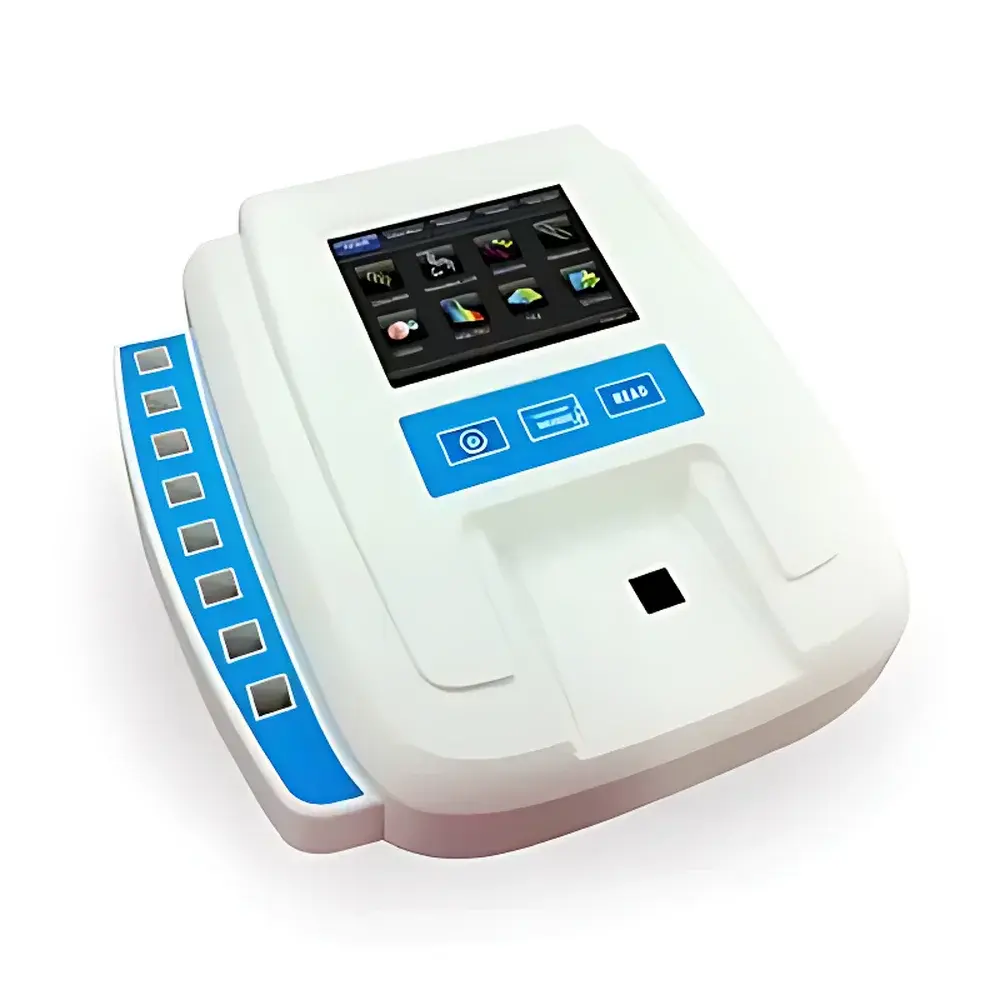
DNA800 Ultra-Micro Nucleic Acid and Protein Spectrophotometer
| Origin | Shanghai, China |
|---|---|
| Manufacturer Type | Authorized Distributor |
| Origin Category | Domestic (PRC) |
| Model | DNA800 |
| Pricing | Available Upon Request |
Overview
The DNA800 Ultra-Micro Nucleic Acid and Protein Spectrophotometer is a benchtop UV-Vis absorption spectrophotometer engineered for precise, rapid quantification and qualitative assessment of nucleic acids (DNA, RNA) and proteins in life science laboratories. It operates on the principle of Beer–Lambert law-based absorbance measurement across a continuous spectral range of 190–850 nm, enabling accurate concentration determination via characteristic extinction coefficients (e.g., A260, A280, A260/280 ratios). Unlike conventional cuvette-based instruments requiring ≥50 µL sample volumes, the DNA800 integrates optical path calibration and high-sensitivity photodiode array detection to support ultra-low-volume analysis—down to 0.7 µL—using proprietary TrayCell technology. This eliminates dilution-related errors and preserves precious clinical, CRISPR-edited, or single-cell-derived samples. Its compact architecture, solid-state xenon lamp source, and thermally stabilized optics ensure long-term photometric stability and inter-laboratory reproducibility under routine QC/QA workflows.
Key Features
- Ultra-micro sample capability: Compatible with TrayCell quartz microvolume platforms (0.7–5 µL loading volume), eliminating pipetting variability and minimizing sample waste.
- Full-spectrum scanning: Continuous wavelength coverage from 190 nm to 850 nm with 1 nm resolution, supporting identification of contaminants (e.g., phenol at 230 nm, guanidine at 235 nm) and secondary structure assessment (e.g., protein unfolding via A205 shifts).
- Four standardized measurement modes: Single-wavelength (e.g., A260 for dsDNA), multi-wavelength (e.g., simultaneous A260/A280/A230), kinetic assays (e.g., enzyme-coupled NADH oxidation), and standard curve quantification (linear or quadratic regression with user-defined calibrants).
- Integrated assay library: Pre-programmed protocols for dsDNA, ssDNA, RNA, oligonucleotides, BSA, IgG, Bradford, Lowry, and BCA methods—with automatic dilution factor compensation and purity flagging (e.g., A260/280 < 1.7 indicates protein contamination).
- Optical path correction: Software-based pathlength normalization eliminates manual cell adjustment; supports both fixed 1-mm and variable-pathlength (0.05–1 mm) measurement logic.
- Robust hardware design: Fan-cooled xenon flash lamp (≥10⁹ flashes lifetime), sealed optical chamber, and ambient-light rejection algorithm for reliable operation in shared core facilities.
Sample Compatibility & Compliance
The DNA800 accepts standard 10-mm square cuvettes (for high-concentration samples or colorimetric assays) and TrayCell microvolume slides (1.0 µL minimum for high-absorbance samples). It accommodates viscous lysates, crude PCR products, purified plasmids, and bacterial suspensions (OD600 mode with built-in 600 nm LED). All firmware and data handling comply with GLP/GMP-aligned practices: audit-trail-enabled software logs user ID, timestamp, method version, and raw absorbance values; exported CSV files retain metadata headers required for ISO/IEC 17025 documentation. While not FDA 21 CFR Part 11-certified out-of-box, the system supports electronic signature add-ons and networked deployment with LIMS integration via RS-232 or USB virtual COM port.
Software & Data Management
Controlled via Windows-based DNA800 Analysis Suite (v3.2+), the instrument features intuitive workflow-driven interface with role-based access control (administrator/operator modes). Raw spectra and processed results are stored in encrypted project files (.dna800) with embedded calibration history. Batch processing supports up to 96 samples per run with auto-flagging of outliers (e.g., A260/280 > 2.2 suggesting RNA carryover in DNA preps). Export options include PDF reports (with lab logo embedding), Excel-compatible CSV, and XML for ELN synchronization. Firmware updates are delivered via signed ZIP packages with SHA-256 checksum verification.
Applications
- Quantitative QC of next-generation sequencing libraries prior to pooling and loading.
- Routine monitoring of protein expression yields in E. coli and mammalian cell cultures (A280 + extinction coefficient method).
- Assessment of RNA integrity via 260/230 ratio in FFPE tissue extracts.
- High-throughput OD600 growth curve acquisition for antibiotic susceptibility testing.
- Validation of CRISPR-Cas9 editing efficiency through amplicon quantification pre- and post-T7E1 digestion.
- Supporting ISO 15195:2018 requirements for reference measurement procedures in clinical molecular diagnostics labs.
FAQ
What is the minimum detectable concentration for double-stranded DNA using the TrayCell?
For dsDNA with ε260 = 50 µg/mL·cm, the practical lower limit is ~2 ng/µL (A260 ≈ 0.04) with 3-signal averaging.
Does the instrument support third-party microvolume chips?
No—only certified TrayCell quartz slides (Cat. No. TC-1000) are optically calibrated and thermally matched to the instrument’s detector geometry.
Can I perform nucleic acid melting curve analysis?
No—the DNA800 lacks temperature-controlled sample holders; it is optimized for room-temperature absorbance, not thermal denaturation kinetics.
Is there an option for automated sample loading?
Not natively; the platform is designed for manual microdrop placement to maintain cross-contamination control and pathlength consistency.
How often does the xenon lamp require recalibration?
No user recalibration is needed; factory spectral calibration is retained for ≥2 years under normal usage (≤4 hrs/day), verified annually via NIST-traceable holmium oxide filter.




