
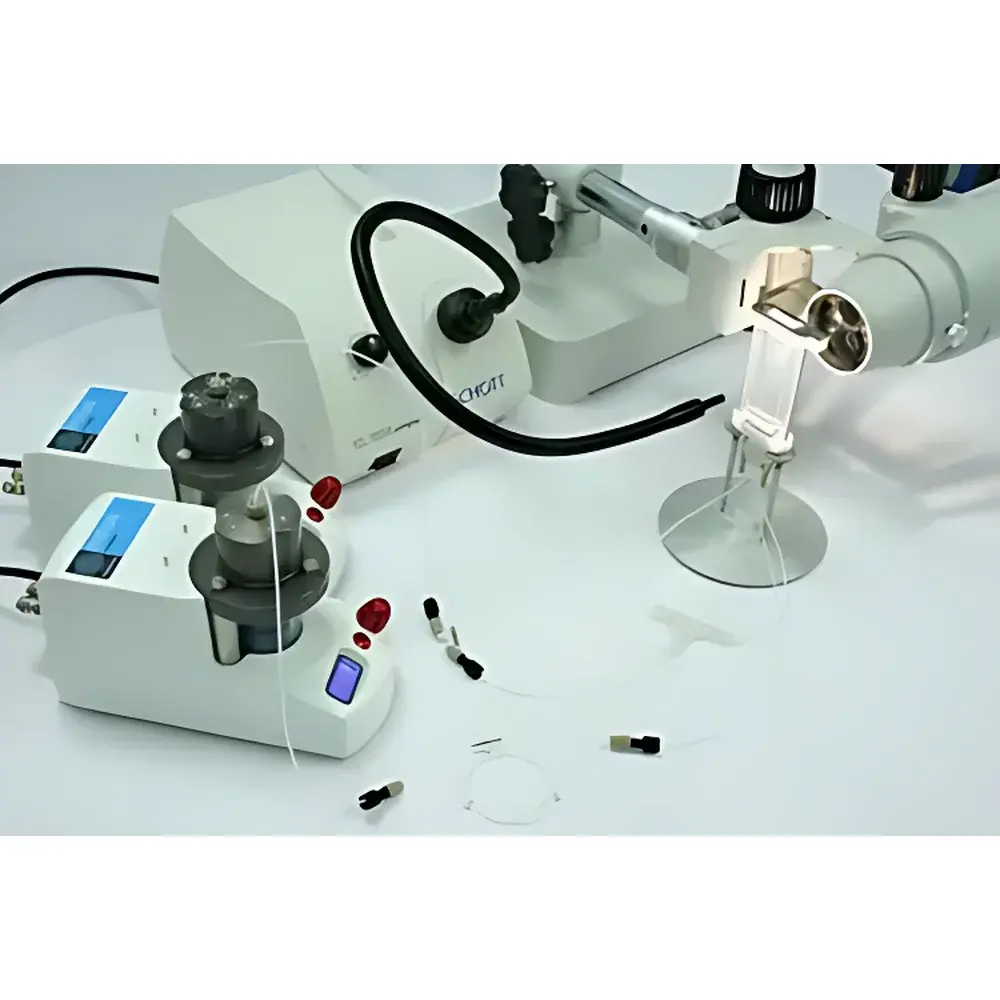
Dolomite Mitios-1 Droplet Microfluidic Chip System
| Brand | Dolomite |
|---|---|
| Origin | Beijing, China |
| Manufacturer Type | Authorized Distributor |
| Origin Category | Imported |
| Model | Mitios-1 |
| Pricing | Available Upon Request |
| Droplet Diameter Range | 10–250 µm |
| Droplet Generation Rate | >10,000 Hz |
| Flow Control | Independent Dual-Channel Pressure-Driven Actuation |
| Max Operating Pressure | 10 bar |
| Pump Type | Pulse-Free Pressure-Driven Microfluidic Pump |
| Chemical Resistance | High (Compatible with Organic Solvents, Acids, Bases) |
| Chip Interface | Standardized PDMS/Glass/Si Modular Cartridge Format |
| Fluid Compatibility | Aqueous, Oil, Surfactant-Stabilized, Viscous (up to 500 mPa·s) |
| Customization | Fully Configurable Chip Geometry, Channel Dimensions, Surface Chemistry, and Integration Ports |
Overview
The Dolomite Mitios-1 Droplet Microfluidic Chip System is a precision-engineered platform for the reproducible generation, manipulation, and analysis of monodisperse droplets in the 10–250 µm diameter range. Built upon Dolomite’s industry-proven pressure-driven microfluidic actuation architecture, the Mitios-1 leverages laminar flow hydrodynamics and controlled interfacial tension to enable robust droplet formation via T-junction, flow-focusing, or co-flow geometries. Unlike syringe-pump-based systems, the Mitios-1 employs a pulse-free, digitally regulated pressure source capable of delivering stable, low-noise flow across multiple immiscible phases—critical for applications requiring high temporal resolution, long-duration stability, and minimal shear-induced coalescence. The system is designed for integration into automated laboratory workflows and supports seamless transition from R&D prototyping to GLP-compliant process development in biopharma, synthetic biology, and materials science.
Key Features
- Pulse-free pressure-driven actuation with digital pressure regulation (0–10 bar), ensuring sub-millisecond response time and flow stability ≤0.5% CV over 24 h
- Independent dual-channel fluid control with real-time pressure feedback, enabling precise tuning of droplet size, frequency, and phase ratio
- Modular chip cartridge interface compatible with standard PDMS, glass, and silicon microfluidic devices—supports rapid chip exchange without re-plumbing or recalibration
- Chemically inert wetted path constructed from PTFE, FFKM, and stainless steel 316L, validated for compatibility with chlorinated solvents, 1 M HCl/NaOH, and surfactants including Span 80 and Tween 20
- Integrated dead-volume minimization design: total internal volume <8 µL per channel; <100 nL residual hold-up after fluid switching
- Scalable architecture supporting up to three simultaneous input streams for ternary emulsions, multi-reagent encapsulation, or sequential droplet loading
- Optional accessories include high-speed imaging modules (up to 10,000 fps), integrated fluorescence detection cells, and temperature-controlled chip holders (4–60 °C)
Sample Compatibility & Compliance
The Mitios-1 accommodates a broad spectrum of sample chemistries and viscosities, including aqueous buffers, polymer solutions (e.g., alginate, PEGDA), cell suspensions (bacteria, yeast, mammalian cells), oil phases (silicone, mineral, fluorinated oils), and reactive monomer blends. Its corrosion-resistant fluidic path meets ASTM D543-20 requirements for chemical resistance testing and complies with ISO 8573-1:2010 for compressed air purity when used with external gas supply. For regulated environments, the system supports audit-trail-enabled operation via optional software add-ons compliant with FDA 21 CFR Part 11 and EU Annex 11 requirements—including electronic signatures, user role management, and immutable data logging.
Software & Data Management
Control and monitoring are performed through Dolomite’s proprietary Microfluidics Control Suite (v4.2+), a Windows-based application offering intuitive graphical workflow configuration, real-time pressure/flow visualization, and parameter scripting via Python API. All experimental metadata—including pressure setpoints, timestamps, chip ID, operator credentials, and environmental conditions—are embedded in HDF5-formatted output files, ensuring FAIR (Findable, Accessible, Interoperable, Reusable) data principles. Export options include CSV, MATLAB .mat, and open-standard JSON-LD for LIMS integration. Version-controlled firmware updates are delivered via secure HTTPS and verified using SHA-256 checksums.
Applications
- Single-cell encapsulation and barcoded sequencing library preparation (e.g., Drop-seq, inDrop)
- High-throughput screening of enzyme variants or metabolic pathways in picoliter reactors
- Encapsulated crystallization for protein X-ray crystallography and polymorph screening
- Synthesis of uniform polymeric nanoparticles (PLGA, chitosan) and liposomes for drug delivery
- Microscale chemical synthesis with residence time control down to 100 ms
- Development of diagnostic emulsion standards for flow cytometry and digital PCR calibration
- Materials science applications including Janus particle fabrication and hydrogel microparticle templating
FAQ
What chip formats are supported by the Mitios-1?
Standardized cartridges for PDMS, glass, and silicon chips with 1/4″-28 UNF threaded ports and integrated O-ring sealing; custom interconnects available upon request.
Can the system generate water-in-oil and oil-in-water droplets interchangeably?
Yes—droplet polarity is determined solely by relative interfacial tension and flow rate ratios; no hardware modification is required.
Is the Mitios-1 compatible with sterile or biosafety-level 2 (BSL-2) workflows?
Fully compatible when equipped with sterilizable chip carriers and validated single-use fluidic kits; full autoclave compatibility (121°C, 20 min) available for metal components.
Does the system support closed-loop feedback control based on real-time droplet imaging?
Yes—when paired with Dolomite’s optional high-speed camera module and VisionLink plugin, pressure setpoints can be dynamically adjusted using image-derived metrics such as droplet diameter variance or generation frequency drift.
What documentation is provided for regulatory submissions?
Dolomite supplies IQ/OQ protocols, traceable calibration certificates (NIST-traceable pressure transducers), material compliance declarations (REACH, RoHS), and full technical specifications aligned with ICH Q5D and USP <1059> guidance for microfluidic device qualification.




