
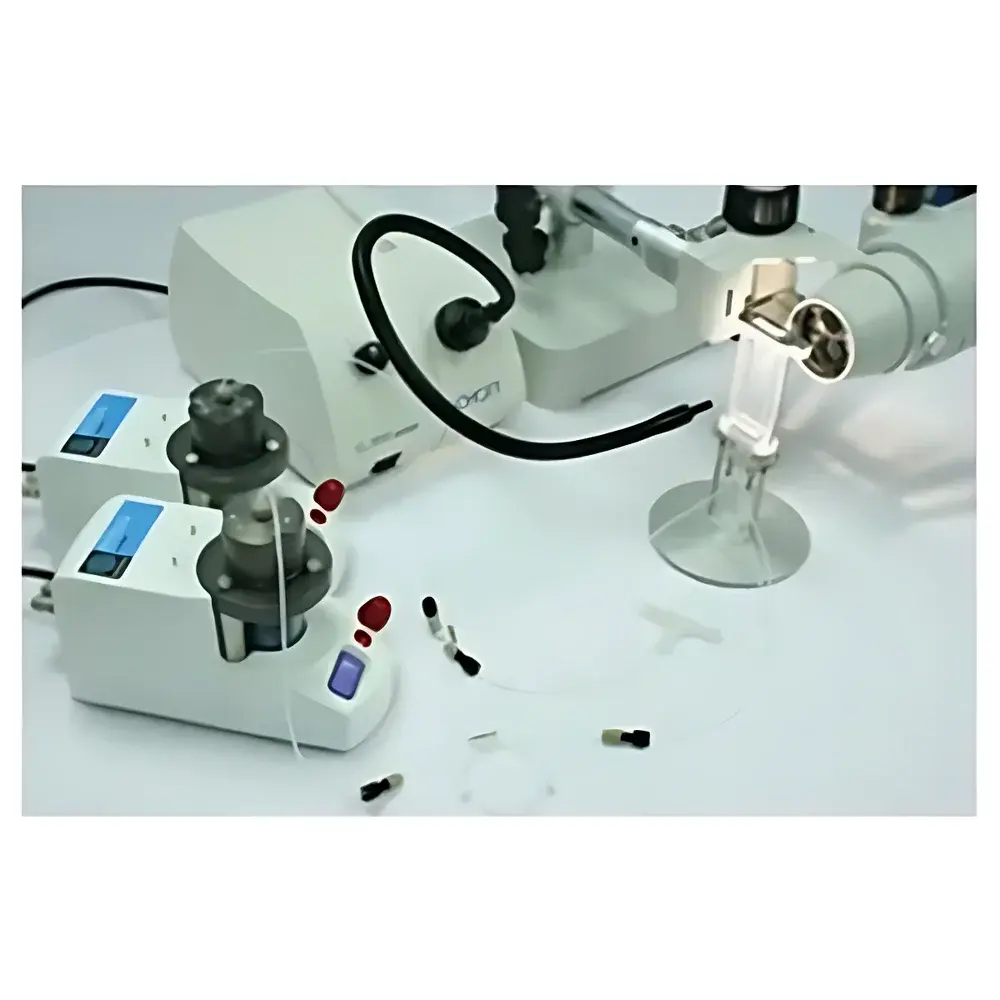
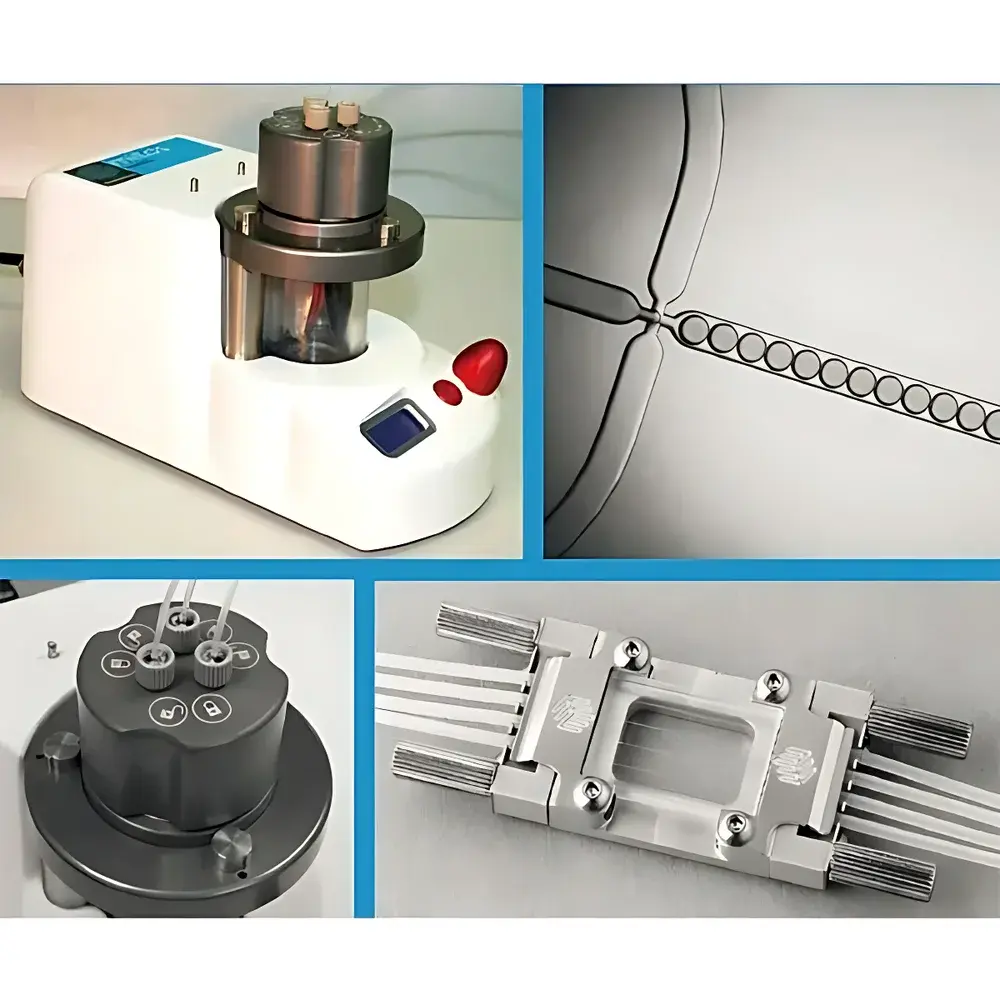
Dolomite Mitios-1 Droplet Microfluidic System
| Brand | Dolomite |
|---|---|
| Origin | United Kingdom |
| Manufacturer Type | Authorized Distributor |
| Origin Category | Imported |
| Model | Mitios-1 |
| Chip Material | Organic Polymer |
| Chip Type | Droplet-Based Microfluidic Chip |
| Droplet Diameter Range | 10–250 µm |
| Droplet Generation Rate | >10,000 Hz |
| Flow Control | Independent Dual-Channel Pressure-Driven Actuation |
| Max Operating Pressure | 10 bar |
| Chemical Resistance | High (Compatible with Common Organic Solvents, Aqueous Buffers, and Surfactant Solutions) |
| System Architecture | Modular, Reconfigurable, and Chip-Interchangeable |
Overview
The Dolomite Mitios-1 Droplet Microfluidic System is a precision-engineered platform for high-throughput, monodisperse droplet generation and manipulation in life science research and process development. Built upon proven pressure-driven microfluidic actuation principles, the Mitios-1 leverages laminar flow hydrodynamics and interfacial tension control to generate highly reproducible aqueous or organic phase droplets within immiscible carrier fluids—enabling robust emulsion formation across water-in-oil (W/O), oil-in-water (O/W), and double-emulsion configurations. Unlike syringe-pump-based systems prone to pulsation and flow instability, the Mitios-1 employs dual, synchronized, pulseless pressure controllers to independently regulate up to three fluidic inputs with sub-mbar pressure resolution. This architecture ensures exceptional temporal and spatial control over droplet nucleation, size distribution (CV < 3%), and frequency—critical for applications demanding statistical rigor, such as single-cell encapsulation, enzymatic assay screening, or nanoparticle synthesis under confined reaction volumes.
Key Features
- Dual independent pressure controllers with real-time feedback and 0.01 bar resolution, enabling precise, pulse-free flow regulation across multiple inlets
- Modular chip interface compatible with standard Dolomite droplet chips fabricated from chemically resistant organic polymers (e.g., COC, COP)
- Scalable droplet diameter range: 10–250 µm, tunable via channel geometry, flow rate ratio, and interfacial tension modulation
- Maximum operating pressure of 10 bar supports handling of moderately viscous reagents (up to ~500 mPa·s at 25 °C) without flow deviation or chip deformation
- Integrated rapid fluid switching capability (<500 ms transition time between three input streams) for multi-step droplet functionalization or reagent addition
- Onboard diagnostics and pressure monitoring with digital logging, supporting GLP-compliant experimental traceability
- Tool-less chip mounting system with standardized PDMS/glass alignment features for repeatable positioning and minimal dead volume (<20 nL)
Sample Compatibility & Compliance
The Mitios-1 accommodates a broad spectrum of biologically and chemically relevant samples—including cell suspensions (e.g., mammalian, yeast, bacterial), protein solutions, polymer precursors, and nanoparticle dispersions—without compromising viability or stability. Its organic polymer chip substrates exhibit low non-specific binding, excellent optical clarity (transmission >90% from 200–800 nm), and compatibility with surface functionalization (e.g., plasma treatment, silanization). The system meets essential laboratory safety and interoperability requirements: CE marking per Directive 2014/30/EU (EMC) and 2014/35/EU (LVD); compliant with ISO 13485 design controls when integrated into IVD development workflows; and validated for use under Good Manufacturing Practice (GMP)-aligned protocols where traceability, calibration records, and audit-ready operation logs are required.
Software & Data Management
Operation is managed via Dolomite’s proprietary Mitos Control Software (v3.2+), a Windows-based application supporting intuitive graphical workflow configuration, real-time pressure/flow visualization, and automated parameter sweeps. The software exports timestamped CSV datasets containing pressure setpoints, measured backpressures, droplet frequency (via optional integrated high-speed imaging trigger), and user-defined metadata fields. All session data—including chip ID, operator name, and environmental conditions—is structured to align with FDA 21 CFR Part 11 requirements when deployed with electronic signature modules and role-based access controls. Raw data files are stored in vendor-neutral HDF5 format, facilitating downstream integration with Python (via h5py), MATLAB, or LabVIEW environments for custom analysis pipelines.
Applications
- Single-cell RNA sequencing library preparation via droplet-based barcoding and lysis
- High-throughput screening of enzyme kinetics or metabolic pathways in picoliter-volume reactors
- Controlled synthesis of polymeric nanoparticles, liposomes, and Janus microparticles
- Encapsulation of probiotics, vaccines, or therapeutic cells for delivery studies
- Microscale crystallization assays for pharmaceutical polymorph screening
- Development and validation of point-of-care diagnostic emulsion assays (e.g., digital ELISA, PCR-in-droplet)
FAQ
Is the Mitios-1 compatible with third-party microfluidic chips?
Yes—provided they conform to Dolomite’s standardized footprint (75 × 25 mm), inlet/outlet port layout (1/4″-28 UNF threaded), and pressure rating (≤10 bar). Custom adapter plates are available upon request.
Can the system operate under sterile conditions for cell-based experiments?
The chip holder and fluidic manifolds are autoclavable (121 °C, 20 min); chips are single-use and supplied gamma-irradiated. Full aseptic integration requires laminar flow hood installation and sterile-filtered reagent lines.
What level of technical support and service coverage is provided?
Dolomite offers global 24-month warranty, on-site installation and qualification (IQ/OQ), and annual preventive maintenance contracts including pressure sensor recalibration and firmware updates.
Does the Mitios-1 support real-time droplet imaging synchronization?
Yes—the system provides TTL-compatible trigger outputs synchronized to pressure transients, enabling frame-accurate capture with commercial high-speed cameras (e.g., Phantom v2512, Hamamatsu ORCA-Fusion BT).
How is chip clogging monitored and mitigated during long-duration runs?
Integrated upstream pressure sensors detect abnormal resistance rise (>15% deviation from baseline); software alerts users and can automatically initiate flush protocols using auxiliary solvent channels.
Related Products




