
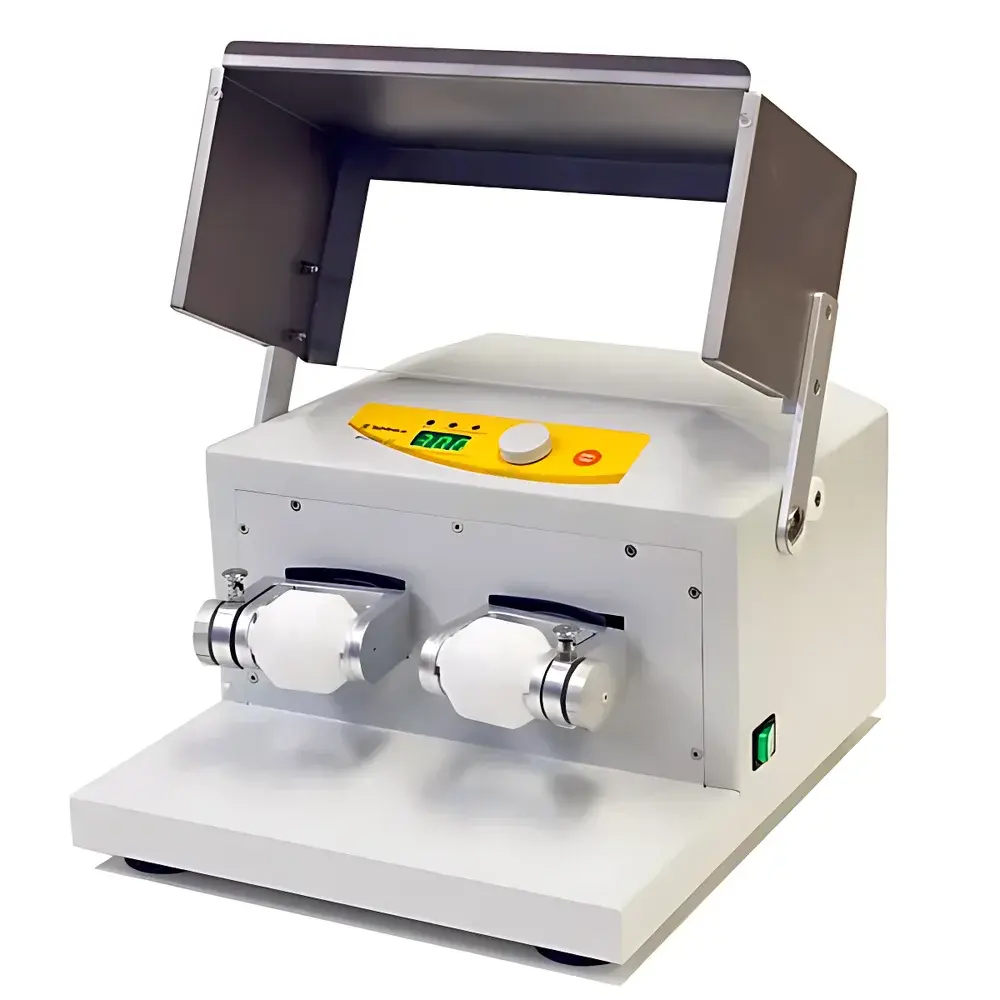
Domel Tehtnica MillMix 20 Bead Mill Homogenizer
| Brand | Domel |
|---|---|
| Origin | Imported (Non-Chinese) |
| Manufacturer Type | Authorized Distributor |
| Instrument Type | Bead-Based Mechanical Homogenizer |
| Model | MillMix 20 |
| Price | €1,000 (Reference Only) |
| Dimensions (W×D×H) | 365 × 405 × 225 mm |
| Sample Volume Range | 0.2–50 mL per tube |
| Oscillation Frequency | 3–30 Hz (180–1,800 cycles/min) |
| Amplitude | 32 mm |
| Timer Range | 5 s–60 min or continuous mode |
| Power Supply | 230 V / 50 Hz |
| Weight | 42 kg |
| Motor Type | Brushless DC Motor |
| Display | LED Parameter Display |
| Control Interface | Single-knob operation for speed and time |
Overview
The Domel Tehtnica MillMix 20 is a high-performance bead mill homogenizer engineered for reproducible, high-shear mechanical lysis of biological and environmental samples. It operates on the principle of horizontal reciprocating oscillation—driving stainless-steel or ceramic grinding beads within sealed tubes to generate intense impact and shear forces. This mechanism enables efficient cell disruption, tissue homogenization, and particle size reduction without significant thermal buildup, especially when used with cryogenic accessories. Designed for routine use in molecular biology, microbiology, agronomy, and environmental laboratories, the MillMix 20 delivers consistent results across diverse sample matrices—including fibrous plant tissues, Gram-positive bacteria, yeast cell walls, frozen animal organs, and mineral-rich soil extracts—where enzymatic or sonication-based methods may underperform or introduce bias.
Key Features
- Brushless DC motor ensures long-term operational stability, zero carbon dust generation, and maintenance-free performance over thousands of cycles.
- Single-knob intuitive interface simplifies protocol execution—simultaneous adjustment of frequency (3–30 Hz) and timer (5 s–60 min or continuous), with real-time LED display of setpoint and elapsed time.
- Fixed 32 mm amplitude provides optimal energy transfer across all compatible tube formats, minimizing tube slippage and maximizing bead collision efficiency.
- Robust aluminum-alloy chassis and vibration-dampening feet ensure stable operation at maximum frequency, even during extended runs with dual 50 mL tubes.
- Cryogenic compatibility: Supports liquid nitrogen pre-chilling of adapters and tubes; optional insulated cooling jackets available for sub-zero processing (−80 °C).
- CE-marked and compliant with IEC 61000-6-2 (EMC immunity) and IEC 61000-6-4 (EMC emission) standards for laboratory environments.
Sample Compatibility & Compliance
The MillMix 20 accommodates a broad spectrum of sample types and container formats via interchangeable adapters. Standard configurations support simultaneous processing of two tubes per run—from microcentrifuge tubes (0.2 mL) to Falcon-style conical tubes (15 mL and 50 mL)—as well as 96-well deep-well plates and standard microtiter plates (up to 6 plates per run). All contact surfaces are constructed from certified INOX stainless steel or PTFE-coated materials to prevent cross-contamination and ensure chemical resistance against organic solvents, chaotropic agents (e.g., guanidine HCl), and acidic or alkaline extraction buffers. The system meets requirements for GLP-compliant workflows: full traceability of operating parameters (frequency, duration, date/time stamp) is retained in non-volatile memory, supporting audit readiness per ISO/IEC 17025 and FDA 21 CFR Part 11 when paired with validated data export protocols.
Software & Data Management
While the MillMix 20 operates as a standalone instrument with embedded firmware, it supports external documentation and quality control integration. All run logs—including start/stop timestamps, applied frequency, total cycle count, and user-assigned batch IDs—are accessible via USB export (CSV format) for LIMS ingestion or electronic lab notebook (ELN) synchronization. Optional PC-based configuration software (Domel Homogenizer Suite v2.1) enables method library creation, password-protected parameter locking for SOP enforcement, and automated report generation aligned with ISO 15189 and CLIA validation frameworks. Audit trails record operator ID, parameter changes, and firmware updates—fully compliant with GxP data integrity principles.
Applications
- Molecular biology: Rapid genomic DNA, plasmid, and total RNA isolation from recalcitrant samples (e.g., Arabidopsis leaves, Bacillus spores, fungal mycelia).
- Clinical microbiology: High-yield lysis of biofilm-embedded pathogens and antibiotic-tolerant persisters for downstream MALDI-TOF MS or NGS library prep.
- Environmental analysis: Homogenization of soil, sediment, and rhizosphere samples prior to metagenomic DNA extraction or heavy metal leaching assays.
- Proteomics: Solubilization of membrane proteins and inclusion bodies under denaturing or native conditions using compatible bead chemistries (e.g., zirconia/silica mixtures).
- Quality control: Batch-to-batch consistency testing in biopharmaceutical raw material screening (e.g., botanical extracts, fermentation broths).
FAQ
What safety certifications does the MillMix 20 hold?
The instrument complies with CE directives for electromagnetic compatibility (EMC) and low voltage equipment (LVD), and conforms to EN 61010-1:2010 for laboratory electrical safety.
Can the MillMix 20 be integrated into automated lab workflows?
Yes—via optional RS-232 or USB-to-serial interface, enabling remote triggering and status polling from robotic liquid handlers or scheduling platforms (e.g., LabVantage, STARLIMS).
Is validation documentation available for GMP environments?
Domel provides IQ/OQ templates, calibration certificates for frequency and timer modules, and a traceable serial-number log—supporting user-led PQ execution per Annex 15 and USP .
How often does the motor require service?
The brushless DC motor is rated for >20,000 hours MTBF and requires no scheduled maintenance; only periodic inspection of mounting bolts and adapter wear is recommended.
Are grinding beads included with purchase?
No—beads are selected based on application: stainless steel (for robust tissues), tungsten carbide (for soils), or zirconium oxide (for nucleic acid preservation); bead size (0.1–2.0 mm) and loading ratio (typically 0.2–0.5 g per 100 µL sample) must be optimized empirically.



