
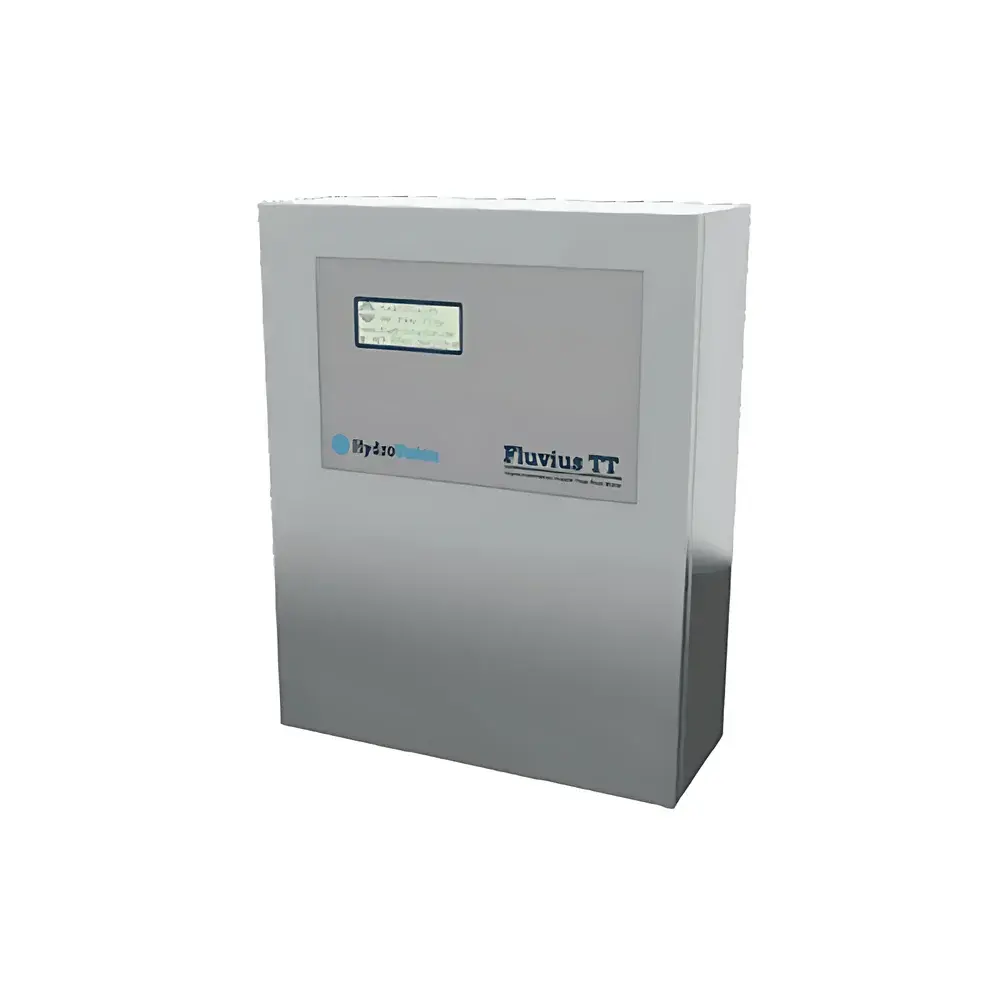
Dongshen Electronics FluviusTT Series Transit-Time Ultrasonic Flowmeter
| Brand | Dongshen Electronics (DSE) |
|---|---|
| Origin | Zhejiang, China |
| Manufacturer Type | Authorized Distributor |
| Country of Origin | China |
| Model | FluviusTT |
| Pricing | Available Upon Request |
Overview
The Dongshen Electronics FluviusTT Series Transit-Time Ultrasonic Flowmeter is an engineered solution for continuous, non-intrusive velocity and volumetric flow measurement in open-channel natural rivers and large artificial waterways. Based on the transit-time difference principle—where ultrasonic pulses are transmitted upstream and downstream across a known acoustic path—the system calculates mean cross-sectional velocity by precisely measuring the time-of-flight differential between co-linear opposing transducers. Unlike Doppler-based systems, the FluviusTT relies on coherent signal propagation through water, delivering high reproducibility even under low-turbidity or low-sediment conditions. Its design specifically targets wide-river applications where conventional acoustic Doppler current profilers (ADCPs) face geometric constraints—particularly limitations imposed by width-to-depth ratio—and where suspended solids may compromise signal integrity. With dual-frequency transducer options operating at 15 kHz and 28 kHz, the FluviusTT achieves optimal acoustic coupling in heterogeneous hydraulic environments, supporting reliable deployment across channels up to 750 meters wide.
Key Features
- Transit-time ultrasonic measurement principle ensures immunity to sediment-induced signal attenuation and eliminates reliance on scatterers for velocity estimation.
- Dual-frequency transducer architecture (15 kHz and 28 kHz) enables adaptive selection based on channel geometry, water clarity, and suspended solids concentration—validated via empirical river cross-section characterization models.
- Modular sensor configuration supports multi-path installation (2-, 4-, or 6-path), allowing integration with varying bank structures and enabling robust averaging of velocity profiles across complex flow fields.
- Real-time data acquisition with sub-second update intervals; output includes instantaneous velocity, cumulative flow volume, and diagnostic signal quality metrics (e.g., SNR, path validity flags).
- IP68-rated transducers and corrosion-resistant mounting hardware ensure long-term operational stability in fluvial environments subject to flooding, ice scour, and biofouling.
- Integrated temperature compensation and automatic gain control maintain measurement consistency across seasonal thermal gradients and variable water conductivity.
Sample Compatibility & Compliance
The FluviusTT is validated for use in natural rivers, irrigation canals, flood control channels, and regulated reservoir outflows. It accommodates a broad range of hydraulic conditions—including low-flow periods, high-velocity flood events, and transitional flow regimes—with no requirement for stilling basins or flow conditioning structures. The system complies with ISO 748:2022 (Measurement of liquid flow in open channels — Velocity-area method) for indirect validation protocols and supports traceable calibration against NIST-traceable reference standards. While not certified to IEC 61508 or SIL levels, its architecture aligns with GLP-aligned data integrity practices, including timestamped raw transit-time logs and configurable audit trails for configuration changes.
Software & Data Management
The FluviusTT integrates with Dongshen’s HydroLink™ software suite, providing remote configuration, real-time visualization, and automated report generation. Data export formats include CSV, NetCDF, and MODBUS TCP for seamless ingestion into SCADA, hydrological modeling platforms (e.g., HEC-RAS, MIKE SHE), and cloud-based dashboards. Firmware updates are delivered over secure HTTPS with SHA-256 signature verification. All measurement records include embedded metadata (transducer ID, path geometry, temperature, signal amplitude), satisfying minimum requirements for regulatory data archival per USGS NWIS and EU WFD reporting frameworks. Optional TLS 1.2 encryption and role-based user access control support environments requiring adherence to IT security policies.
Applications
- Long-term river discharge monitoring for hydrometric networks and climate change impact studies.
- Real-time flood forecasting and reservoir release optimization in integrated water resource management systems.
- Regulatory compliance reporting for water abstraction licensing and ecological flow assessment (e.g., EU Water Framework Directive Article 4 obligations).
- Performance validation of hydraulic structures such as weirs, sluices, and diversion gates.
- Calibration reference for satellite-based surface velocity retrieval algorithms (e.g., NASA SWOT mission ground truthing).
FAQ
How does the FluviusTT differ from ADCP-based systems in wide-river applications?
The FluviusTT eliminates dependence on width-to-depth ratio constraints inherent to ADCPs, enabling accurate measurements in shallow, wide floodplains where ADCP beam spreading and bottom-tracking failure occur.
Can the system operate reliably in highly turbid or sediment-laden rivers?
Yes—by leveraging low-frequency ultrasound (15 kHz), the FluviusTT maintains sufficient penetration depth and signal coherence even at suspended sediment concentrations exceeding 5 g/L, unlike higher-frequency Doppler systems that suffer rapid attenuation.
Is field calibration required after installation?
No routine recalibration is needed; however, annual verification using portable acoustic velocity references or stage-discharge rating curve reconciliation is recommended per ISO 4053-2 guidelines.
What communication protocols are supported for integration with existing telemetry infrastructure?
Standard support includes RS-485 (Modbus RTU), Ethernet (Modbus TCP), and optional 4–20 mA analog output with HART protocol compatibility.
Does the system meet cybersecurity requirements for critical infrastructure deployments?
Firmware v3.2+ includes disabled default credentials, configurable password policies, and encrypted firmware updates—meeting baseline NIST SP 800-82 Annex A controls for industrial IoT devices.







