
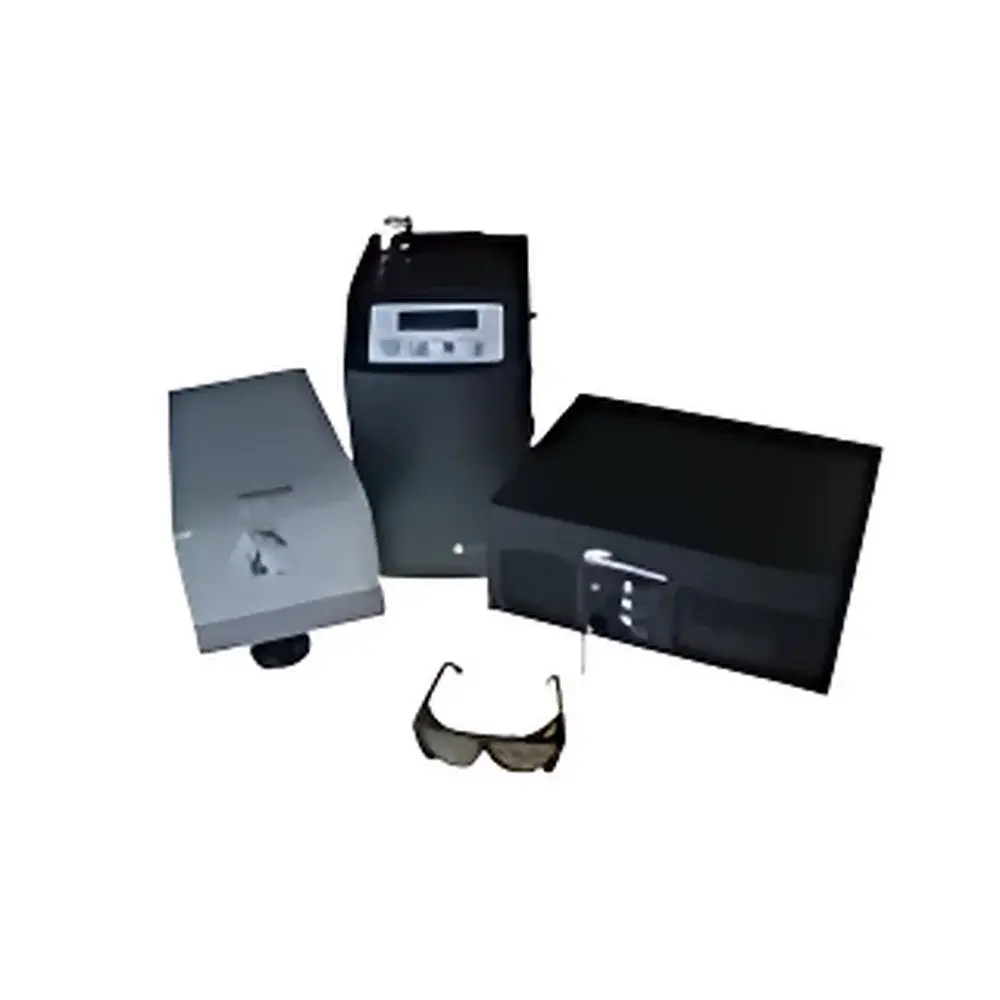
DPSS Lasers TCW Series 355 nm Continuous-Wave Ultraviolet Laser System
| Brand | DPSS Lasers |
|---|---|
| Origin | USA |
| Model | TCW Series |
| Wavelength | 354.7 nm |
| Output Power Options | 10–200 mW (TCW50/TCW100/TCW150/TCW200) |
| Beam Mode | TEM₀₀ (M² < 1.3) |
| Beam Diameter (1/e²) | 1.2 mm |
| Beam Divergence (full angle) | < 0.3 mrad |
| Beam Pointing Stability | < 25 µrad |
| Polarization Ratio | > 100:1 |
| Ellipticity | < 10% |
| Astigmatism | < 0.3 |
| Optical Noise (P-P, 0–2 MHz) | < 10% |
| Optical Noise (RMS) | < 1% |
| Power Stability (8 hrs) | < 5% |
| Warm-up Time | < 1 hour |
| Input Voltage | 90–240 VAC |
| Power Consumption | < 1000 W |
| Operating Temperature | 10–30 °C |
| Laser Head Dimensions (L×W×H) | 521 × 254 × 129 mm³ |
| Laser Head Weight | 15.9 kg |
| Power Supply Dimensions | 330 × 455 × 137 mm³ |
| Power Supply Weight | 10.5 kg |
| Chiller Dimensions | 287 × 224 × 389 mm³ |
| Chiller Weight (dry) | 9.1 kg |
| Cooling | Active liquid cooling |
| Laser Type | Diode-pumped solid-state (DPSS), frequency-tripled Nd:YVO₄ |
Overview
The DPSS Lasers TCW Series is a high-performance, continuous-wave (CW) ultraviolet laser system engineered for precision scientific and industrial applications requiring stable, diffraction-limited 355 nm output. Based on diode-pumped solid-state (DPSS) architecture, the TCW lasers employ intracavity frequency tripling of a Nd:YVO₄ gain medium to generate narrowband UV radiation at 354.7 nm — closely aligned with the standard 355 nm spectral line used in fluorescence excitation, photolithography alignment, and high-resolution optical metrology. Unlike pulsed UV sources, the TCW series delivers true CW emission with exceptional temporal stability and minimal amplitude noise, enabling quantitative intensity-dependent measurements where pulse-to-pulse variability would introduce systematic error. Its TEM₀₀ spatial profile (M² < 1.3), low beam divergence (< 0.3 mrad full angle), and sub-25 µrad pointing stability ensure consistent coupling into single-mode fibers, scanning galvanometers, and high-NA microscope objectives — critical for confocal microscopy and flow cytometry platforms operating under GLP-compliant workflows.
Key Features
- Diode-pumped solid-state (DPSS) design with integrated temperature-stabilized cavity and harmonic generation optics
- Output power options spanning 10 mW to 200 mW (TCW50, TCW100, TCW150, TCW200 models), calibrated and certified per ISO 11554
- Diffraction-limited beam quality: TEM₀₀ mode with M² < 1.3 and ellipticity < 10%
- Ultra-low amplitude noise: RMS < 1% and peak-to-peak < 10% over 0–2 MHz bandwidth
- Long-term power stability: < 5% deviation over 8-hour continuous operation, verified under controlled ambient conditions (20 ± 1 °C)
- Integrated active liquid cooling subsystem with dry-weight chiller (9.1 kg) and fail-safe thermal interlock circuitry
- Comprehensive safety architecture compliant with IEC 60825-1:2014 Class 3B laser product requirements, including key-switched enable, emission indicator, and interlocked enclosure interfaces
Sample Compatibility & Compliance
The TCW Series is compatible with standard optomechanical mounting systems (e.g., Thorlabs SM1-threaded housings) and integrates seamlessly into OEM instrumentation platforms requiring UV excitation sources. Its polarization ratio (> 100:1) supports polarization-sensitive assays such as anisotropy-based binding studies or stress-birefringence mapping. All units undergo factory calibration traceable to NIST standards and conform to electromagnetic compatibility (EMC) directives per EN 55011 Group 1 Class B. For regulated environments—including clinical diagnostics labs and pharmaceutical QC facilities—the system supports optional audit trail logging when paired with validated third-party control software, aligning with FDA 21 CFR Part 11 data integrity expectations. The laser head and power supply meet RoHS 2011/65/EU and REACH SVHC compliance criteria.
Software & Data Management
While the TCW Series operates as a standalone analog-controlled laser, it features TTL-compatible modulation input (0–5 V) and RS-232 serial interface for remote parameter monitoring and basic control (enable/disable, power setpoint). Integration with LabVIEW™, MATLAB®, or Python-based automation frameworks is supported via documented ASCII command protocol. Optional OEM firmware upgrades enable real-time telemetry streaming (output power, diode current, heatsink temperature) for preventive maintenance scheduling and predictive failure analysis. All configuration logs and operational timestamps are stored internally with non-volatile memory retention—facilitating retrospective review during GMP audits or ISO 17025 method validation.
Applications
- Confocal laser scanning microscopy (CLSM) for DAPI, Hoechst, and other UV-excitable nuclear stains
- Flow cytometry illumination in multi-parameter cell sorting systems requiring stable UV excitation
- Fluorescence correlation spectroscopy (FCS) and Förster resonance energy transfer (FRET) assays demanding low-noise CW excitation
- UV lithography alignment and mask inspection in semiconductor packaging
- Photochemical reaction initiation in microfluidic synthesis platforms
- Calibration source for UV spectroradiometers and radiometric detectors (NIST-traceable irradiance verification)
FAQ
Is the 355 nm output wavelength tunable?
No. The TCW Series emits at a fixed center wavelength of 354.7 nm, with spectral bandwidth < 0.1 nm (FWHM), optimized for fluorescence excitation rather than spectroscopic scanning.
What cooling infrastructure is required?
A dedicated recirculating chiller is included; it operates with deionized water or 30/70 ethylene glycol/water mixture. Ambient air exchange ≥ 200 CFM is recommended near the chiller exhaust.
Can the laser be integrated into a Class 1 enclosed instrument?
Yes. The TCW laser head is designed for OEM integration with interlocked access panels and meets IEC 60825-1 requirements for embedded Class 1 systems when properly enclosed and interlocked.
Does the system support analog power modulation?
Yes — 0–5 V analog input provides linear control over output power from 10% to 100% of rated maximum, with < 10 µs rise time and no mode-hopping artifacts.
What is the expected lifetime of the laser crystal and pump diodes?
Rated mean time to failure (MTTF) exceeds 10,000 hours under nominal operating conditions (20–25 °C ambient, stable power input, proper cooling flow rate ≥ 1.2 L/min).



