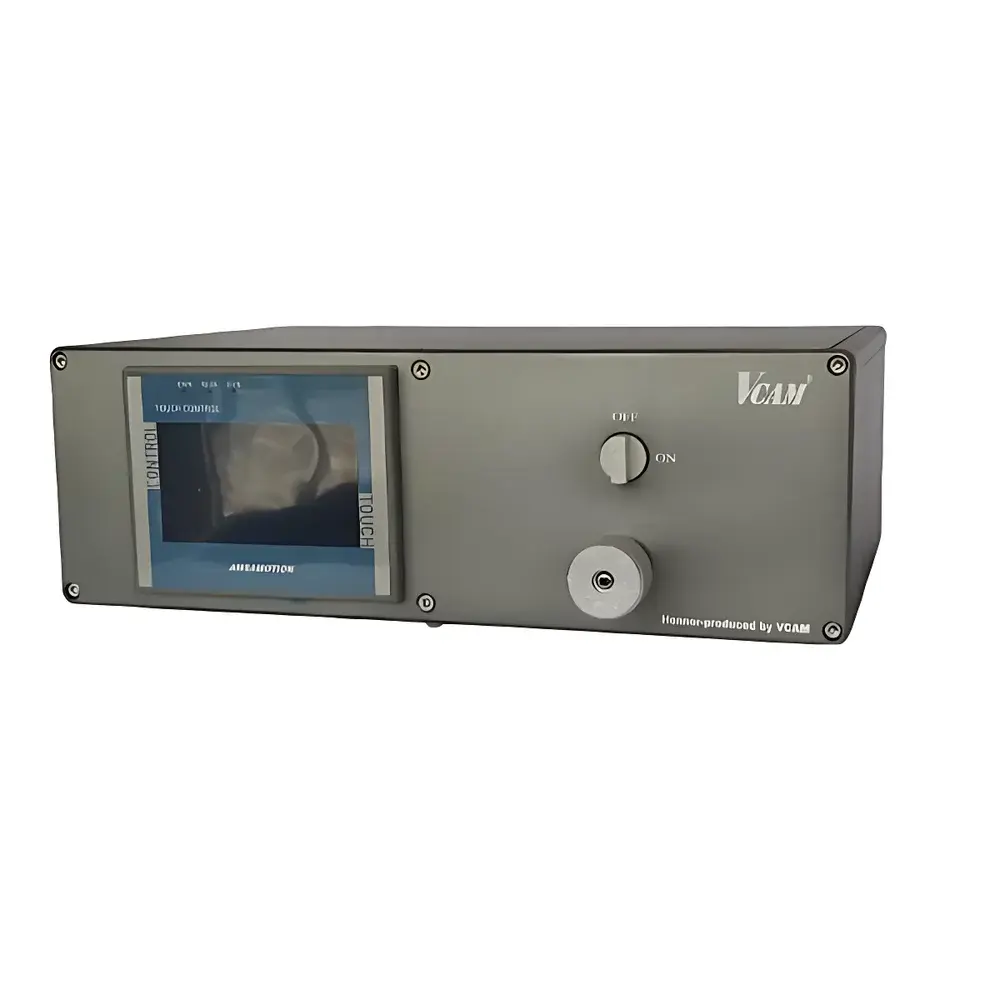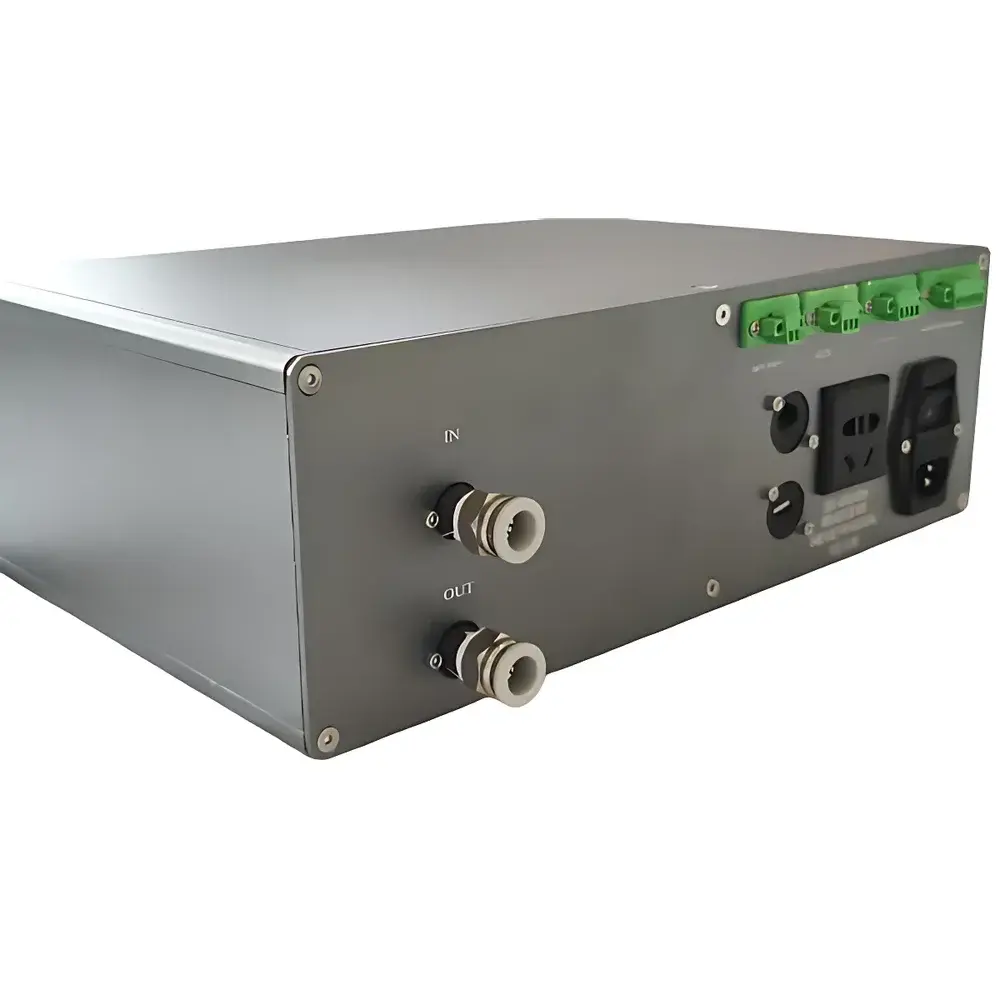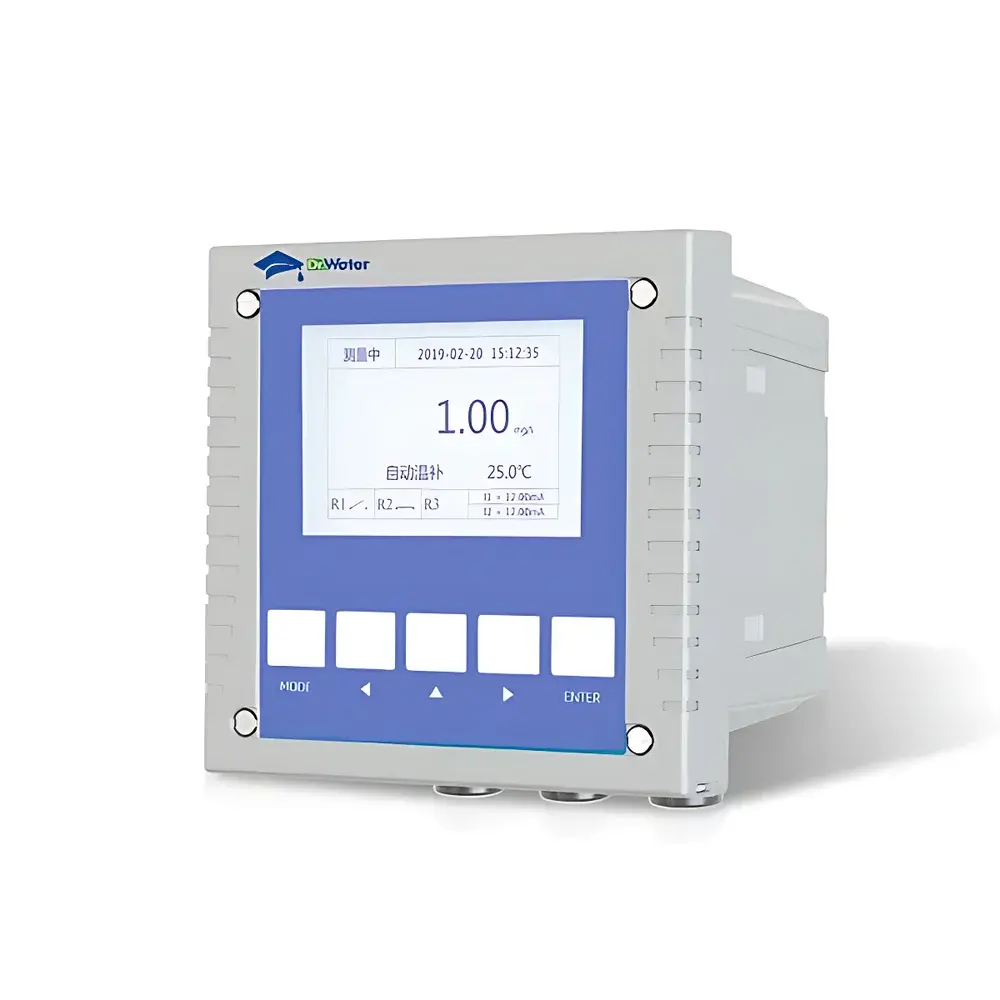
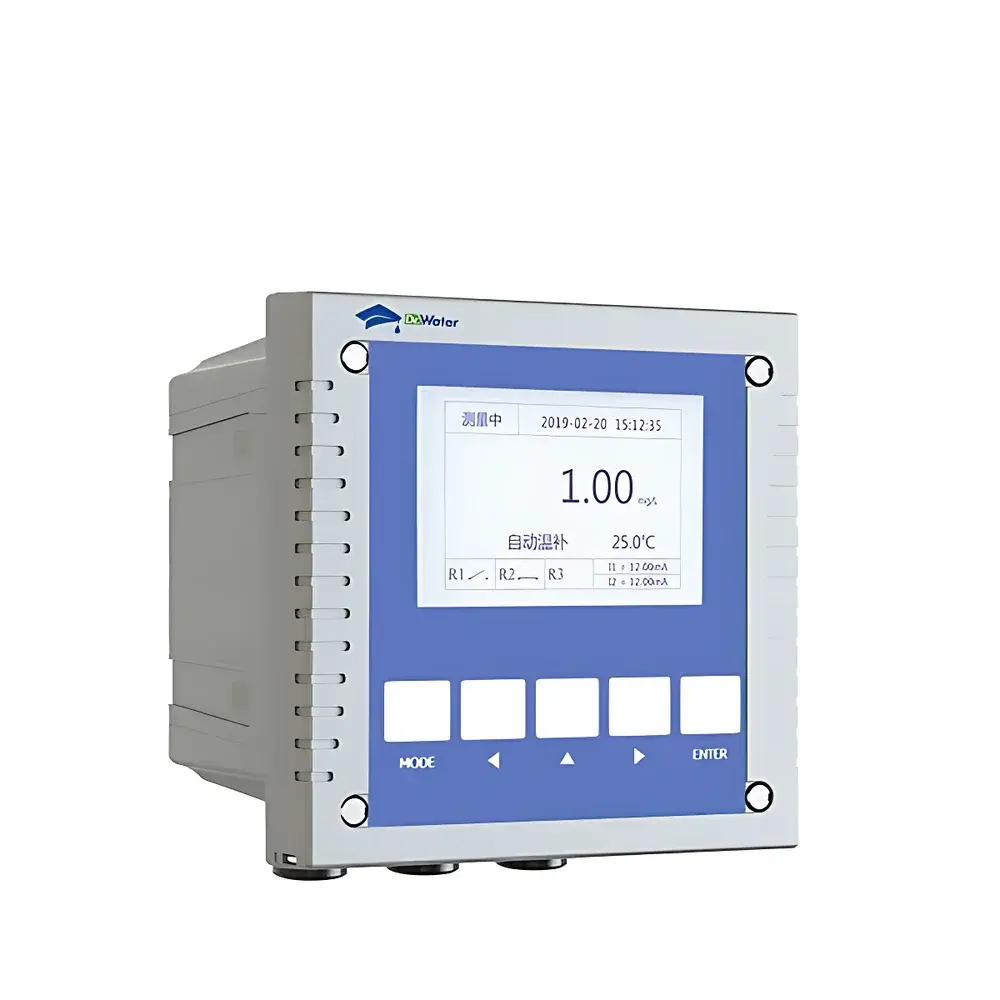
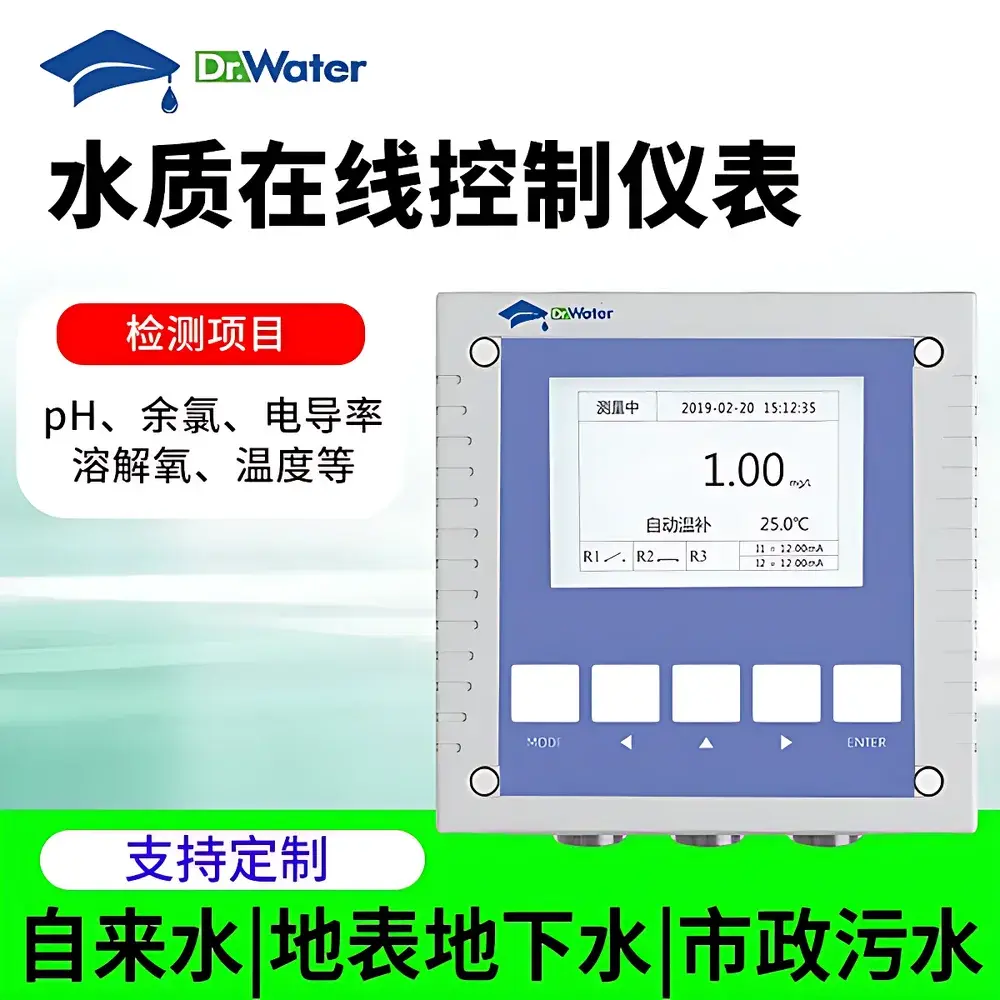
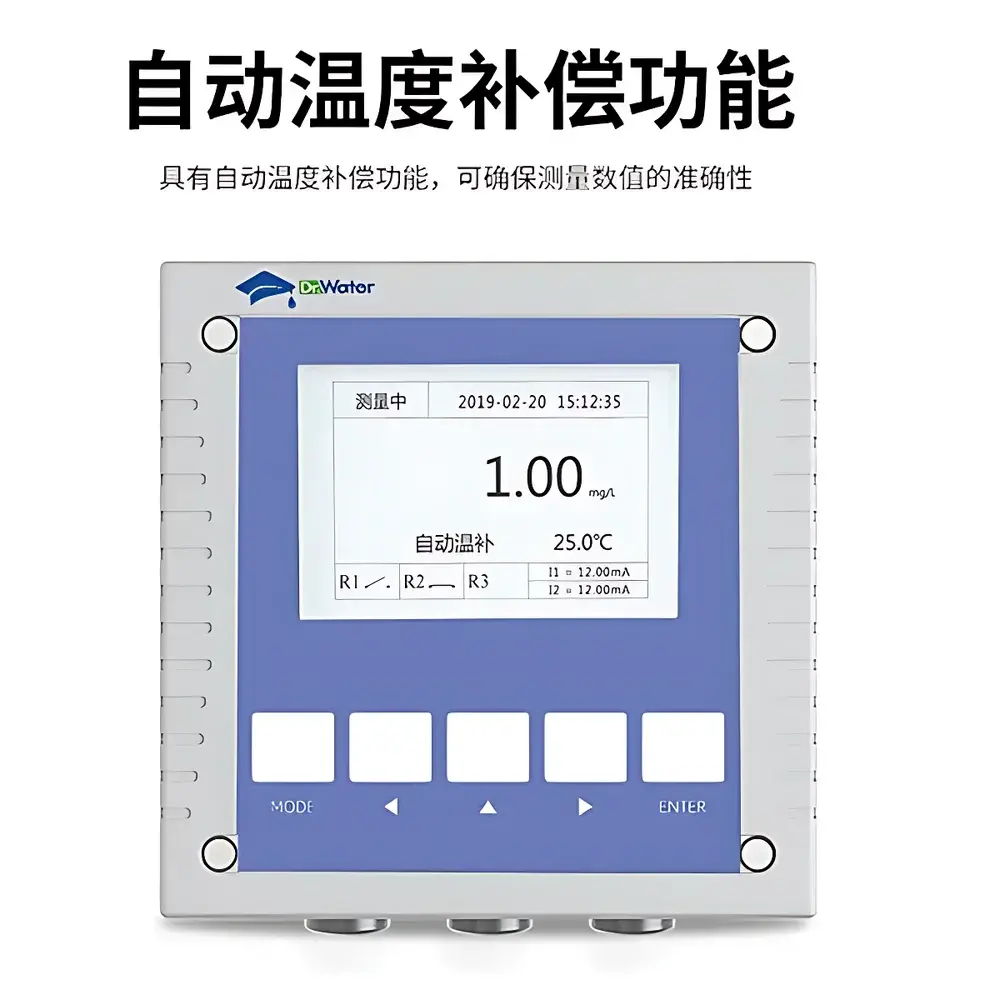
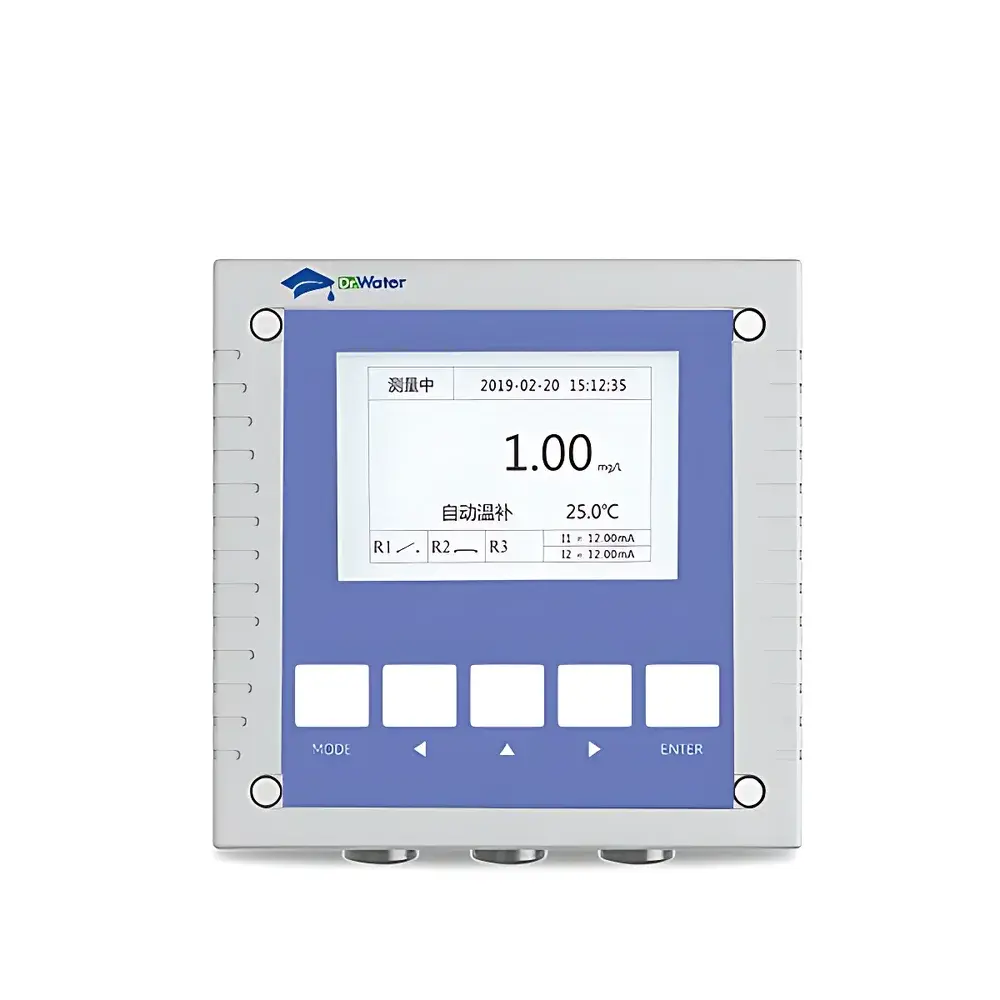
Dr-W390 Multi-Parameter Online Water Quality Controller by DoctorWater
| Brand | DoctorWater |
|---|---|
| Model | Dr-W390 |
| Measurement Parameters | pH (0–14), Residual Chlorine (0–2 / 0–20 mg/L), Dissolved Oxygen (0–20 mg/L), Conductivity (0–2000 / 0–20000 µS/cm), Temperature (0–60 °C) |
| Conductivity Range | 0–2000 µS/cm, 0–20000 µS/cm |
| Temp. Range | 0–60 °C |
| Accuracy | ±2% F.S. (all parameters) |
| Conductivity Resolution | 0.01 µS/cm |
| Temp. Compensation | Automatic |
| Data Storage | 500,000 records |
| Output | Dual 4–20 mA (±0.05 mA accuracy), RS485 Modbus RTU |
| Relay Outputs | 1 multifunctional relay (cleaning/interval/error alarm), 2 controllable relays with adjustable delay |
| Update Interval | 1–60 s adjustable |
| Enclosure Rating | IP68 (electrode), IP65 (controller) |
| Max. Pressure Rating | up to 4 bar (conductivity sensor) |
| Cable Length | 5 m standard (customizable) |
Overview
The Dr-W390 Multi-Parameter Online Water Quality Controller is an integrated industrial process analyzer engineered for continuous, real-time monitoring of critical water quality parameters in demanding operational environments. Designed around a modular sensor architecture and embedded microprocessor-based signal conditioning, the Dr-W390 simultaneously acquires and processes analog signals from up to five independently connected electrochemical and physical sensors—including pH, residual chlorine (amperometric or DPD-based), dissolved oxygen (optical or polarographic), conductivity (two-range, four-electrode cell), and Pt1000 temperature probes. Its measurement principle relies on calibrated potentiometric (pH), amperometric (Cl₂), luminescence quenching (DO), and conductometric (σ) transduction—each digitized via 24-bit ADCs and corrected using NIST-traceable algorithms. The controller operates within a wide ambient temperature range (−10 to 50 °C) and supports pressure-rated sensor housings suitable for pressurized pipelines (up to 4 bar), making it suitable for raw water intake, potable distribution networks, municipal wastewater treatment plants, and high-integration industrial effluent monitoring stations.
Key Features
- Simultaneous multi-parameter acquisition with independent calibration routines per channel—enabling concurrent validation and drift correction without cross-channel interference.
- Automatic temperature compensation (ATC) implemented per parameter using embedded Pt1000 reference and polynomial correction coefficients compliant with ISO 7888 (conductivity) and ISO 10523 (pH).
- Dual isolated 4–20 mA current outputs with configurable scaling, smoothing filters (exponential moving average), and fault signaling (e.g., open-circuit or out-of-range indication).
- Three programmable relay outputs: one multifunction relay supporting cleaning cycles, periodic maintenance alerts, and system fault notifications; two additional relays with user-defined time-delay logic for actuator control (e.g., dosing pump activation or valve sequencing).
- Onboard non-volatile memory storing 500,000 timestamped data points with UTC synchronization (via optional GPS or NTP gateway), supporting audit-ready data retention aligned with GLP and ISO/IEC 17025 documentation requirements.
- RS485 serial interface conforming to Modbus RTU protocol (slave ID 1–247), enabling seamless integration into SCADA, DCS, or PLC-based control infrastructures—fully compatible with industry-standard HMI configuration tools.
Sample Compatibility & Compliance
The Dr-W390 is validated for use with natural waters, treated drinking water, secondary-treated wastewater, cooling tower recirculation streams, and low-TDS industrial process water. Sensor configurations support flow-through, submersible, and insertion-type installations. All wetted materials comply with NSF/ANSI Standard 61 for potable water contact (EPDM seals, 316L stainless steel bodies, PEEK sensor housings). Electrical safety meets IEC 61000-6-2 (immunity) and IEC 61000-6-4 (emissions); enclosure rating is IP65 for the main controller unit and IP68 for all field-mounted electrodes. Calibration traceability follows ISO/IEC 17025-accredited reference standards, and firmware supports electronic record generation required under FDA 21 CFR Part 11 when paired with validated data acquisition software.
Software & Data Management
Data logging and configuration are managed via the local LCD interface (backlit, 128×64 monochrome) with full Chinese language support and optional English firmware. Remote configuration, real-time trend visualization, and historical export (CSV/Excel) are enabled through the DoctorWater PC Utility (Windows-based), which includes built-in validation reports, calibration certificate templates, and change-log auditing. All configuration changes, calibration events, and alarm triggers are automatically timestamped and stored with operator ID fields—supporting full GMP/GLP compliance workflows. Optional cloud connectivity (MQTT over Ethernet or 4G LTE) allows secure remote access via TLS 1.2-encrypted channels, with role-based user permissions and encrypted data-at-rest (AES-256).
Applications
- Municipal drinking water distribution: real-time residual chlorine and pH monitoring at booster stations and zone entry points.
- Wastewater treatment: DO profiling in aerobic basins, conductivity-based salinity tracking in tertiary filtration, and pH control in neutralization tanks.
- Industrial park centralized wastewater collection: multi-point surveillance of influent variability prior to pretreatment.
- Cooling water systems: early detection of microbiological activity (via DO drop + conductivity rise) and corrosion risk (pH excursion).
- Pharmaceutical facility PW/DI loops: conductivity verification per USP and temperature-compensated resistivity trending.
FAQ
Does the Dr-W390 support automatic sensor diagnostics and failure prediction?
Yes—it continuously monitors electrode impedance, signal noise ratio, and response time stability. Deviations beyond configurable thresholds trigger predictive maintenance alerts before measurement integrity is compromised.
Can the device be calibrated remotely via Modbus?
No—calibration requires physical access to initiate standard buffer/solution procedures per parameter; however, calibration coefficients, dates, and operator IDs are logged and reportable via Modbus register mapping.
Is the firmware upgradable in the field?
Yes—firmware updates are delivered via USB flash drive or Modbus file transfer protocol (MFTP), with checksum verification and rollback capability to ensure system integrity.
What is the maximum recommended cable length between the controller and conductivity sensor?
For optimal signal fidelity and noise immunity, the standard 5 m shielded twisted-pair cable is rated for full specification performance; custom lengths up to 50 m are supported with active signal conditioning modules (optional accessory).
How does the Dr-W390 handle temperature compensation for residual chlorine measurements?
It applies a dual-variable compensation model: first correcting for solution temperature (via integrated Pt1000), then applying a chemical reaction rate factor derived from Arrhenius kinetics—improving accuracy across seasonal ambient shifts in surface water applications.