


Dr-WCB Portable Turbidimeter by Doctor Water
| Brand | Doctor Water |
|---|---|
| Origin | Hunan, China |
| Model | Dr-WCB |
| Type | Portable Turbidimeter |
| Measurement Range | 0–20 NTU / 0–200 NTU / 0–1000 NTU |
| Resolution | 0.001 Abs |
| Accuracy | ≤ ±5% |
| Repeatability | ≤ ±2% |
| Optical Stability | ≤ ±0.005 Abs/20 min |
| Wavelength Range | 330–900 nm |
| Wavelength Accuracy | ±5 nm |
| Operating Temperature | 0–50 °C |
| Operating Humidity | 0–95% RH (non-condensing) |
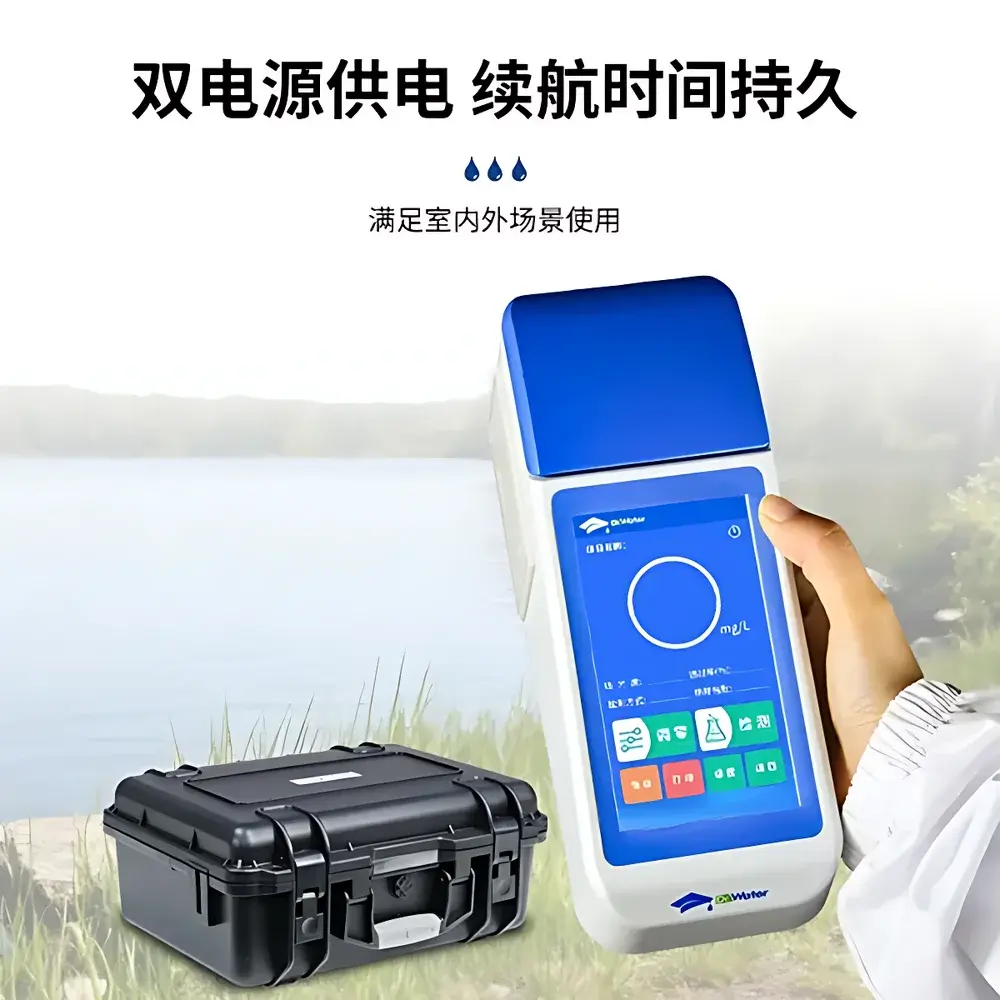
| Power | Dual AC/DC supply |
| Display | 5-inch HD color capacitive touchscreen |
| Sample Format | 16 mm and 25 mm round cuvettes |
| Light Source | Imported long-life cold LED source (>100,000 h) |
| Data Storage | Up to 1,000,000 measurement records |
| Interface | USB Type-C (charging + data transfer) |
| Printing | Integrated thermal printer |
| Readout Modes | Turbidity (NTU), Absorbance (Abs) |
| Housing Material | Corrosion- and heat-resistant ABS |
Overview
The Dr-WCB Portable Turbidimeter by Doctor Water is a precision optical instrument engineered for reliable in-field and laboratory turbidity quantification in accordance with national standard methodologies (e.g., GB/T 5750.4–2023 and ISO 7027:2016). It operates on the principle of nephelometric detection—measuring the intensity of light scattered at 90° by suspended particles in aqueous samples—ensuring compliance with internationally recognized turbidity measurement protocols. Its dual-range optical architecture (0–20 NTU, 0–200 NTU, and 0–1000 NTU) supports both low-turbidity drinking water verification and high-turbidity industrial effluent screening. The system integrates an auto-wavelength positioning optical detection module, coupled with a thermally stable imported cold LED source (rated >100,000 h), to minimize drift and maintain photometric integrity across extended operation cycles. Designed for rugged deployment, the instrument delivers consistent performance under ambient conditions from 0 to 50 °C and up to 95% relative humidity (non-condensing), making it suitable for mobile environmental monitoring, utility field audits, and quality control labs operating under GLP-aligned workflows.
Key Features
- 5-inch HD capacitive touchscreen with intuitive UI and seamless English/Chinese language switching
- Dual-core algorithm engine: combines interpolation and regression curve fitting for enhanced data fidelity and reduced calibration dependency
- Real-time initialization stability check: suppresses transient optical fluctuations during startup to prevent erroneous baseline readings
- Multi-mode turbidity measurement: selectable modes include Standard, Low-Turbidity (optimized for <5 NTU), Signal-Averaging (for noisy or particulate-laden samples), and Rapid Sedimentation Mode (for time-resolved settling kinetics)
- Integrated interference compensation algorithm: corrects for chromatic interference and optical attenuation caused by sample coloration or cuvette fouling
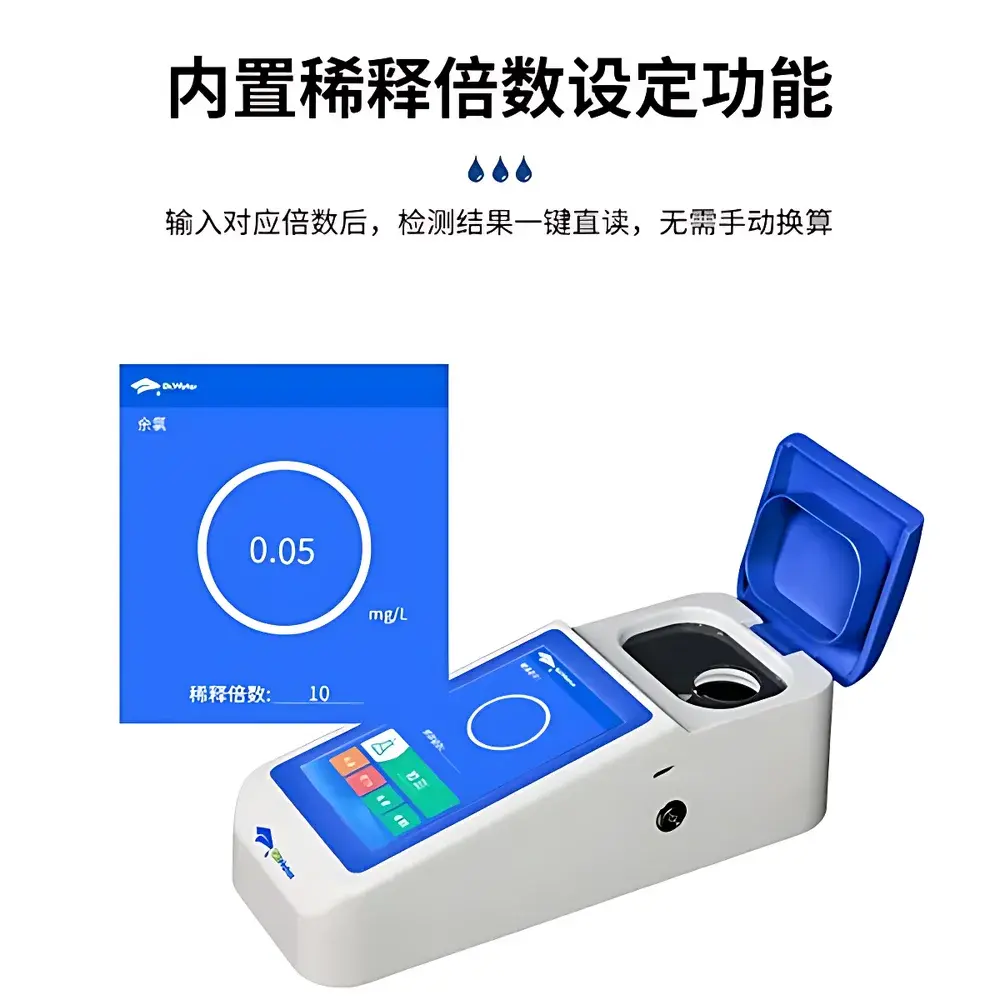
- On-device dilution factor programming: direct readout of undiluted sample concentration without manual calculation
- Configurable alarm thresholds: visual and audible alerts triggered when measured NTU exceeds user-defined limits
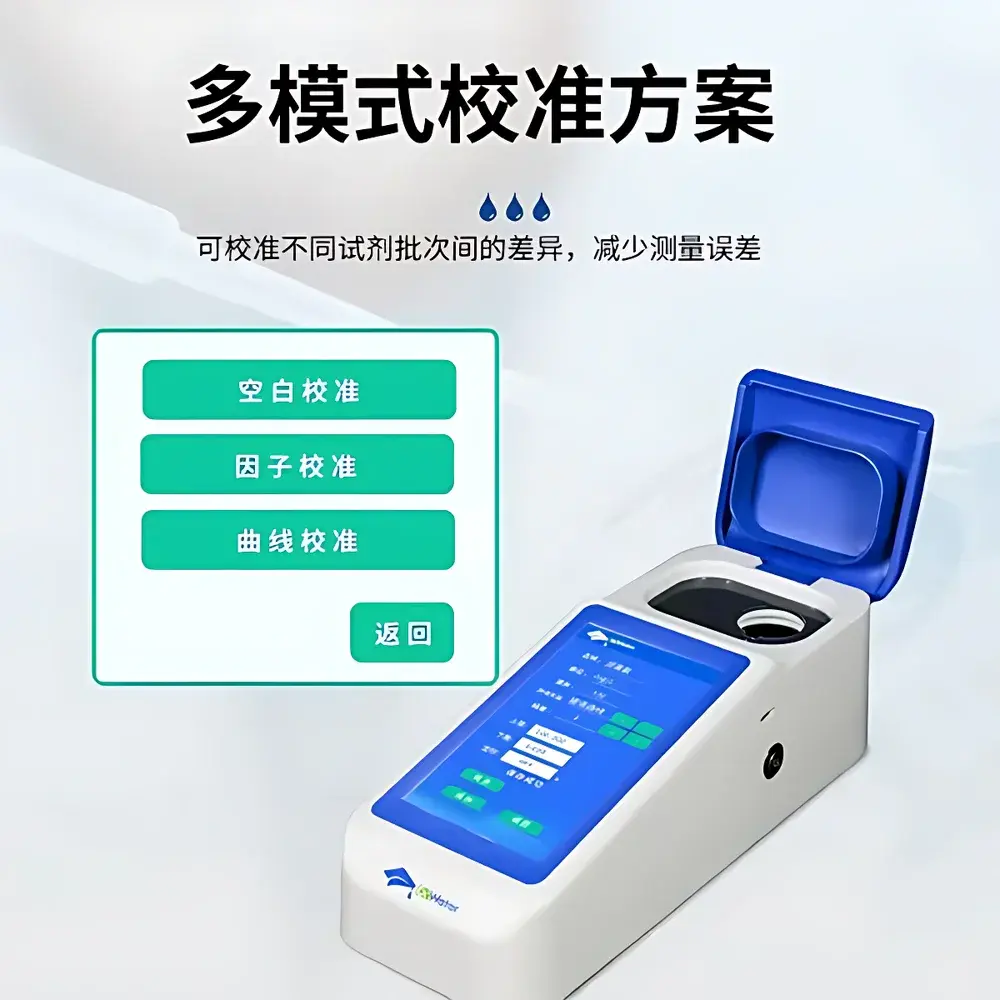
- Triple calibration flexibility: blank calibration, factor-based calibration, and multi-point curve calibration—supporting reagent lot traceability and inter-batch consistency verification
- Auto-diagnostic power management: real-time battery health monitoring with low-power warning and graceful shutdown protocol
Sample Compatibility & Compliance
The Dr-WCB accepts standard round glass or quartz cuvettes (16 mm and 25 mm outer diameter), ensuring compatibility with widely adopted sample handling protocols across municipal water utilities, pharmaceutical manufacturing, and food & beverage QA/QC laboratories. Its optical design adheres to the angular geometry requirements specified in ISO 7027 for formazin-based turbidity standards and supports verification against StablCal® or AMCO AEPA standards. While not certified to FDA 21 CFR Part 11 out-of-the-box, its audit-ready data logging—including timestamps, operator ID fields (via optional login), and immutable record storage—facilitates alignment with GLP and GMP documentation practices. All firmware operations are deterministic and repeatable, enabling full traceability for internal validation and third-party regulatory review.
Software & Data Management
Embedded firmware provides comprehensive local data handling: measurement acquisition, parameter configuration, calibration management, and report generation. Each stored record includes sample ID, date/time stamp, measurement mode, calibration status, operator tag (if enabled), and raw absorbance/turbidity values. With capacity for 1,000,000 entries, historical trends can be reviewed directly on-device or exported via USB Type-C to CSV or PDF formats. The integrated thermal printer supports on-site hardcopy reporting with embedded instrument ID and calibration validity indicators. No cloud dependency or proprietary software installation is required—data exchange is file-system-level and OS-agnostic (Windows/macOS/Linux compatible).
Applications
- Drinking water and municipal distribution system monitoring (compliance with WHO Guidelines and China’s GB 5749–2022)
- Wastewater treatment plant influent/effluent QC and sludge blanket profiling
- Pharmaceutical purified water (PW) and water-for-injection (WFI) pre-filtration verification
- Beverage production line clarity checks (e.g., bottled water, juices, carbonated drinks)
- Environmental field surveys: river, lake, and reservoir turbidity mapping
- Academic research on particle aggregation kinetics and coagulation efficiency studies
- Food processing hygiene validation (e.g., rinse water clarity post-CIP)
FAQ
What turbidity standards is the Dr-WCB calibrated against?
The instrument supports calibration using formazin suspension (FTU), StablCal®, or custom user-defined standards. Factory calibration is traceable to NIST-traceable reference materials.
Does the Dr-WCB meet ISO 7027:2016 requirements?
Yes—the optical path geometry, detector angle (90° ± 2.5°), and spectral bandwidth (centered at 860 nm with FWHM ≤ 60 nm) conform to ISO 7027:2016 specifications for ratio-based nephelometry.
Can the device store calibration curves for multiple reagent lots?
Yes—up to 10 independent calibration curves may be saved and recalled, each tagged with lot number, expiration date, and technician ID.
Is the thermal printer replaceable or serviceable in the field?
The integrated thermal print head is sealed and non-user-replaceable; however, consumable thermal paper rolls are standardized (57 mm width) and globally available.
How does the interference compensation algorithm function?
It applies real-time spectral correction using dual-wavelength absorbance ratios (e.g., 450 nm vs. 860 nm) to decouple color-induced scattering artifacts from true particle-derived turbidity signals.




