
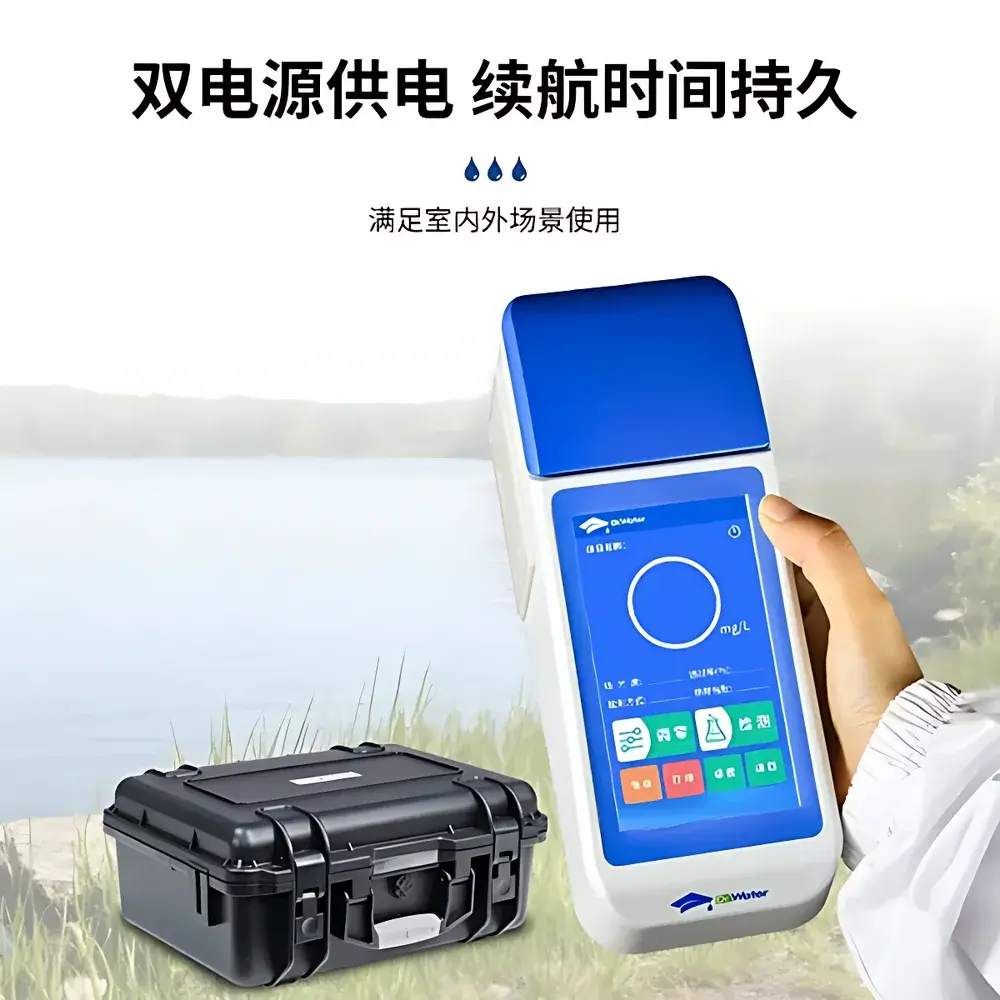
Dr-WCl Residual Chlorine and Chlorine Dioxide Analyzer by DoctorWater
| Brand | DoctorWater |
|---|---|
| Origin | Hunan, China |
| Model | Dr-WCl |
| Instrument Type | Portable |
| Measurement Principle | DPD Colorimetric Spectrophotometry |
| Measuring Parameter | Free Chlorine (Residual Chlorine) |
| Range | 0.02–2.00 mg/L |
| Accuracy | ≤ ±5% |
| Repeatability | ≤ ±2% |
| Resolution | 0.001 mg/L |
| LOD | 0.02 mg/L |
| Wavelength Range | 330–900 nm |
| Wavelength Accuracy | ±5 nm |
| Optical Stability | ≤ ±0.005 Abs/20 min |
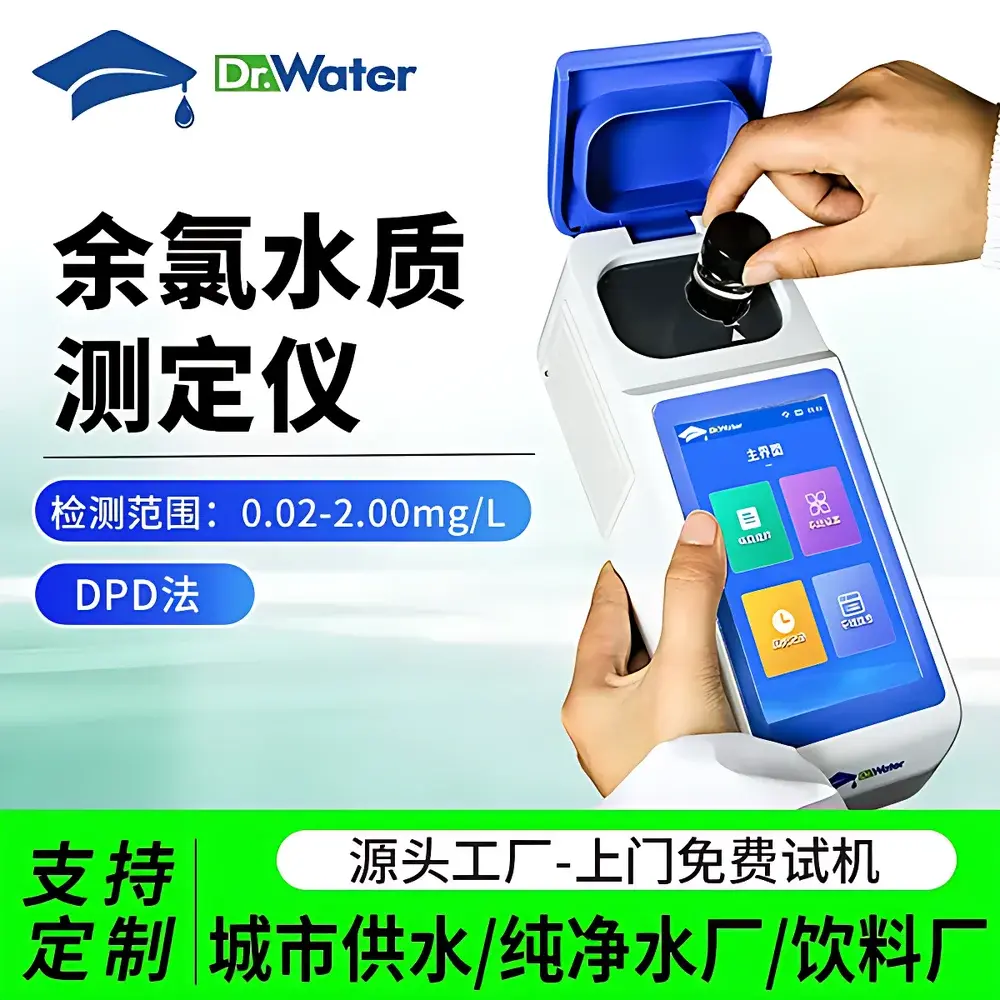
| Display | 5-inch HD color TFT touchscreen |
| Light Source | Imported long-life cold LED (≥100,000 h) |
| Sample Cell | 16 mm and 25 mm round cuvettes |
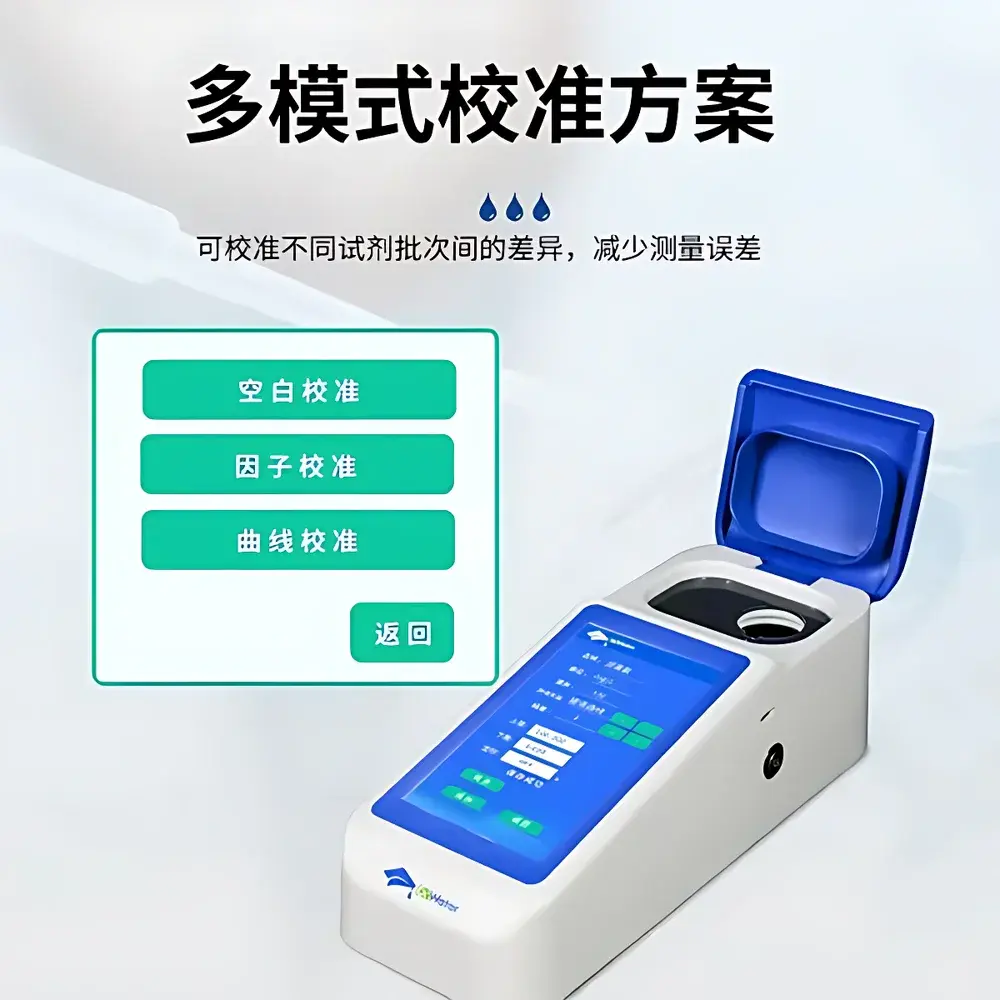
| Calibration Modes | Blank, Factor, and Calibration Curve |
| Data Storage | Up to 1,000,000 records |
| Power Supply | Rechargeable Li-ion battery + AC adapter |
| Interface | USB Type-C (charging & data transfer) |
| Print Output | Built-in thermal printer |
| Readout Modes | Concentration (mg/L) and Absorbance (Abs) |
| Housing Material | Corrosion- and heat-resistant ABS |
Overview
The Dr-WCl Residual Chlorine and Chlorine Dioxide Analyzer is a field-deployable, multi-parameter spectrophotometric instrument engineered for regulatory-compliant measurement of free chlorine in drinking water, distribution systems, swimming pools, wastewater effluents, and process streams. It operates on the standardized N,N-diethyl-p-phenylenediamine (DPD) colorimetric method—aligned with ISO 7393-2, EPA Method 334.0, and GB/T 5750.11–2023—where free chlorine oxidizes DPD to form a stable pink-colored quinoneimine dye, quantified via absorbance at wavelengths between 515 nm and 530 nm. The analyzer integrates an automatic wavelength positioning optical system with high-stability cold LED illumination (≥100,000 h lifetime), precision interference filters, and real-time photometric drift compensation to ensure metrological integrity across extended operational cycles. Its dual-mode detection architecture supports both direct concentration readout and raw absorbance output, enabling traceable validation against reference standards and facilitating method verification per ISO/IEC 17025 requirements.
Key Features
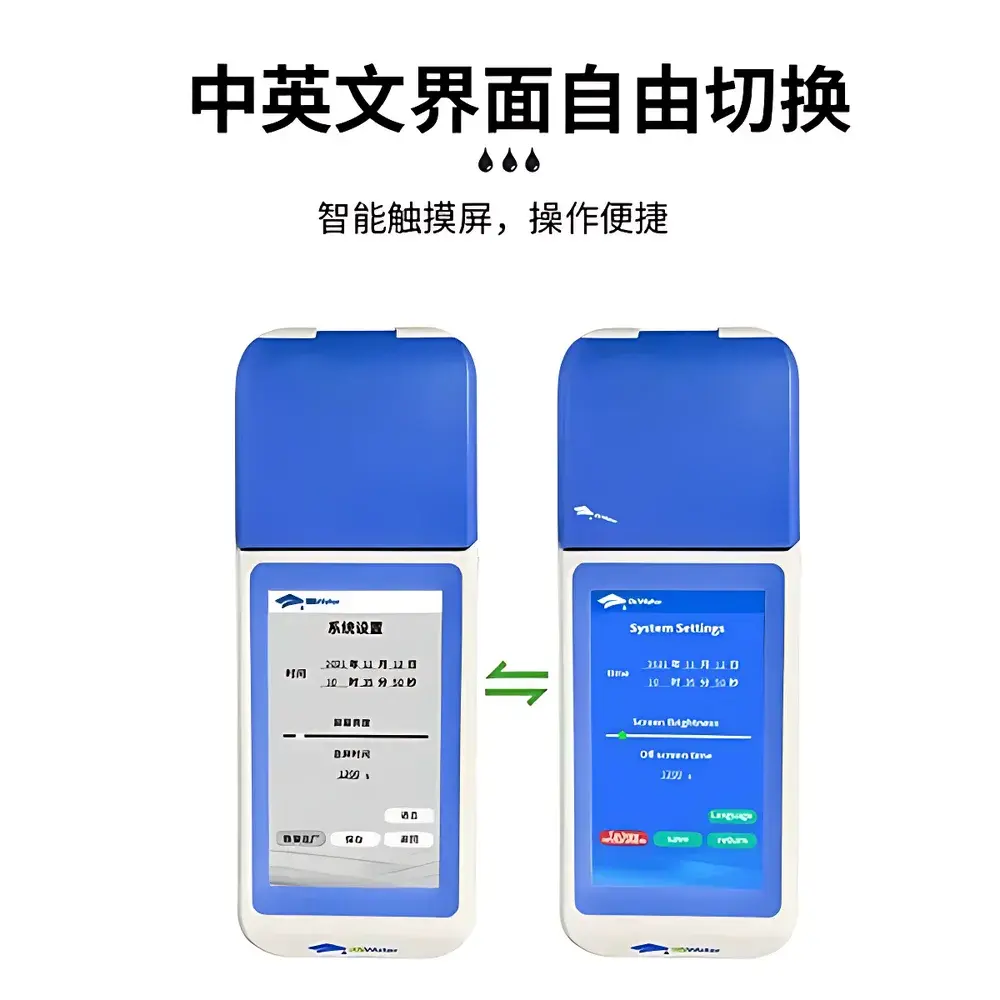
- 5-inch high-resolution color TFT touchscreen with intuitive icon-driven UI and seamless English/Chinese language switching
- Automatic initialization stability check that suppresses transient photometric noise during warm-up phase
- Dual-algorithm processing engine combining polynomial interpolation and least-squares regression curve fitting for enhanced linearity and outlier rejection
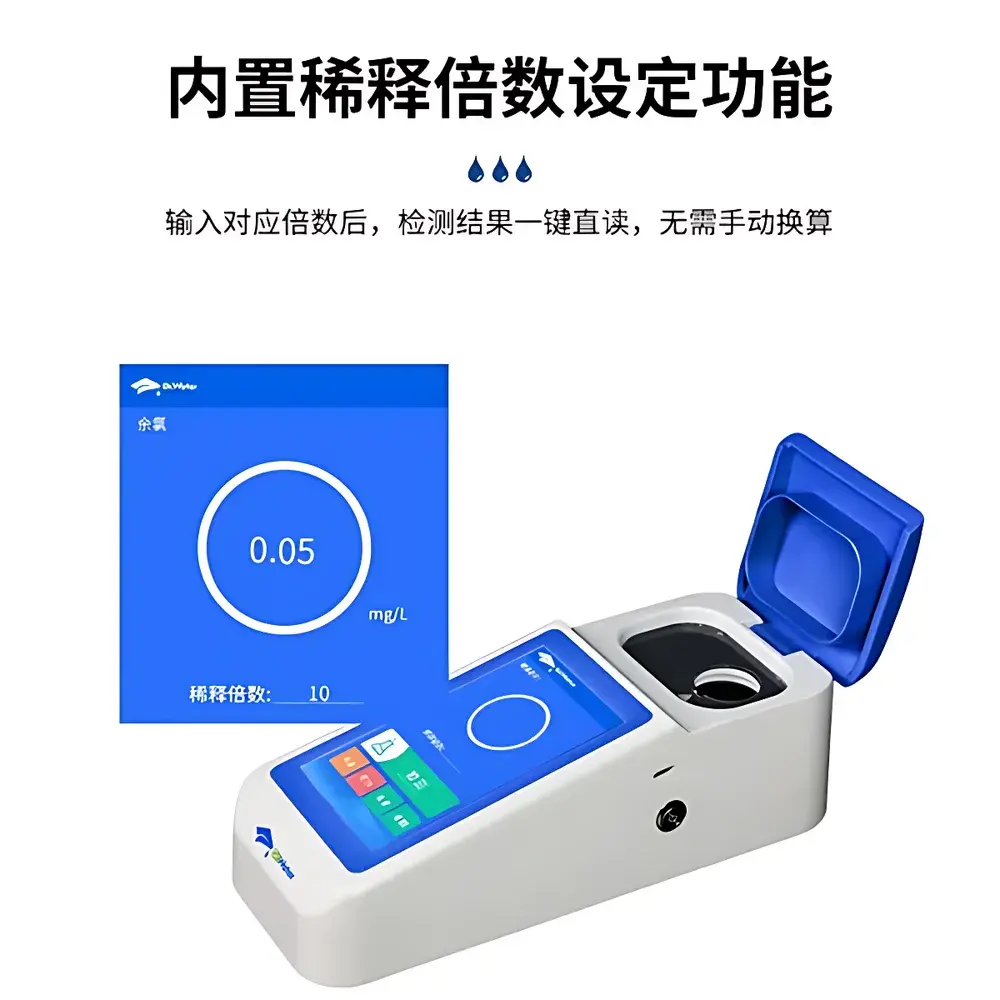
- On-device dilution factor input: enter sample dilution ratio and obtain corrected concentration directly—no manual calculation required
- Programmable timed measurement mode for unattended operation in continuous monitoring or batch screening workflows
- Triple calibration flexibility: blank calibration (zero offset correction), factor calibration (slope adjustment), and full multi-point calibration curve generation
- User-definable alarm thresholds with visual and audible alerts upon exceedance—supporting proactive compliance management
- Interference compensation algorithm mitigating spectral artifacts from color, turbidity, and photometric attenuation—validated against colored humic acid and kaolin suspension matrices
- Multi-mode turbidity analysis: standard, low-turbidity (0.1–10 NTU), signal-averaged (for unstable samples), and rapid sedimentation (for flocculant settling studies)
- USB Type-C interface supporting simultaneous charging and encrypted data export—compatible with Windows-based LIMS integration frameworks
Sample Compatibility & Compliance
The Dr-WCl accommodates standard 16 mm and 25 mm round glass or quartz cuvettes, ensuring compatibility with globally accepted DPD reagent kits (e.g., Hach, Palintest, Merck). Its optical design meets ISO 8466-1 requirements for calibration function linearity and ASTM D1253-22 specifications for residual chlorine assay sensitivity. The instrument’s performance validation protocol includes repeatability testing per ISO 5725-2, accuracy verification against NIST-traceable chlorine standards (SRM 3191a), and robustness assessment under variable ambient lighting and temperature (10–40 °C). While not FDA 21 CFR Part 11–certified out-of-the-box, its audit trail–capable firmware architecture supports configuration for GLP/GMP environments when paired with validated SOPs and electronic signature workflows.
Software & Data Management
Embedded firmware delivers full-cycle data lifecycle control: real-time measurement, parameter configuration, calibration archiving, and timestamped record storage. All 1,000,000 measurement entries include metadata—operator ID, date/time, cuvette ID, calibration version, and environmental conditions (if external sensor inputs are enabled). Data export via USB Type-C yields CSV-formatted files compliant with LIMS ingestion protocols (e.g., LabWare, STARLIMS). Optional PC software provides trend visualization, statistical summary (mean, SD, CV%), and QC charting (X-bar/R charts) aligned with ISO 8258. Thermal printing supports on-site reporting with embedded instrument ID, calibration status, and measurement uncertainty estimates.
Applications
The Dr-WCl serves as a primary verification tool in municipal water utilities for routine free chlorine residual monitoring at entry points, storage tanks, and endpoint taps. It supports emergency response teams during contamination events by delivering on-site results within 90 seconds per sample. In regulated manufacturing settings—including pharmaceutical water-for-injection (WFI) loops, beverage production lines, and dialysis centers—it fulfills periodic verification requirements per USP , EP 2.2.43, and ISO 14644-1. Environmental laboratories use it for field validation of online amperometric sensors, while public health agencies deploy it for epidemiological surveillance of disinfection byproduct precursors in source waters.
FAQ
What regulatory methods does the Dr-WCl comply with?
It implements DPD-based methodology conforming to ISO 7393-2, EPA Method 334.0, and Chinese national standard GB/T 5750.11–2023.
Can the instrument measure total chlorine or combined chlorine?
No—the Dr-WCl is optimized for free (residual) chlorine; total chlorine requires additional iodide-mediated oxidation steps not supported in its current firmware.
Is external calibration verification required before each use?
Blank and factor calibrations are recommended daily; full multi-point curve calibration is advised weekly or after reagent lot changes.
How is optical drift compensated during extended field use?
The system performs automatic zero-tracking every 20 minutes and applies real-time baseline correction using internal reference photodiodes.
Does the device support network connectivity or cloud upload?
Not natively—data transfer is USB-only; however, exported CSV files integrate seamlessly with enterprise cloud platforms via middleware scripts.







