
DR280 Coating Thickness Gauge for Zinc, Paint & Anti-Corrosion Coatings
| Brand | Fangyuan Instruments |
|---|---|
| Origin | Guangdong, China |
| Manufacturer Type | Authorized Distributor |
| Country of Manufacture | China |
| Model | DR280 |
| Price | USD 225 (FOB Guangdong) |
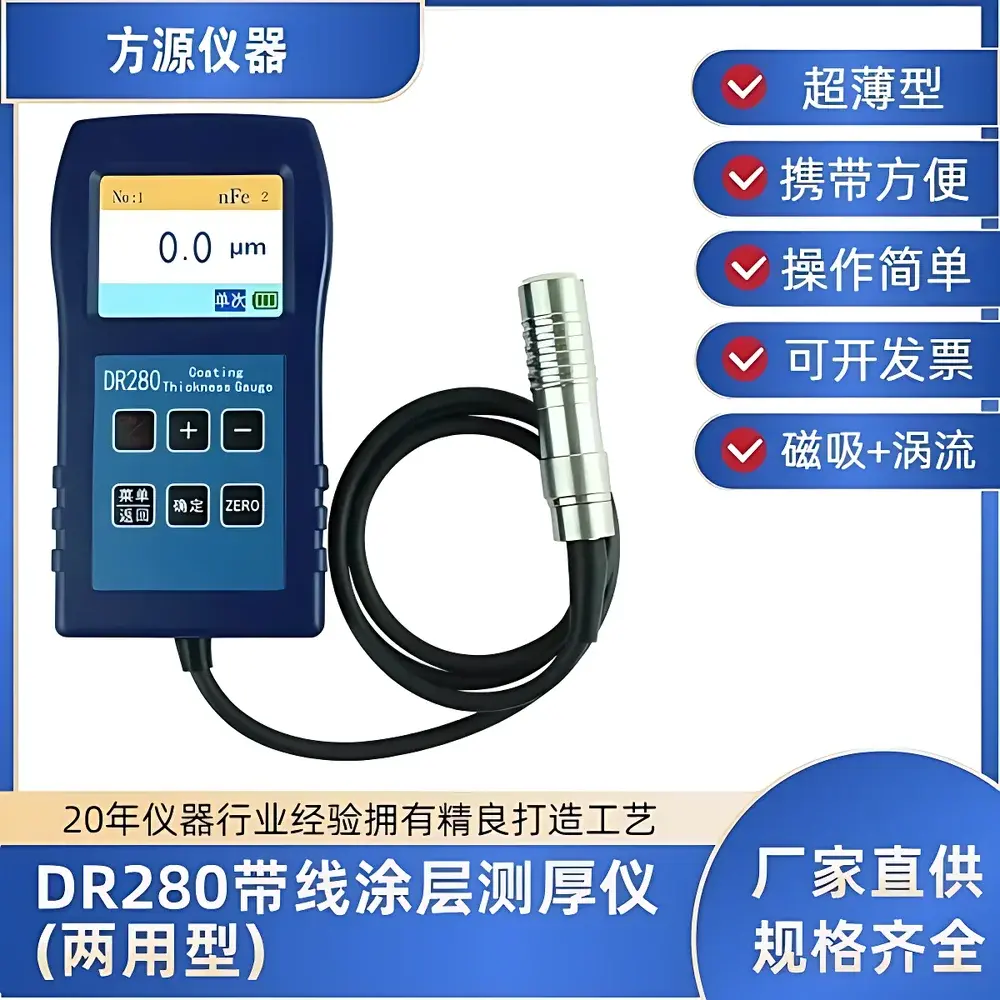
| Measurement Principle | Magnetic Induction (Fe) & Eddy Current (Non-Fe) |
| Resolution | 0.1 µm |
| Repeatability | ±(1% + 1 µm) |
| Measurement Speed | ≤0.3 s per reading |
| Temperature Compensation | Built-in real-time compensation algorithm |
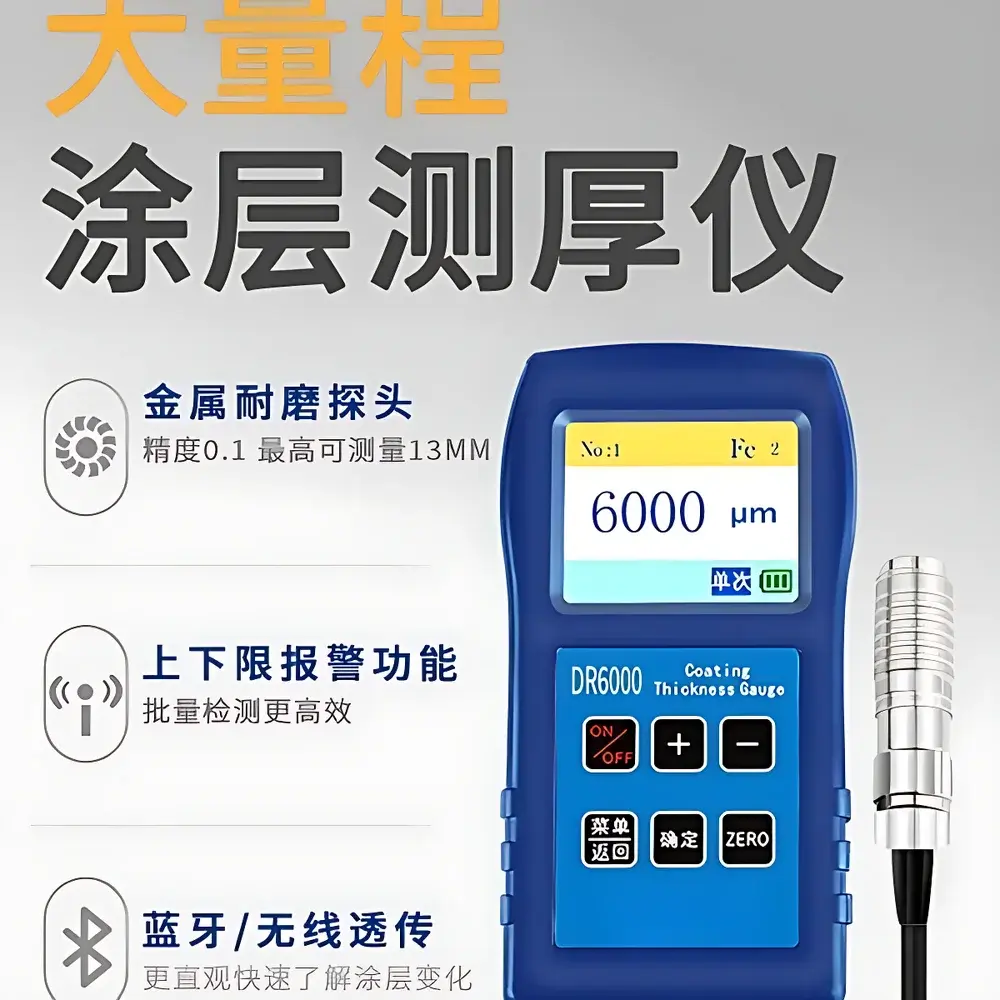
| Max. Measurable Thickness | 6000 µm (6 mm) |
| Display | High-contrast LCD with backlight |
| Data Storage | 1000+ readings (non-volatile memory) |
| Calibration | Factory-calibrated per ISO 2178 & ISO 2360 |
| Compliance | Meets ASTM D7091 and GB/T 4956–2012 requirements |
Overview
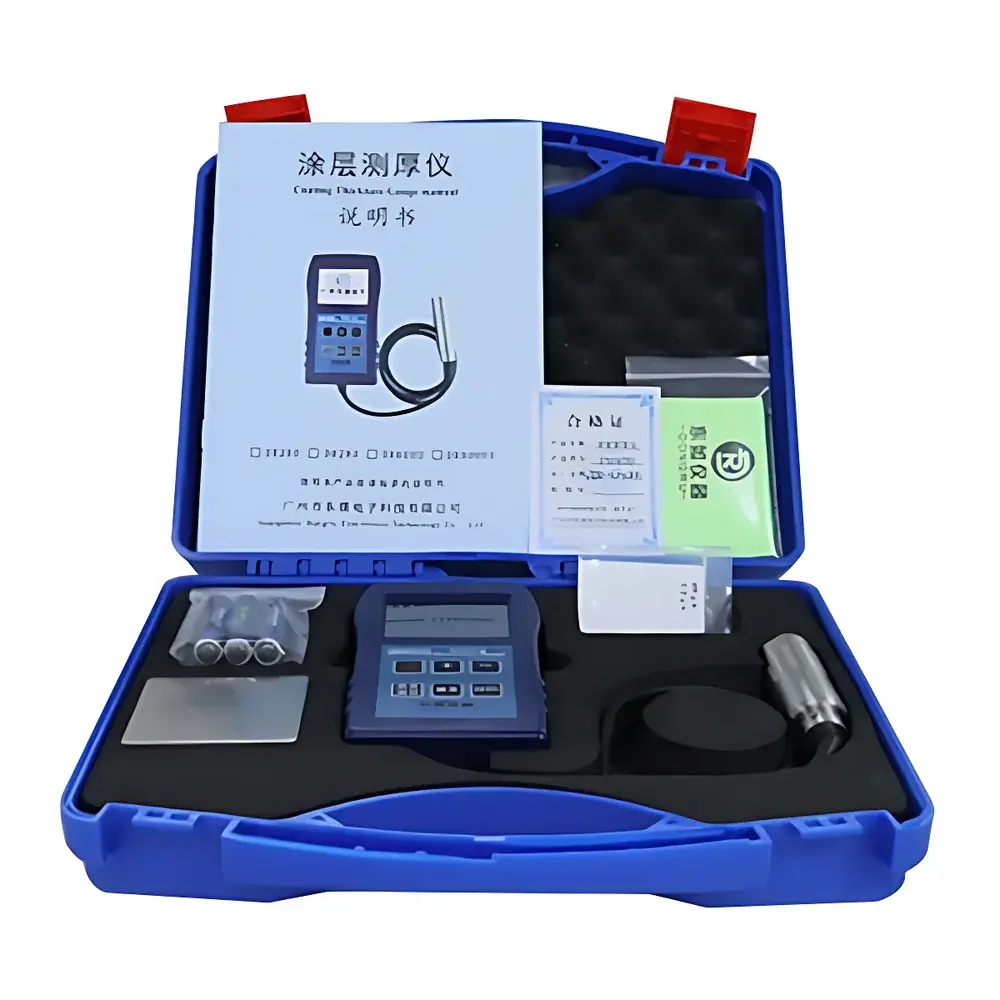
The DR280 Coating Thickness Gauge is a dual-mode, handheld instrument engineered for precise, non-destructive measurement of non-magnetic coatings on ferrous substrates (e.g., zinc, epoxy, polyurethane on steel) and non-conductive coatings on non-ferrous metals (e.g., anodized layers, paint on aluminum). It operates on two well-established physical principles: magnetic induction (per ISO 2178) for Fe-based substrates and eddy current (per ISO 2360) for non-ferrous conductive substrates. Designed for field and shop-floor use in quality control, maintenance inspection, and coating process validation, the DR280 delivers laboratory-grade repeatability under variable ambient conditions—enabled by its proprietary real-time temperature compensation algorithm and high-stability analog front-end architecture.
Key Features
- Dual-sensor platform supporting simultaneous calibration and measurement on both ferrous (steel, iron) and non-ferrous (aluminum, copper, stainless steel) substrates without manual mode switching.
- 0.1 µm resolution with typical repeatability of ±(1% + 1 µm) across the full 0–6000 µm range—verified per ASTM D7091 Annex A2 precision protocols.
- Sub-300 ms single-point measurement cycle, optimized for high-throughput inspection in production line environments or multi-point surveying on large structures (e.g., bridges, pipelines, wind turbine towers).
- Integrated temperature compensation logic continuously adjusts sensor output based on thermal drift of probe coil resistance and substrate conductivity—critical for measurements conducted between 0 °C and 50 °C.
- Rugged IP54-rated housing with rubberized grip and scratch-resistant sapphire window; designed to withstand incidental drops from 1.2 m onto concrete (IEC 60068-2-32 compliant shock testing).
- Factory-calibrated traceable to NIST-traceable reference standards; includes calibration certificate documenting as-received performance at three thickness points (50 µm, 500 µm, 3000 µm) on certified Fe and Al base plates.
Sample Compatibility & Compliance
The DR280 is validated for use on smooth, flat, or gently curved surfaces (minimum radius ≥25 mm). It supports common industrial coating systems including hot-dip galvanizing (HDG), electroplated zinc, liquid-applied epoxies, polyurethanes, acrylics, powder coatings, and anodized oxide films. Substrate requirements include minimum thickness ≥1 mm for ferrous bases and ≥0.5 mm for non-ferrous bases to ensure magnetic saturation or eddy current confinement. The instrument complies with ISO 2178 (magnetic methods), ISO 2360 (eddy current methods), ASTM D7091 (standard practice for nondestructive measurement of dry film thickness), and Chinese national standard GB/T 4956–2012. It is suitable for GLP-compliant documentation workflows when paired with optional PC software and audit-trail-enabled reporting.
Software & Data Management
The DR280 supports bidirectional USB-C data transfer to Windows-based PCs via included Fangyuan DataLink v3.2 software. This application enables statistical analysis (mean, SD, min/max, Cp/Cpk), customizable report generation (PDF/CSV/XLSX), batch calibration verification, and time-stamped measurement logging with operator ID fields. All stored readings retain metadata—including date/time stamp, substrate type flag (Fe/Non-Fe), probe serial number, and ambient temperature at time of acquisition—ensuring full traceability per FDA 21 CFR Part 11 and ISO/IEC 17025 documentation requirements. Firmware updates are delivered via signed binary packages to maintain integrity and version control.
Applications
- Quality assurance in galvanizing plants: verifying HDG coating mass per ASTM A123 and ISO 1461 compliance.
- Automotive OEM and Tier-1 suppliers: measuring e-coat and topcoat thickness on body-in-white and chassis components.
- Marine and offshore infrastructure: monitoring protective coating integrity during commissioning and in-service inspections.
- Aerospace MRO facilities: validating primer and topcoat thickness on aluminum airframes per Boeing D6-17487 and Airbus AITM 1-0002.
- Construction QA/QC: field verification of fireproofing intumescent coatings and corrosion-resistant systems on structural steel.
FAQ
Does the DR280 require periodic recalibration?
Yes—annual recalibration is recommended for metrological continuity. Users may perform daily verification using certified foil or step shims per ASTM D7091 Section 8. Full recalibration must be performed by an accredited lab or authorized service center.
Can the DR280 measure coatings on rough or blasted surfaces?
It is not recommended for profiles exceeding Sa 2.5 (ISO 8501-1); surface roughness >50 µm peak-to-valley may introduce systematic bias. For such cases, cross-sectional microscopy or ultrasonic gauging is advised.
Is the instrument compatible with third-party LIMS or SAP QM modules?
Yes—via CSV export with configurable delimiter and column mapping; custom API integration is supported through Fangyuan’s Developer SDK (available under NDA).
What probe options are available for curved or confined geometries?
Standard probe (Φ12 mm) is supplied; optional mini-probes (Φ6 mm) and right-angle probes are available for access-limited areas or small-diameter pipes (down to Ø15 mm).
Does the DR280 support statistical process control (SPC) output?
Yes—the DataLink software generates X̄-R charts, histogram distributions, and capability indices (Cp, Cpk) directly from measurement batches, exportable to industry-standard SPC platforms.



