

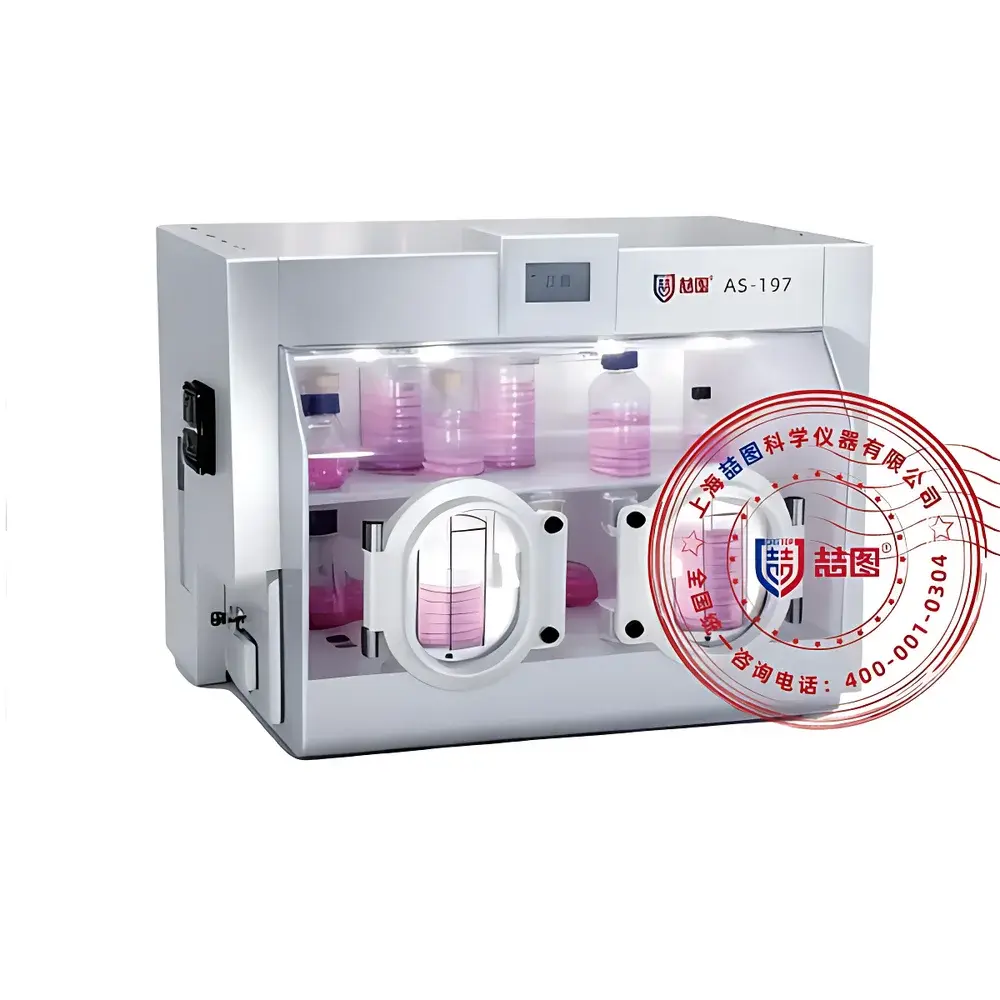
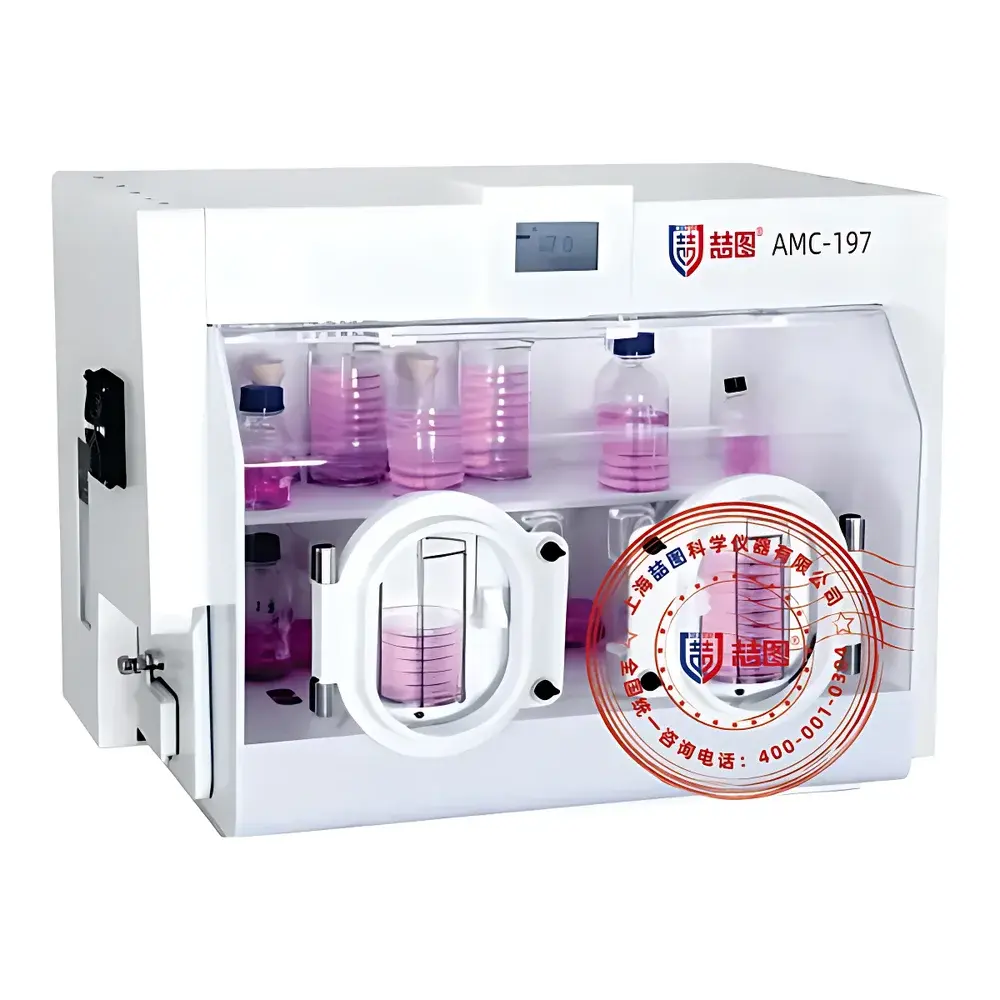
DRETOP AS-197 Multi-Mode Anaerobic Incubator
| Brand | DRETOP |
|---|---|
| Origin | Shanghai, China |
| Manufacturer Type | Direct Manufacturer |
| Instrument Type | Manual Anaerobic Incubator |
| Temperature Range | RT + 3°C to 52°C |
| Temperature Uniformity & Fluctuation | ±0.3°C |
| Humidity Range | 20–90% RH |
| O₂ Concentration Range | 0–100% |
| Gas Supply | Anaerobic gas mixture (80% N₂, 10% CO₂, 10% H₂) and pure N₂ |
| Chamber Dimensions (W×D×H) | 490 × 760 × 530 mm |
| O₂ Detection Resolution | 0.1% |
| O₂ Control Accuracy | ±0.1% |
| Catalyst Lifetime | >3 years without thermal activation |
| Anaerobic Equilibration Time | ≤30 min to ≤5 ppm O₂ |
| Transfer Lock Capacity | 6 L chamber (supports 22 × 90 mm Petri dishes or 3 × 500 mL screw-cap bottles) |
| UV Sterilization | 254 nm integrated lamp with programmable timing |
| Filtration | HEPA-grade air filtration system |
| Data Logging | 45-day internal history storage with USB export capability |
| Safety Interlocks | Dual-door pneumatic seal with vacuum-assisted gasket, mechanical/electronic interlock logic |
| Validation Interface | Standardized 4–20 mA / RS485 ports for third-party probe integration |
| Operating System | Bilingual (Simplified Chinese & English), three-tier user permission management |
Overview
The DRETOP AS-197 Multi-Mode Anaerobic Incubator is an engineered environmental control platform designed for precise cultivation and physiological characterization of obligate anaerobes, facultative anaerobes, microaerophiles, and oxygen-sensitive cell lines. Unlike conventional single-mode anaerobic chambers, the AS-197 implements a closed-loop, sensor-driven gas modulation architecture based on real-time feedback from electrochemical O₂ sensors, NDIR CO₂ sensors, capacitive humidity sensors, and high-stability PT100 temperature probes. Its core operational principle relies on catalytic hydrogen-mediated oxygen scavenging—where H₂ and residual O₂ react over a palladium-based catalyst at ambient temperature to form water—enabling rapid (<30 min), reproducible establishment of ultra-low-oxygen environments (≤5 ppm O₂). The system supports three distinct operational modes: strict anaerobiosis (O₂ ≤5 ppm), microaerophilic conditions (O₂ = 1–10%), and programmable gradient oxygen profiles—making it suitable for studies in gut microbiota metabolism, wound infection modeling, biofilm development under hypoxia, and stem cell niche simulation.
Key Features
- Triple-sensor environmental regulation: Independent closed-loop control of O₂ (0–100%, resolution 0.1%), CO₂ (0–20%), temperature (RT+3°C to 52°C, ±0.3°C uniformity), and relative humidity (20–90% RH)
- Catalyst-integrated anaerobic generation: Cold-catalysis system eliminates need for pre-activation; certified >3-year service life under continuous operation
- Pneumatically sealed transfer lock: 6 L dual-door chamber with PLC-controlled inflatable gasket, vacuum-assisted purge cycle, and hardware-enforced interlock preventing simultaneous door opening
- Direct-access operation interface: Optional sleeve-free entry port enables bare-hand manipulation without vacuum/nitrogen purging—reducing gas consumption by up to 65% versus traditional glovebox workflows
- Intelligent moisture management: Self-regulating condensate removal system channels excess water into a dedicated sump reservoir with automatic overflow protection
- Bilingual, role-based touchscreen HMI: 4.3-inch color LCD with configurable user permissions (admin/operator/observer), audit-trail-enabled parameter logging, and firmware-upgradable architecture
- Integrated biosafety infrastructure: 254 nm UV-C lamp with timer-based sterilization cycles, HEPA-filtered recirculated airflow (≥99.97% @ 0.3 µm), and LED interior illumination optimized for visual inspection under low-oxygen conditions
Sample Compatibility & Compliance
The AS-197 accommodates standard microbiological formats including 90 mm Petri dishes (up to 22 per transfer cycle), 500 mL blue-cap bottles, 250 mL Erlenmeyer flasks, and sterile homogenization bags. Its chamber geometry (490 × 760 × 530 mm) permits vertical stacking of multi-tier culture racks while maintaining laminar airflow distribution. From a regulatory standpoint, the incubator supports GLP-compliant workflows through its built-in data integrity features: timestamped parameter records (temperature, humidity, O₂, CO₂, gas injection duration), USB-exportable CSV logs, and third-party validation ports compatible with NIST-traceable thermistors, hygrometers, and trace-gas analyzers. While not certified to ISO 13485 or FDA 21 CFR Part 11 out-of-box, its architecture meets foundational requirements for electronic record retention—including write-protection of historical data, operator ID tagging, and immutable event timestamps—facilitating internal SOP alignment with USP , ISO/IEC 17025, and EU Annex 11 expectations.
Software & Data Management
The embedded controller firmware provides native support for continuous parameter acquisition at 10-second intervals, storing up to 45 days of time-series data onboard. All logged variables—including chamber temperature, relative humidity, O₂ %, CO₂ %, door status, gas injection events, and alarm triggers—are accessible via intuitive menu navigation and exportable in comma-separated format via USB 2.0 port. The system includes a validation-ready interface supporting analog (4–20 mA) and digital (RS485 Modbus RTU) inputs for external calibration probes. Audit trail functionality captures user login/logout sequences, parameter modification events, and calibration actions with associated timestamps and operator IDs—enabling reconstruction of experimental conditions during QA review or regulatory inspection. Firmware updates are performed offline via USB stick, preserving configuration integrity across revisions.
Applications
- Cultivation and isolation of obligate anaerobes such as Clostridium difficile, Bacteroides fragilis, and Fusobacterium nucleatum for clinical diagnostics and antibiotic susceptibility testing
- Microbiome research requiring controlled O₂ gradients to model intestinal crypt physiology or periodontal pocket microenvironments
- Host–pathogen interaction studies under physiologically relevant hypoxic conditions (e.g., Helicobacter pylori adaptation, Pseudomonas aeruginosa biofilm maturation)
- Stem cell expansion protocols where transient hypoxia enhances pluripotency marker expression and reduces oxidative stress
- Industrial fermentation process development involving anaerobic biocatalysts (e.g., syngas fermentation, dark hydrogen production)
- Environmental microbiology applications including sulfate-reducing bacteria enrichment and methanogenic consortia maintenance
FAQ
What gas mixtures are required for anaerobic mode operation?
The system requires two independent gas supplies: (1) an anaerobic premix (80% N₂, 10% CO₂, 10% H₂) for initial deoxygenation and catalyst reactivation, and (2) high-purity nitrogen (≥99.998%) for routine purging and transfer lock operation.
Can the AS-197 be validated for GMP environments?
Yes—the unit includes dedicated validation interfaces (4–20 mA analog inputs, RS485), full parameter logging with operator attribution, and hardware-level door interlocks. Users must perform IQ/OQ/PQ using qualified third-party probes and document procedures per internal SOPs aligned with ISO 13485 or FDA guidance.
How often does the catalyst require replacement?
Under normal usage (daily cycling, proper gas purity, avoidance of sulfur-containing media), the palladium catalyst maintains ≤5 ppm O₂ performance for ≥36 months without thermal regeneration.
Is remote monitoring supported?
No native Ethernet or Wi-Fi connectivity is provided; however, the USB data export and RS485 interface enable integration with facility-wide SCADA or LIMS platforms via external gateway hardware.
What safety mechanisms prevent accidental oxygen ingress during sample transfer?
The transfer lock employs a triple-layer safeguard: (1) vacuum-assisted gasket sealing, (2) mandatory nitrogen purge sequence before inner door release, and (3) hardwired interlock that physically disables inner door actuation unless purge cycle completes successfully.
Related Products



