

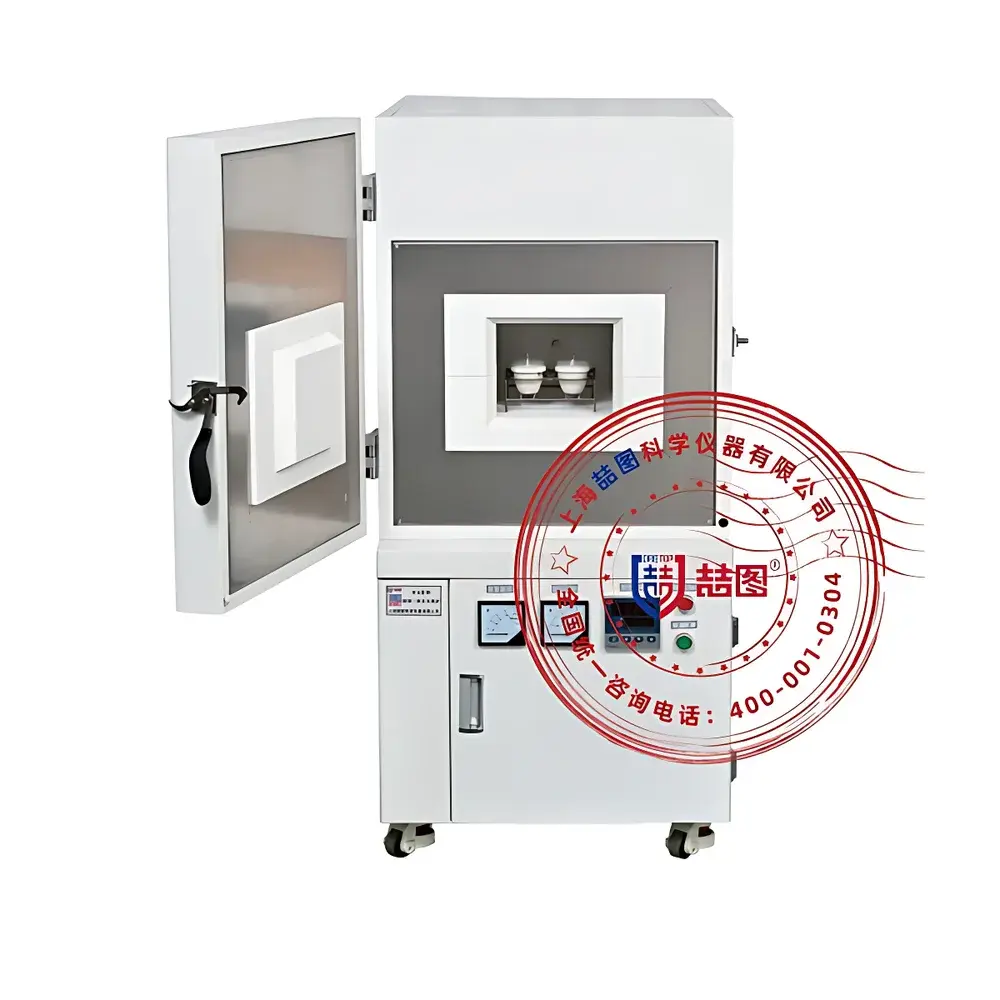
DRETOP B18-9AI Programmable Integrated High-Temperature Muffle Furnace
| Brand | DRETOP |
|---|---|
| Origin | Shanghai, China |
| Manufacturer | Yes |
| Product Type | Box-Type Muffle Furnace |
| Model | B18-9AI |
| Max Temperature | 1800 °C |
| Temperature Control Accuracy | ±1 °C |
| Max Power | 12 kW |
| Heating Time to Max Temp | 70 min |
| Heating Element | Silicon-Molybdenum Rod (MoSi₂) |
| Internal Chamber Dimensions | 200 × 300 × 150 mm |
| Nominal Volume | 9 L |
| Control Interface | 7-inch Color Touchscreen HMI |
| Transformer | Built-in Three-Phase Dry-Type Isolation Transformer |
| Compliance | Designed for GLP/GMP-aligned lab environments |
Overview
The DRETOP B18-9AI Programmable Integrated High-Temperature Muffle Furnace is a precision-engineered box-type resistance furnace designed for controlled thermal processing in research laboratories, materials science facilities, and quality control environments. It operates on Joule heating principles, utilizing silicon-molybdenum (MoSi₂) rods as high-stability heating elements capable of sustained operation at up to 1800 °C. Unlike tubular furnaces, the B18-9AI features a fully enclosed, three-sided radiant heating architecture—optimized to deliver exceptional temperature uniformity across its 9-liter chamber (200 × 300 × 150 mm internal dimensions). Its integrated three-phase dry-type isolation transformer ensures stable voltage supply and suppresses electrical interference, critical for reproducible thermal cycles in analytical applications such as ashing, calcination, sintering, heat treatment (annealing, tempering, quenching), and ceramic/metal oxide synthesis.
Key Features
- Advanced AI-based programmable controller with multi-segment ramp/soak profiles—supports up to 30 user-defined segments per program, including linear and non-linear temperature transitions.
- 7-inch full-color touchscreen HMI with real-time trend visualization, historical curve replay, and dual-mode data display (numerical + graphical); exportable CSV logs via USB interface.
- Three-zone radiant heating configuration with MoSi₂ rods embedded in high-purity polycrystalline alumina fiber insulation—ensures ±1 °C control accuracy and ≤±3 °C uniformity across the working zone (per ASTM E220 calibration methodology).
- Integrated safety architecture: dual-stage overtemperature protection, door-interlocked power cutoff, thermocouple break detection, phase-loss monitoring, and automatic power-limiting during low-temperature ramps to prevent thermal shock to heating elements.
- Robust mechanical design: phosphate-treated steel enclosure with high-temp epoxy powder coating; front-loading door with precision-machined refractory gasket and dual-lever locking mechanism for consistent thermal seal integrity.
- Energy-optimized construction: vacuum-formed micro-porous ceramic fiber chamber lining (density 40% compared to traditional brick-lined furnaces.
Sample Compatibility & Compliance
The B18-9AI accommodates standard crucibles (alumina, quartz, graphite, or Pt–Rh), ceramic setters, and small-format metal specimens (≤100 g). Its inert atmosphere compatibility—via optional inert gas inlet valve (N₂, Ar)—enables oxidation-sensitive processes including reduction sintering and controlled-atmosphere annealing. The furnace meets structural and operational requirements for ISO/IEC 17025-accredited testing labs and supports audit-ready documentation workflows under FDA 21 CFR Part 11 when paired with optional RS485 Modbus RTU communication and electronic signature-enabled software. All thermal profiles are timestamped and stored with operator ID, supporting GLP traceability and GMP batch record linkage.
Software & Data Management
The embedded controller firmware implements deterministic real-time scheduling for thermal programs, with non-volatile memory retaining up to 100 full-cycle logs (including setpoint, PV, power %, and alarm events). Data export supports direct USB flash drive transfer in CSV format, compatible with LIMS integration and statistical process control (SPC) platforms. Optional RS485 interface enables remote supervision via SCADA or LabVIEW-based systems. For regulatory environments, the system supports configurable user privilege levels (Operator, Technician, Administrator), password-protected parameter editing, and tamper-evident audit trails—including power interruption recovery with state-resume functionality and persistent memory retention (>10 years without backup power).
Applications
- High-temperature ashing of organic matrices (e.g., food, pharmaceuticals, polymers) per AOAC 990.18 and EPA Method 3050B.
- Sintering of advanced ceramics (ZrO₂, Al₂O₃, SiC) and battery cathode materials (NMC, LFP) under controlled thermal gradients.
- Heat treatment of tool steels and aerospace alloys requiring precise austenitizing and tempering cycles.
- Thermal gravimetric analysis (TGA) sample preparation, including pre-oxidation and binder burnout prior to DSC or XRD characterization.
- Calibration reference source for thermocouple verification (Type S, R, B) within the 1000–1700 °C range per ISO 5725 repeatability standards.
FAQ
What type of thermocouple is used for temperature sensing?
Type S (Platinum–10% Rhodium / Platinum) thermocouples are factory-installed and calibrated to NIST-traceable standards, rated for continuous use up to 1600 °C with extended-range capability to 1800 °C for short-duration cycles.
Is the furnace suitable for inert or reducing atmospheres?
Yes—when equipped with the optional inert gas inlet valve and exhaust chimney, the B18-9AI maintains positive pressure control and supports N₂, Ar, or forming gas (5% H₂/95% N₂) environments per ASTM F2325 guidelines.
Can the controller be integrated into a central lab automation system?
Yes—the RS485 Modbus RTU port enables bidirectional communication with PLCs, MES, or ELN platforms; register mapping documentation is provided for seamless protocol integration.
What maintenance is required for the MoSi₂ heating elements?
MoSi₂ rods require no periodic replacement under normal operating conditions; however, visual inspection every 200 operational hours is recommended to verify surface integrity and alignment. Avoid rapid cooling below 800 °C to prevent thermal stress-induced embrittlement.
Does the unit comply with electromagnetic compatibility (EMC) directives?
Yes—the built-in three-phase isolation transformer, shielded internal cabling, and IEC 61000-4-3/6 certified filtering meet CE/UKCA EMC requirements for laboratory-grade equipment in shared electrical infrastructure environments.
Related Products



