
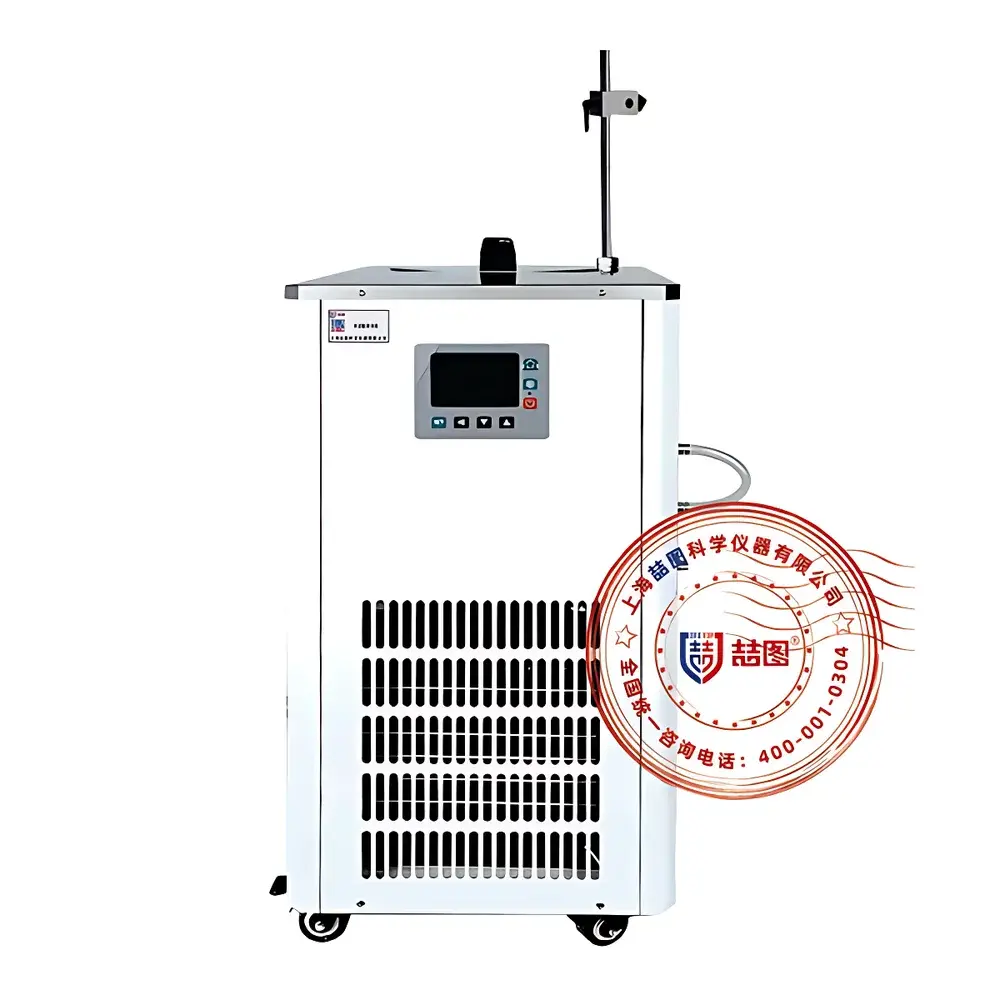
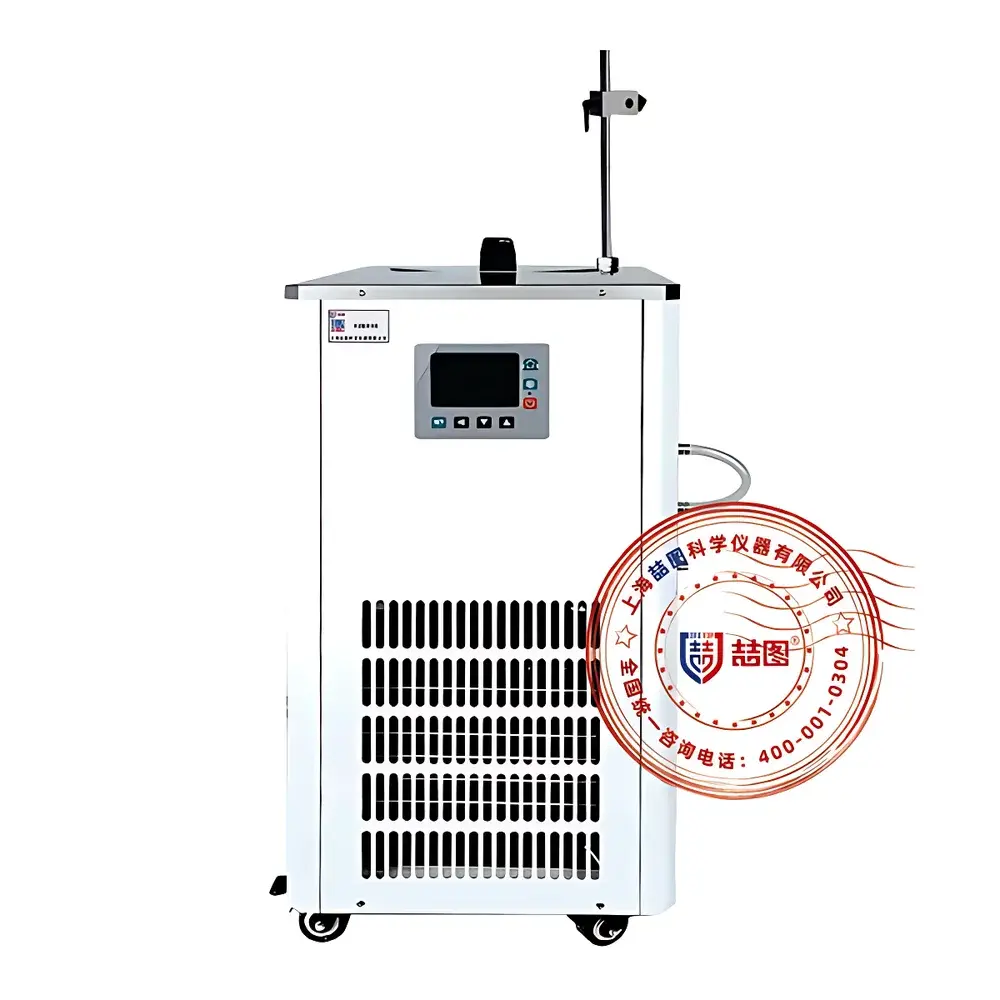
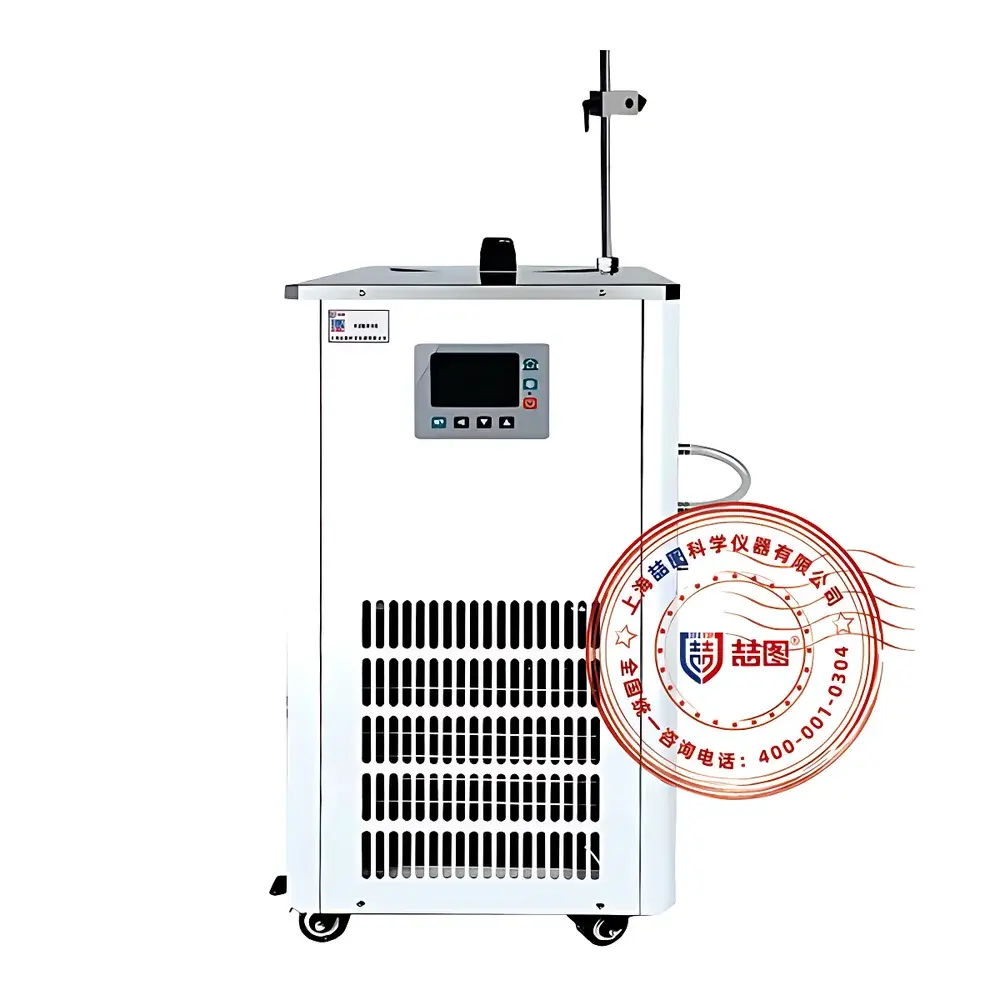
DRETOP HLX-5-20 Integrated High-Low Temperature Circulating Chiller
| Brand | DRETOP |
|---|---|
| Origin | Shanghai, China |
| Manufacturer Type | Direct Manufacturer |
| Product Type | Integrated Circulating Chiller |
| Cooling Method | Air-Cooled |
| Temperature Control Range | −20 °C to 200 °C |
| Circulation Flow Rate | 20 L/min |
| Reservoir Volume | 5 L |
| Circulation Mode | Internal Closed-Loop |
Overview
The DRETOP HLX-5-20 Integrated High-Low Temperature Circulating Chiller is an engineered thermal management system designed for precision temperature control across demanding laboratory and industrial applications. It operates on a dual-mode thermodynamic architecture—combining variable-speed compressor-based refrigeration with electric resistance heating—to deliver seamless, stable, and programmable thermal regulation from −20 °C to +200 °C within a single compact unit. Unlike segmented cooling-only or heating-only systems, the HLX-5-20 implements a closed-loop circulation principle: a corrosion-resistant stainless-steel pump circulates heat-transfer media (e.g., water, ethylene glycol/water mixtures, or silicone oil) through insulated tubing to external equipment—such as reaction vessels, spectroscopic detectors, laser diodes, or vacuum deposition chambers—enabling indirect, high-fidelity thermal coupling without direct immersion. Its air-cooled condenser eliminates dependency on facility chilled water infrastructure, while its 5 L reservoir and 20 L/min flow rate ensure rapid thermal response and uniform heat exchange across moderate-volume secondary loops.
Key Features
- PID-based digital temperature controller with ±1 °C accuracy and <±0.5 °C short-term stability over full operating range;
- Integrated variable-frequency scroll compressor and low-noise centrifugal circulation pump—optimized for energy efficiency, load-adaptive power modulation, and continuous-duty operation;
- Stainless-steel reservoir and fluid pathways (including 10 mm OD stainless metal hose with bayonet-style fittings) resist oxidation, corrosion, and thermal degradation of common heat-transfer fluids;
- IP54-rated enclosure with industrial-grade insulation, anti-condensation design, and low-temperature liquid containment features suitable for vacuum coating, ultra-high-purity metallurgy, and cryogenic synthesis environments;
- Comprehensive safety architecture: real-time monitoring of overtemperature, low fluid level, refrigerant pressure anomaly, electrical leakage, and circuit fault—with automatic shutdown, audible/visual alarm, and non-volatile power-loss memory;
- RS485 serial interface compliant with Modbus RTU protocol for integration into LabVIEW, SCADA, or LIMS platforms; supports timestamped temperature logging, historical curve export, and remote parameter adjustment.
Sample Compatibility & Compliance
The HLX-5-20 accommodates a broad spectrum of heat-transfer media—including deionized water (for 5–100 °C), 30–50% ethylene glycol aqueous solutions (for −20–100 °C), and methyl silicone oil (for 100–200 °C)—ensuring chemical compatibility and thermal stability across application-specific requirements. Its sealed circulation path prevents evaporation, oxidation, and particulate ingress, maintaining fluid integrity over extended operational cycles. The unit conforms to IEC 61000-6-3 (EMC emissions), IEC 61000-6-2 (immunity), and UL/CSA 61010-1 safety standards for laboratory equipment. While not certified under FDA 21 CFR Part 11, its audit-ready data logging—featuring user-accessible timestamps, immutable event records, and password-protected configuration—supports GLP/GMP-aligned workflows in pharmaceutical QC, bioprocess development, and materials qualification labs.
Software & Data Management
The embedded microcontroller firmware provides intuitive local operation via a backlit LCD interface with multi-level menu navigation, real-time temperature graphing, and programmable ramp-soak profiles (up to 10 segments). Through the RS485 port, users can deploy third-party software (e.g., Datalogger Pro, MATLAB Instrument Control Toolbox) to acquire time-synchronized temperature, flow status, and alarm events at configurable intervals (1 s to 60 min resolution). All logged data are stored in CSV format with ISO 8601 timestamps, enabling traceability for internal SOP compliance, equipment validation (IQ/OQ), and regulatory submissions. Optional PC software includes automated report generation, deviation flagging, and trend analysis aligned with ASTM E29–23 and ISO/IEC 17025 documentation expectations.
Applications
- Multi-stage organic synthesis requiring sequential cryogenic addition (−20 °C) followed by reflux heating (120 °C) in jacketed reactors;
- Thermal cycling of advanced materials—e.g., polymer composites, battery electrolytes, or phase-change alloys—across −40 °C to +200 °C for accelerated aging or coefficient-of-thermal-expansion (CTE) characterization;
- Cooling of high-power semiconductor lasers, ICP-OES plasma sources, and vacuum pump forelines where precise thermal drift suppression (<0.1 °C/h) is critical to signal stability;
- Indirect temperature control of analytical instrumentation—HPLC column ovens, GC injectors, and FTIR sample compartments—via external recirculation manifolds;
- Controlled-rate freezing of biological samples in cryopreservation protocols, leveraging programmable cooling ramps and hold steps validated per USP and ISO 20417.
FAQ
What heat-transfer fluids are compatible with the HLX-5-20 across its full temperature range?
Water is suitable from 5 °C to 100 °C; 30–50% ethylene glycol/water mixtures extend low-temperature capability to −20 °C; methyl silicone oil (e.g., DC200 series) enables stable operation up to 200 °C. Fluid selection must consider viscosity, flash point, and thermal expansion coefficients per ASTM D1259.
Can the HLX-5-20 support external open-bath applications like traditional reaction baths?
No—it is configured exclusively for closed-loop external circulation. For direct immersion applications, DRETOP’s LF-series low-temperature reaction baths with integrated magnetic stirring are recommended.
Is the unit suitable for GMP-regulated environments requiring electronic record integrity?
While not Part 11–certified out-of-the-box, its tamper-evident CSV logs, user-accessible audit trails, and configurable access levels meet foundational ALCOA+ principles when deployed with validated procedures and supplementary IT controls.
How does the HLX-5-20 differ from standard cooling-only chillers in terms of thermal inertia and control fidelity?
Its dual-mode thermal actuation (simultaneous compression cooling and resistive heating) eliminates the “dead band” inherent in on/off chillers, enabling sub-degree setpoint tracking during dynamic load transitions—critical for exothermic reaction control and calorimetric measurements.
What maintenance intervals are recommended for long-term reliability?
Compressor oil and refrigerant charge require verification every 24 months; stainless-steel fluid pathways should be flushed annually with compatible solvent if switching between glycol and oil-based media; filter elements (if installed upstream) must be replaced per manufacturer specifications or at 6-month intervals under continuous use.
Related Products



