
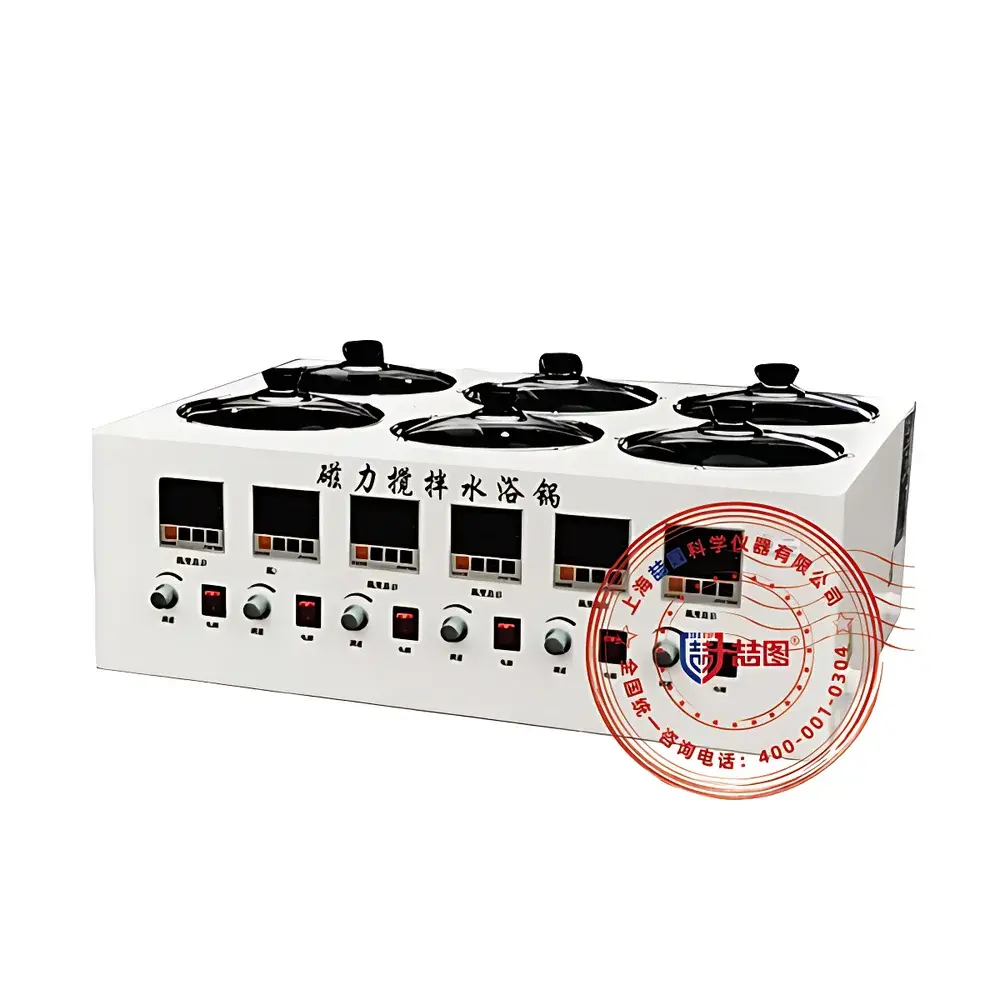
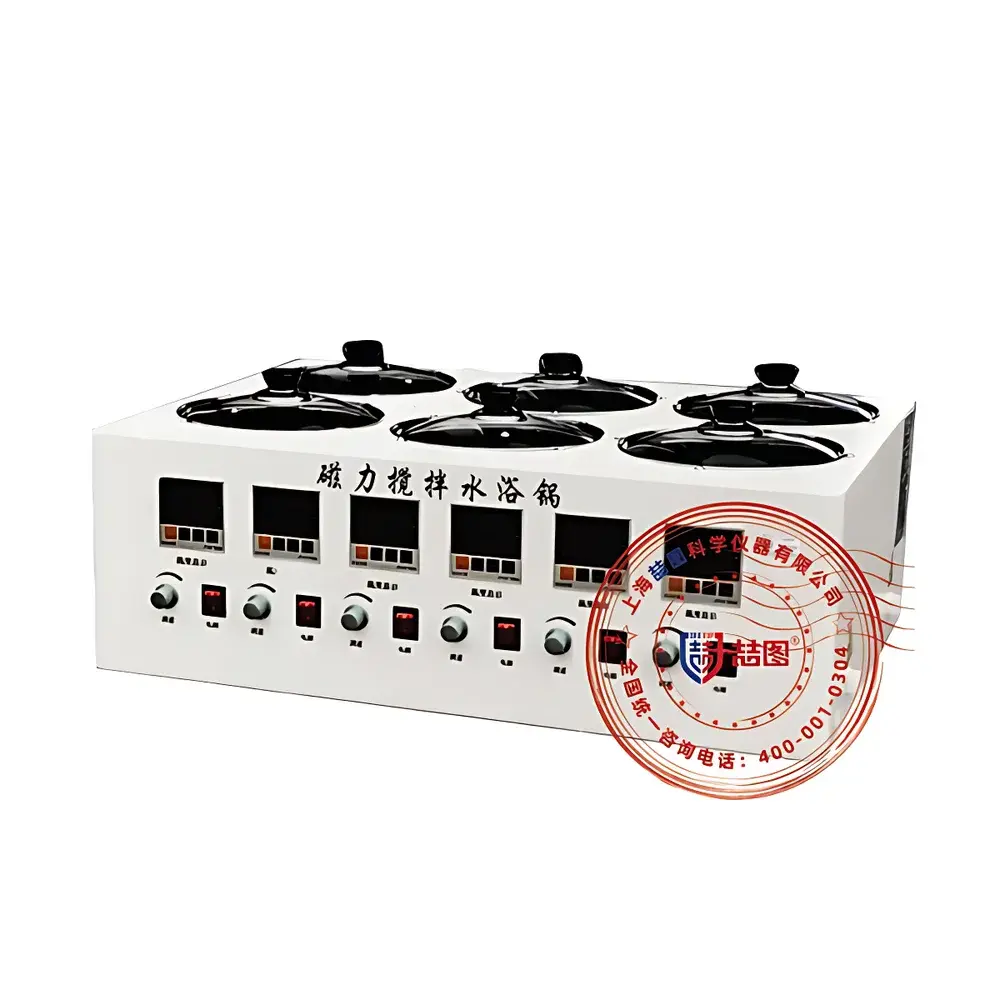
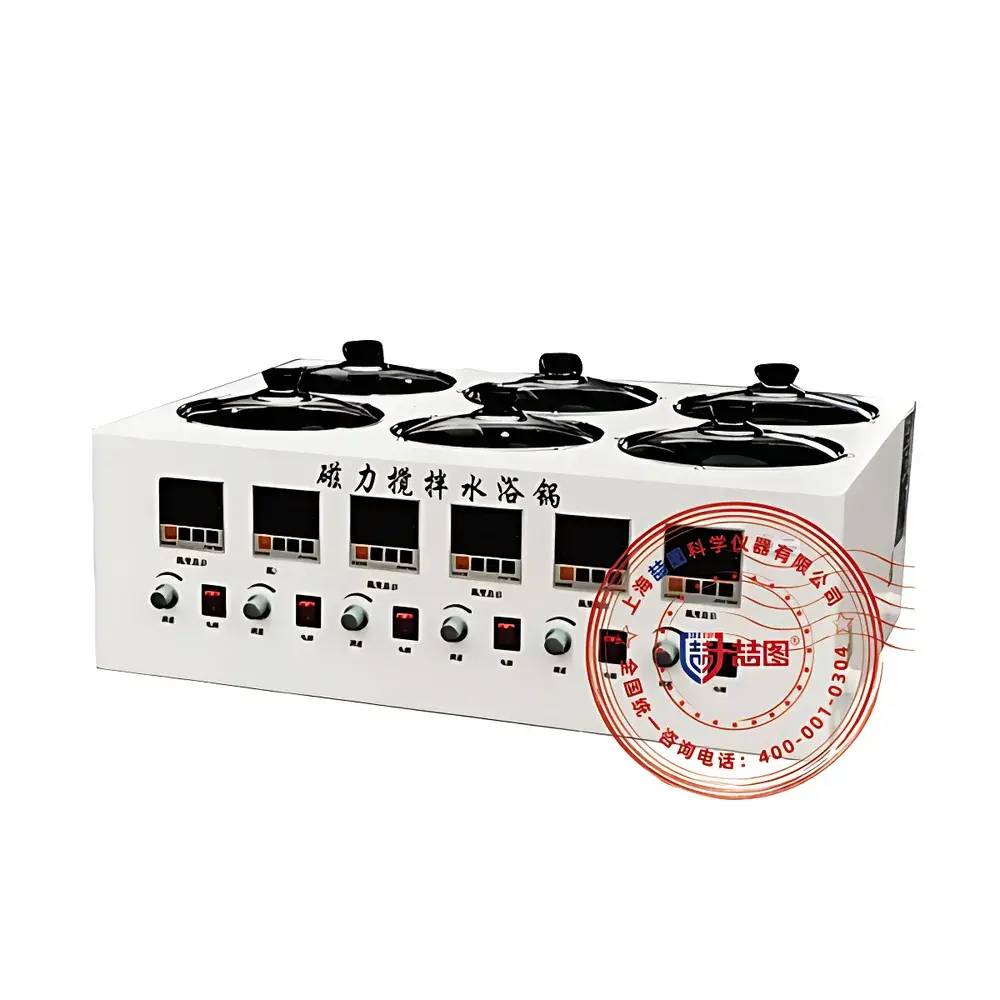
DRETOP JCS-1012 Magnetic Stirring Water Bath
| Brand | DRETOP |
|---|---|
| Origin | Shanghai, China |
| Manufacturer Type | Direct Manufacturer |
| Product Category | Domestic |
| Model | JCS-1012 |
| Price Range | USD 420–700 (FOB) |
| Temperature Range | RT+5°C to 100°C |
| Bath Dimensions | Φ220 mm × 100 mm (height customizable >100 mm) |
| Heating Power | 2 × 300 W |
| Stirring Speed Range | 0–2400 rpm |
| Temperature Control Accuracy | ±0.1°C |
| Temperature Uniformity (Stability) | ±0.5°C |
| Max. Stirring Capacity | 2 × 2000 mL |
| Stirring Motor Power | 2 × 25 W |
| Built-in Drain Valve | Yes |
| Power Supply | 220 V, 50 Hz |
Overview
The DRETOP JCS-1012 Magnetic Stirring Water Bath is a dual-function laboratory instrument engineered for precise temperature regulation and homogeneous sample mixing in aqueous or low-viscosity media. It operates on the principle of resistive immersion heating combined with electromagnetic coupling—where a rotating magnetic field generated by a pair of embedded stirrer motors drives PTFE-coated magnetic stir bars within the bath chamber. This design ensures uniform thermal distribution across the entire bath volume while eliminating mechanical shaft penetration, thereby enhancing seal integrity and reducing contamination risk. The unit is calibrated for stable operation from ambient +5°C up to 100°C, making it suitable for applications requiring gentle yet consistent thermal activation—such as enzyme kinetics assays, dissolution testing, buffer equilibration, and pre-incubation of reagents prior to chromatographic or spectroscopic analysis.
Key Features
- Microprocessor-based PID temperature controller with dual digital display (setpoint and real-time bath temperature), enabling high reproducibility and minimal overshoot during ramping cycles.
- Dual independent 300 W heating elements arranged in a ring configuration beneath the stainless-steel bath chamber ensure rapid heat-up times and exceptional axial and radial temperature uniformity (±0.5°C at 60°C).
- Two synchronized magnetic stirring units, each rated at 25 W, support simultaneous agitation of two separate vessels (e.g., beakers or flasks) with speed control from 0 to 2400 rpm via rotary encoder or front-panel keypad input.
- Corrosion-resistant 304 stainless-steel inner tank and lid, finished with electrostatic powder coating on the exterior housing, provide long-term durability in humid or chemically exposed lab environments.
- Integrated drain valve located at the lowest point of the bath chamber allows complete fluid evacuation without tilting or disassembly—critical for routine maintenance and cross-contamination prevention between experiments.
- Power-loss recovery function retains user-defined parameters (temperature setpoint, timer, stirring speed) during unexpected outages, resuming operation automatically upon power restoration.
Sample Compatibility & Compliance
The JCS-1012 accommodates standard laboratory glassware including 50–2000 mL beakers, Erlenmeyer flasks, and cylindrical reaction vessels with flat bases. Its open-bath geometry supports both direct immersion and indirect heating configurations—for example, when used with water-jacketed reactors or condenser assemblies mounted on optional vertical support rods (sold separately). The device complies with IEC 61010-1:2010 safety standards for electrical equipment used in laboratory settings. While not certified for use in regulated GxP environments out-of-the-box, its stable thermal performance and parameter retention capability align with foundational requirements for GLP-compliant method development workflows, particularly where manual data recording is supplemented by external audit-trail documentation.
Software & Data Management
The JCS-1012 operates as a standalone analog-digital hybrid system with no built-in data logging or PC interface. All operational parameters—including temperature setpoint, elapsed time, and stirring speed—are displayed locally on a backlit LCD screen. For laboratories requiring electronic recordkeeping, third-party USB-connected thermocouple loggers (e.g., Omega OM-DAQPRO-5300 series) may be deployed alongside the unit to capture time-stamped bath temperature profiles. When integrated into validated protocols, such external monitoring satisfies basic traceability needs under FDA 21 CFR Part 11 Annex A guidelines, provided that procedural controls govern calibration frequency, sensor placement verification, and raw data archival.
Applications
- Chemical synthesis: Controlled heating and mixing during reflux, hydrolysis, or esterification reactions where solvent boiling points fall within the 30–100°C range.
- Biological sample preparation: Equilibration of cell culture media, antibody diluents, or electrophoresis buffers at physiological or sub-physiological temperatures.
- Pharmaceutical quality control: Dissolution testing of solid oral dosage forms per USP , particularly for apparatus II (paddle) method validation requiring auxiliary water bath stabilization.
- Food and beverage analytics: Homogenization and thermal conditioning of homogenates prior to heavy metal extraction or microbiological enrichment steps.
- Environmental testing: Extraction of organic pollutants from aqueous matrices using Soxhlet-compatible setups or accelerated solvent extraction workflows.
FAQ
Can the JCS-1012 operate continuously at 100°C for extended periods?
Yes—the unit is rated for continuous duty at maximum setpoint, provided ambient conditions remain below 30°C and adequate ventilation is maintained around the rear heat dissipation grilles.
Is the bath depth customizable beyond 100 mm?
Yes—DRETOP offers factory customization of bath height upon request; lead time and minimum order quantities apply.
Does the unit support RS-232 or USB communication?
No—this model lacks native digital connectivity; external data acquisition requires third-party sensors and logging hardware.
What type of magnetic stir bars are recommended for optimal performance?
Cylindrical PTFE-coated stir bars (8–10 mm diameter × 30 mm length) with neodymium magnets deliver best torque transfer and chemical resistance across the full operating temperature range.
How often should the temperature sensor be recalibrated?
Annual calibration against a NIST-traceable reference thermometer is recommended for critical applications; routine verification using a calibrated platinum RTD probe is advised before high-precision experiments.



