
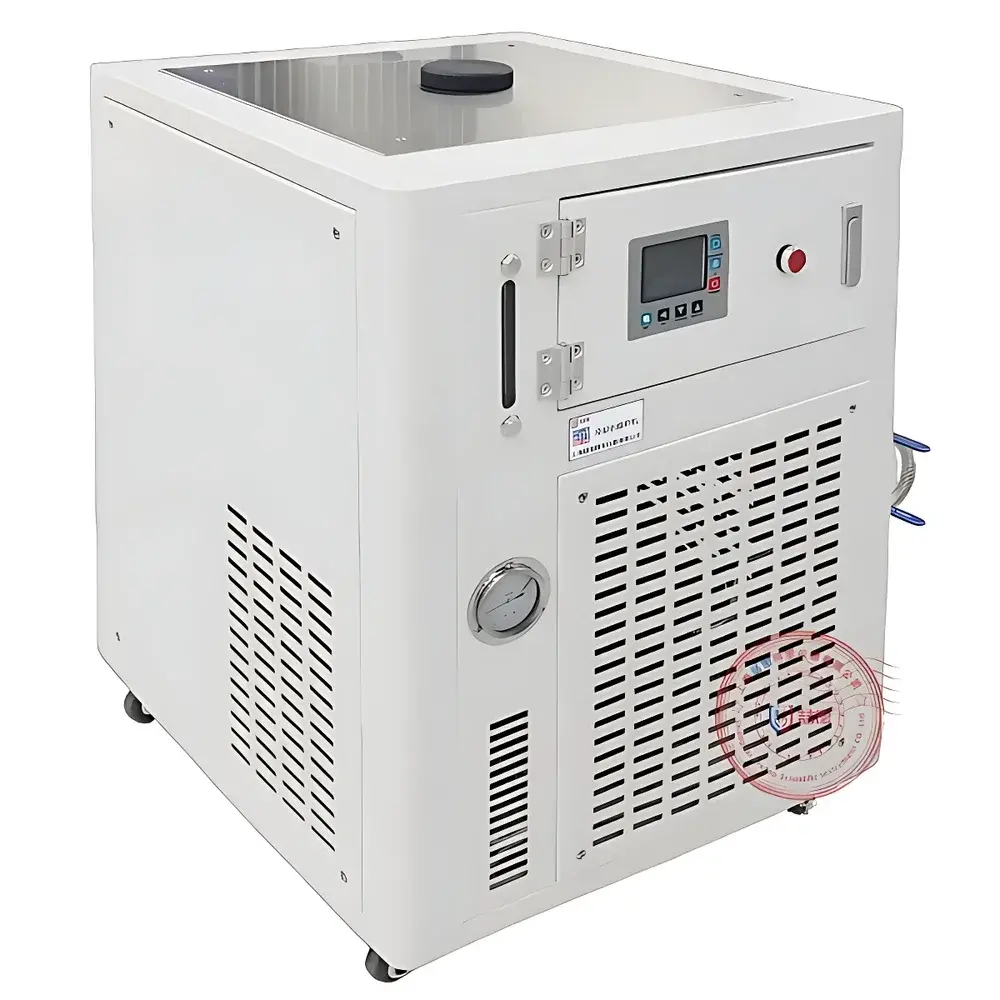
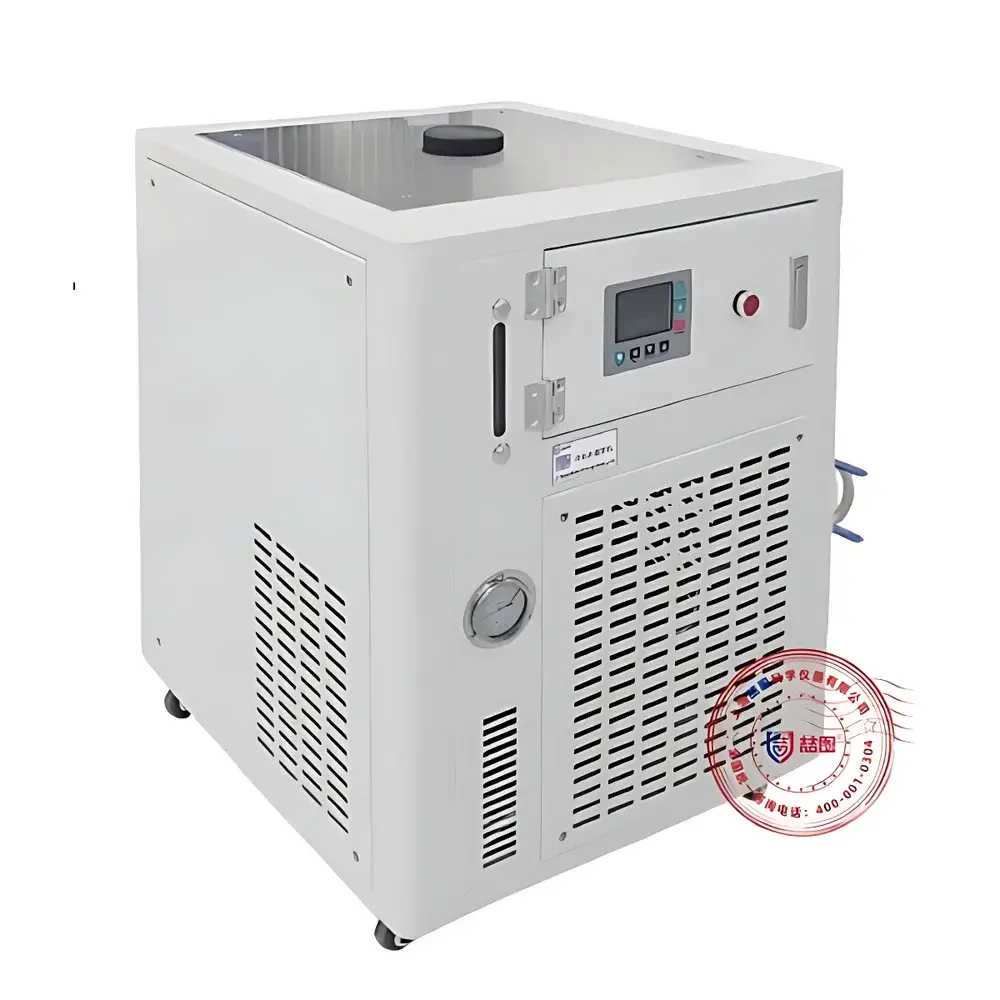
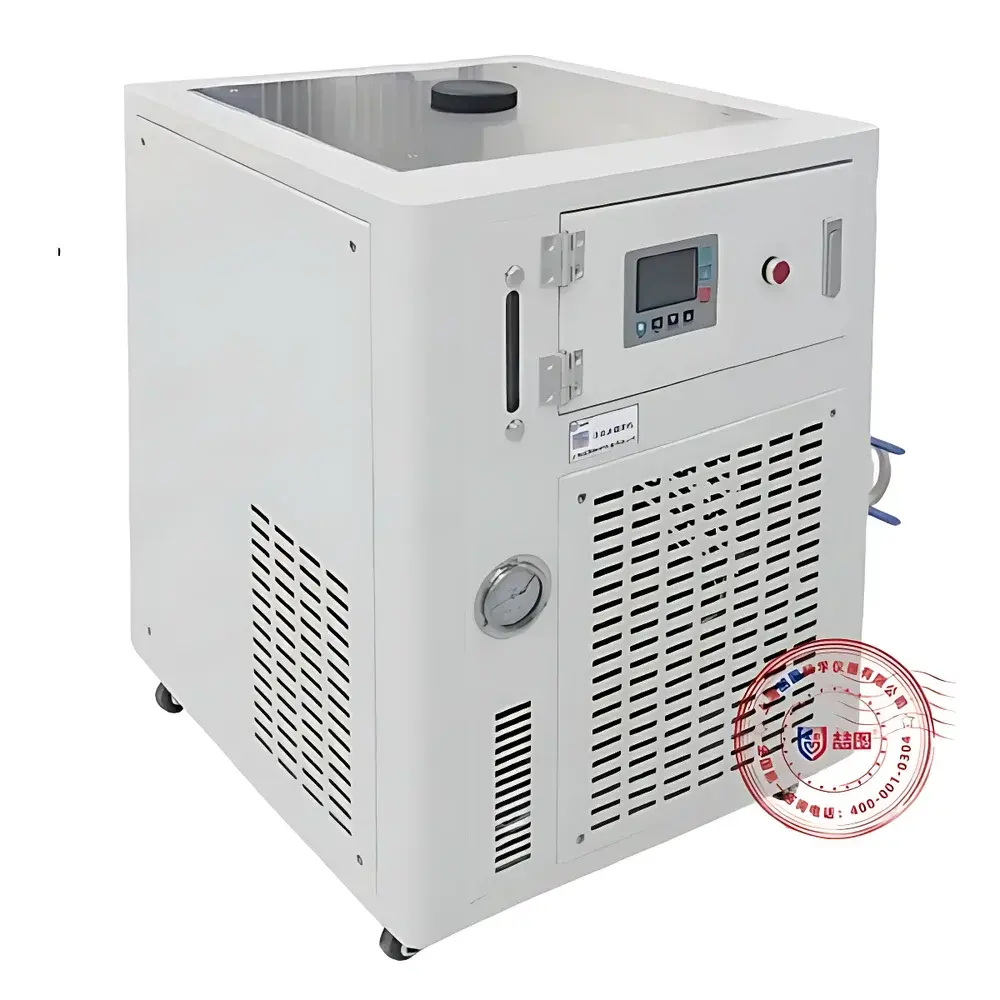
DRETOP LC3-50 Integrated Circulating Chiller
| Brand | DRETOP |
|---|---|
| Origin | Shanghai, China |
| Manufacturer Type | Direct Manufacturer |
| Product Type | Integrated Circulating Chiller |
| Cooling Method | Water-Cooled |
| Temperature Range | 5–100 °C |
| Refrigeration Capacity | 3 HP (≈2.24 kW) |
| Reservoir Volume | 50 L |
| Circulation Pressure | 0–2 bar |
| Flow Rate | 0–30 L/min |
| Operating Mode | Continuous |
| Construction | Stainless Steel Inner Tank & Work Surface |
| Control System | PID-Based Digital Temperature Controller |
| Communication Interface | RS485 |
| Heating Method | Immersed Electric Heater |
| Compressor Type | Variable-Frequency Scroll Compressor |
| Safety Protections | Over-Temperature, Low-Level, Leak, Short-Circuit, and High-Pressure Alarms |
| IP Rating | IP54 |
Overview
The DRETOP LC3-50 Integrated Circulating Chiller is an engineered thermal management system designed for continuous, high-stability temperature control in laboratory and industrial applications requiring precise heat removal or thermal conditioning of external equipment. It operates on a closed-loop refrigeration cycle combining vapor-compression cooling with electric resistance heating, enabling bidirectional temperature regulation across a broad operational range (5–100 °C). Unlike cryogenic circulation pumps or reaction baths, the LC3-50 is purpose-built for auxiliary cooling—delivering chilled water or aqueous glycol solutions to maintain stable operating temperatures in analytical instruments (e.g., ICP-OES spectrometers, laser sources, vacuum pumps), semiconductor fabrication tools, and chemical reactors. Its integrated architecture eliminates the need for external chillers or heat exchangers, reducing footprint, fluid loss risk, and system complexity while ensuring long-term reliability under uninterrupted duty cycles.
Key Features
- High-efficiency variable-frequency scroll compressor with load-responsive power modulation—minimizing energy consumption and acoustic emissions during partial-load operation.
- PID-controlled digital temperature regulation with high-resolution platinum RTD sensor (±0.1 °C typical accuracy), delivering low-temperature fluctuation (<±0.3 °C at steady state) and uniform thermal distribution throughout the reservoir and output stream.
- Corrosion-resistant 304 stainless steel reservoir and circulation manifold—compatible with deionized water, 20–50% ethylene glycol/water mixtures, and other non-aggressive heat transfer fluids.
- Low-heat-generation magnetic drive circulation pump (0–30 L/min, max 2 bar pressure), isolated from thermal feedback to preserve setpoint integrity and prevent localized heating of the working fluid.
- RS485 serial interface compliant with Modbus RTU protocol—enabling integration into centralized lab automation systems for remote monitoring, data logging, alarm triggering, and audit-trail generation per GLP/GMP requirements.
- Multi-layer safety architecture: real-time detection of reservoir level, refrigerant pressure anomalies, electrical faults, and over-temperature events; automatic shutdown with non-volatile memory retention of last operational parameters.
Sample Compatibility & Compliance
The LC3-50 supports closed-loop circulation of water-based coolants only—not intended for direct immersion of samples or reactive chemistry. It complies with IEC 61000-6-3 (EMC emission limits) and IEC 61000-6-2 (immunity standards), and meets CE marking requirements for laboratory equipment within the European Economic Area. While not certified to UL/CSA standards, its electrical design adheres to IEC 61010-1 safety principles for measurement/control equipment. The unit is suitable for environments requiring ISO/IEC 17025-aligned thermal stability (e.g., calibration labs), and its data logging capability supports FDA 21 CFR Part 11 compliance when deployed with validated software platforms that enforce electronic signatures and audit trails.
Software & Data Management
The chiller’s embedded firmware supports time-stamped temperature logging at user-defined intervals (1 s to 60 min resolution) with up to 100,000 data points stored locally. Through the RS485 interface, third-party SCADA or LIMS systems can retrieve real-time process variables—including setpoint, actual temperature, flow status, compressor runtime, and alarm history—via standard Modbus function codes (03h, 04h, 06h). Optional DRETOP LabControl Suite (Windows-based) provides graphical trend analysis, export to CSV/PDF, configurable email/SMS alerts, and password-protected parameter modification—facilitating documentation for quality audits and regulatory submissions.
Applications
- Analytical instrumentation cooling: Maintaining optimal detector and optical component temperatures in ICP, HPLC, GC-MS, and Raman spectrometers to ensure signal stability and baseline reproducibility.
- Laser and photonics systems: Stabilizing diode-pumped solid-state (DPSS) lasers, fiber amplifiers, and optical parametric oscillators where thermal drift directly impacts wavelength accuracy and beam quality.
- Chemical process control: Providing consistent jacket cooling for glass-lined reactors, pilot-scale batch vessels, and continuous flow synthesis modules—particularly in exothermic catalytic hydrogenations or nitration reactions.
- Materials testing: Supporting thermal cycling protocols in mechanical testing frames, DSC calibration rigs, and thermal conductivity analyzers requiring repeatable boundary conditions.
- Bioengineering infrastructure: Regulating temperature in bioreactor cooling jackets, electrophoresis apparatus, and chromatography column ovens where ±0.5 °C stability is critical for assay fidelity.
FAQ
What cooling fluids are compatible with the LC3-50?
Deionized water, distilled water, or aqueous ethylene glycol solutions (up to 50% v/v) are recommended. Avoid chlorinated solvents, mineral oils, or silicone-based fluids, which may degrade seals or impair heat transfer efficiency.
Can the LC3-50 achieve sub-zero temperatures?
No. Its minimum operating temperature is +5 °C. For applications requiring below-freezing operation (e.g., rotary evaporator condensers), DRETOP’s LX-series low-temperature circulating pumps are engineered alternatives.
Is the unit suitable for GMP-regulated pharmaceutical manufacturing?
Yes—when integrated with validated supervisory software and operated within documented SOPs, the LC3-50 meets foundational requirements for equipment qualification (IQ/OQ) and traceable temperature control in cleanroom support systems.
Does it support external temperature feedback control?
Not natively. The LC3-50 regulates based on internal reservoir temperature. For process-critical applications requiring junction or reactor-jacket feedback, external PID controllers with analog input/output (4–20 mA) must be used in cascade configuration.
What maintenance is required for sustained performance?
Annual inspection of refrigerant charge, desiccant cartridge replacement, and verification of pump impeller clearance and seal integrity are recommended. Filter cartridges (inlet strainer) should be cleaned quarterly in hard-water environments.



