
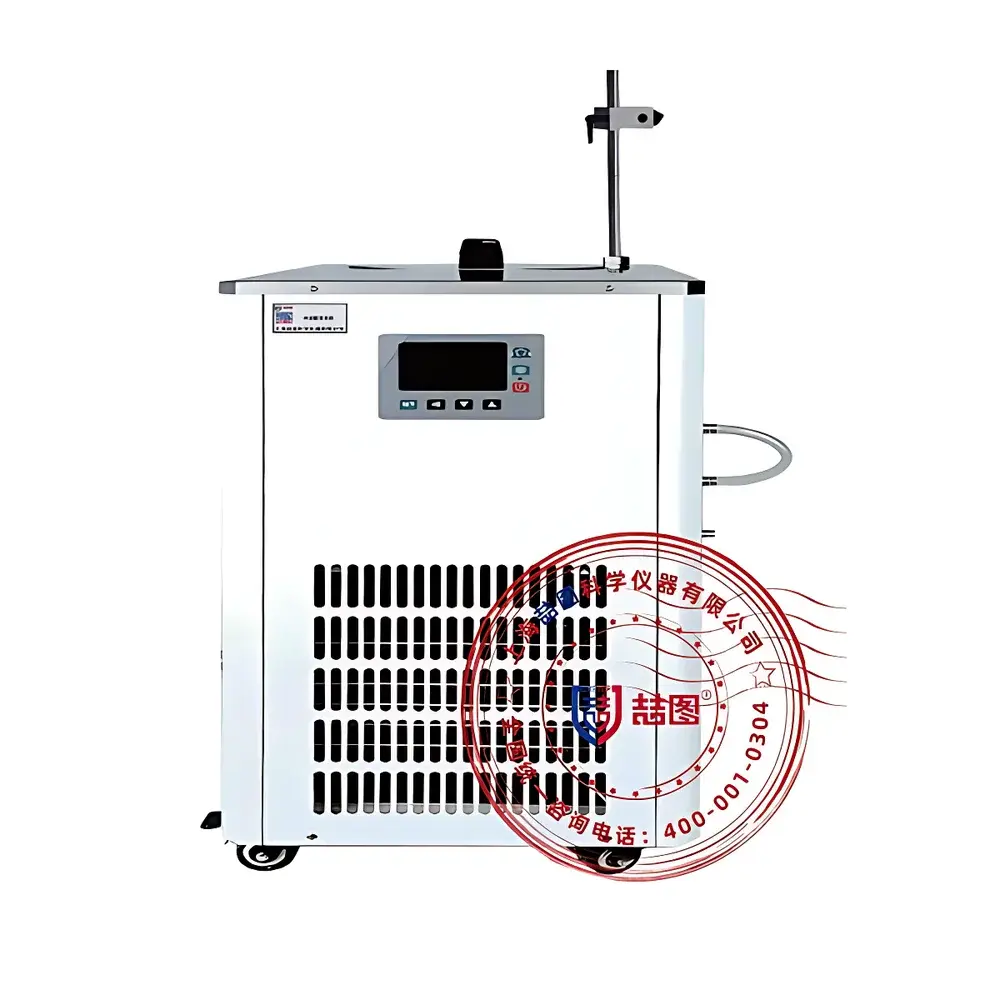
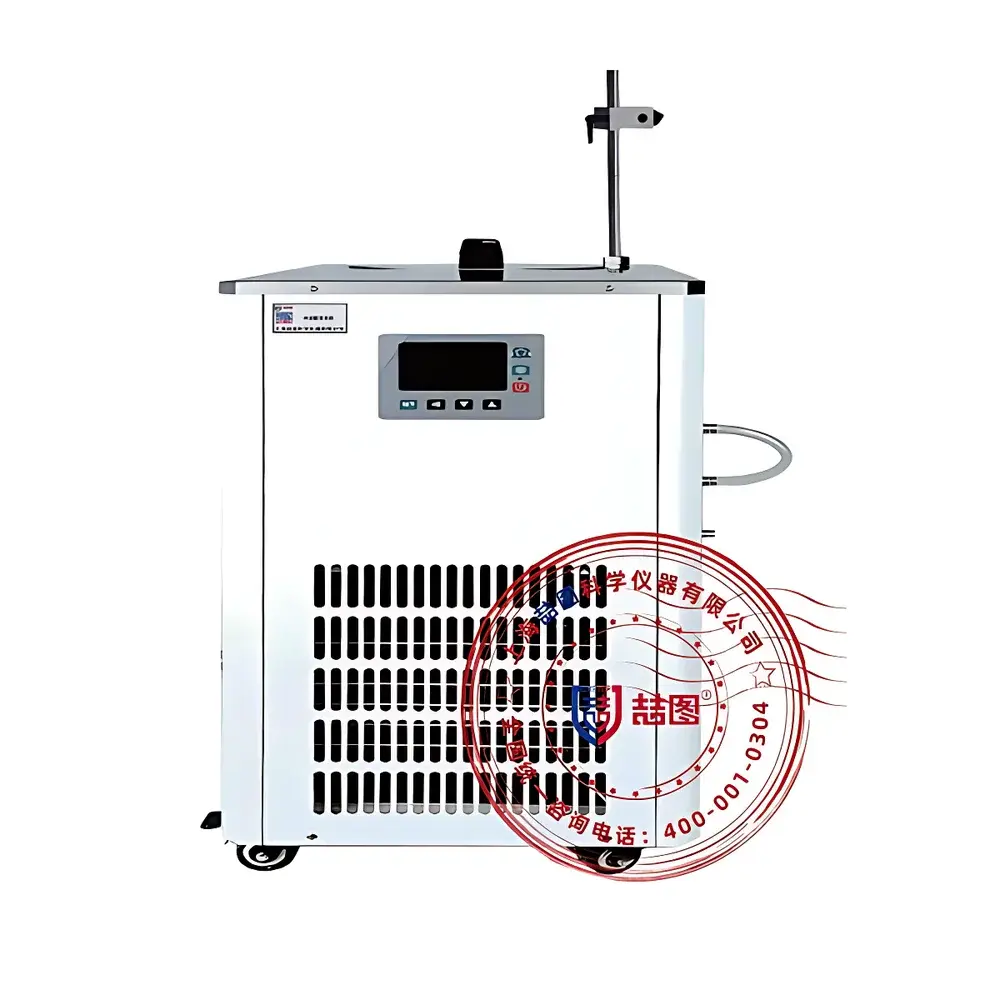
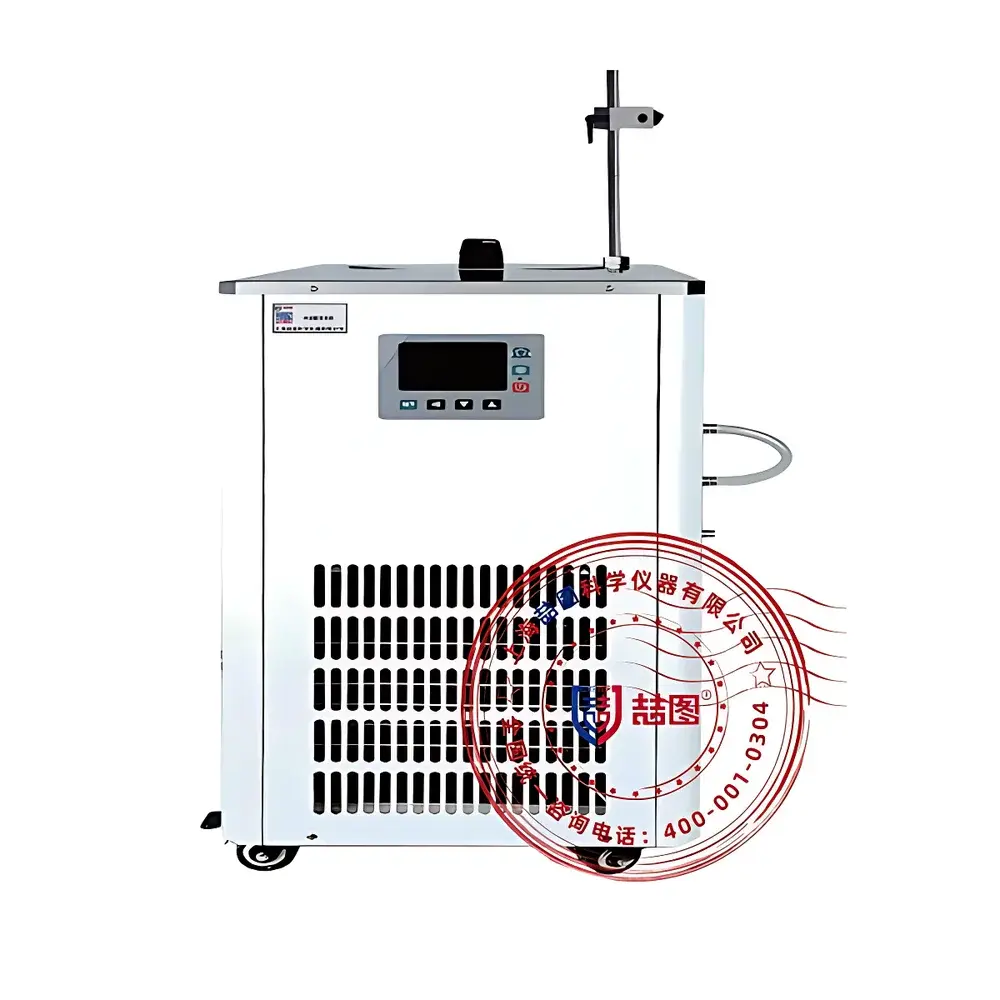
DRETOP LJF30-10 Low-Temperature Magnetic Stirring Circulating Bath
| Brand | DRETOP |
|---|---|
| Origin | Shanghai, China |
| Manufacturer Type | Direct Manufacturer |
| Product Category | Domestic |
| Model | LJF30-10 |
| Instrument Type | Integrated Unit |
| Cooling Method | Water-Cooled |
| Temperature Control Range | −10 °C to 100 °C |
| Temperature Stability | Not Specified |
| Circulating Pump Flow Rate | 35 L/min |
| Reservoir Volume | 30 L |
Overview
The DRETOP LJF30-10 Low-Temperature Magnetic Stirring Circulating Bath is an integrated precision temperature control system engineered for laboratory-scale chemical synthesis, material characterization, and biological sample conditioning. It combines active refrigeration, electric heating, closed-loop fluid circulation, and built-in magnetic stirring in a single compact chassis—eliminating the need for external chillers, auxiliary pumps, or separate reaction vessels. Unlike standard circulating chillers (e.g., LX-series) that supply coolant to external jackets or condensers, the LJF30-10 features a stainless-steel bath reservoir with direct immersion capability, enabling precise thermal management of reaction mixtures placed directly within the bath medium. Its operational principle relies on vapor-compression refrigeration coupled with PID-regulated resistive heating and a corrosion-resistant magnetic drive pump, ensuring stable thermal gradients and uniform heat transfer across the entire 30 L working volume. Designed for reproducible low-temperature chemistry—including Grignard reactions, cryogenic oxidation/reduction, and polymerization kinetics—the unit supports both static and dynamic thermal protocols under ambient or controlled-atmosphere enclosures.
Key Features
- Integrated dual-mode thermal control: Variable-speed inverter-driven compressor for efficient sub-zero cooling (down to −10 °C) and high-wattage tubular heater for rapid, uniform warming up to 100 °C.
- High-flow magnetic drive circulation pump (35 L/min) with IP54-rated motor housing; thermally isolated from bath chamber to prevent self-heating interference.
- PID-based digital temperature controller with ±0.1 °C setpoint resolution and real-time deviation monitoring; optional RS485 interface enables Modbus RTU communication for SCADA integration and audit-trail-compliant data logging.
- 30 L seamless 304 stainless-steel reservoir with reinforced flange, anti-spill rim, and integrated mounting rod system for secure attachment of overhead stirrers, pH electrodes, reflux condensers, or temperature probes.
- Double-sealed, chemically inert fluid path: All wetted components—including inlet/outlet fittings, internal piping, and pump housing—are constructed from passivated stainless steel or PTFE-lined materials compatible with aqueous buffers, ethylene glycol/water mixtures, silicone oils, and other common heat-transfer media.
- Comprehensive safety architecture: Dual-level overtemperature cutoff, low-fluid-level detection, leak sensing, pressure monitoring, short-circuit protection, and non-volatile power-failure memory retention.
Sample Compatibility & Compliance
The LJF30-10 accommodates standard laboratory glassware (e.g., round-bottom flasks up to 5 L, jacketed reactors, crystallization dishes) directly immersed in the bath medium. Its open-bath geometry allows unobstructed access for sampling, gas sparging, or inert atmosphere purging via Schlenk lines. The unit complies with IEC 61010-1:2010 for electrical safety in laboratory equipment and meets CE marking requirements for EMC and low-voltage directives. While not certified for GMP manufacturing environments per se, its design supports GLP-aligned workflows: temperature logs exported via RS485 are timestamped and immutable when paired with compliant data acquisition software, satisfying basic FDA 21 CFR Part 11 record-keeping expectations for research-grade instrumentation. It is routinely deployed in academic labs, pharmaceutical R&D centers, and semiconductor process development facilities where traceable thermal history and repeatable bath homogeneity are critical.
Software & Data Management
The embedded microcontroller supports local parameter configuration via intuitive keypad interface and LCD display. For advanced operation, the RS485 port enables bidirectional communication with host PCs running custom LabVIEW VIs, Python-based control scripts (via PySerial), or third-party LIMS platforms. Historical temperature profiles—including setpoint, actual bath temperature, compressor duty cycle, and pump RPM—are stored onboard for ≥30 days and exportable as CSV files. Optional firmware upgrades introduce programmable ramp-soak sequences, multi-step temperature profiles, and alarm event tagging—facilitating DOE (Design of Experiments) execution and ISO/IEC 17025 method validation documentation.
Applications
- Low-temperature organic synthesis: Controlled exotherm management during n-BuLi additions, cryogenic Diels–Alder cycloadditions, and enantioselective reductions.
- Biological stability studies: Isothermal incubation of protein formulations, nucleic acid hybridization assays, or cell lysate storage at defined sub-zero setpoints using antifreeze-compatible media.
- Materials science testing: Thermal cycling of superconducting ceramics, phase-change material characterization, and thin-film deposition substrate pre-cooling.
- Instrument cooling support: Secondary cooling loop for FTIR spectrometers, CCD detectors, or laser diodes requiring stabilized thermal sinks below ambient.
- Educational laboratories: Demonstrating Arrhenius kinetics, Le Chatelier’s principle, or colligative property effects under rigorously maintained thermal conditions.
FAQ
What types of heat-transfer fluids are compatible with the LJF30-10?
Deionized water, 30–50% ethylene glycol/water mixtures (for sub-zero operation), and low-viscosity silicone oils (up to 100 °C) are validated. Avoid halogenated solvents or strong oxidizers due to seal compatibility constraints.
Can the unit maintain temperature uniformity during vigorous magnetic stirring?
Yes. The integrated stirrer operates independently of thermal control; bath homogeneity is maintained within ±0.3 °C across the full depth at 35 L/min flow, verified by multi-point NIST-traceable probe mapping.
Is external chiller integration possible?
No—the LJF30-10 is a self-contained system. For applications requiring <−10 °C, consider the DRETOP LX30-20 or HLX-30-40 series, which offer extended low-temperature capability but lack built-in stirring.
Does the unit support remote monitoring via Ethernet or Wi-Fi?
Not natively; only RS485 serial communication is provided. Third-party protocol converters (e.g., RS485-to-Ethernet gateways) may be used, though DRETOP does not validate or support such configurations.
What maintenance intervals are recommended for long-term reliability?
Compressor oil and refrigerant levels should be inspected annually by authorized service personnel. The stainless-steel reservoir requires quarterly descaling if operated with hard water; use citric acid solution per manufacturer guidelines.



