
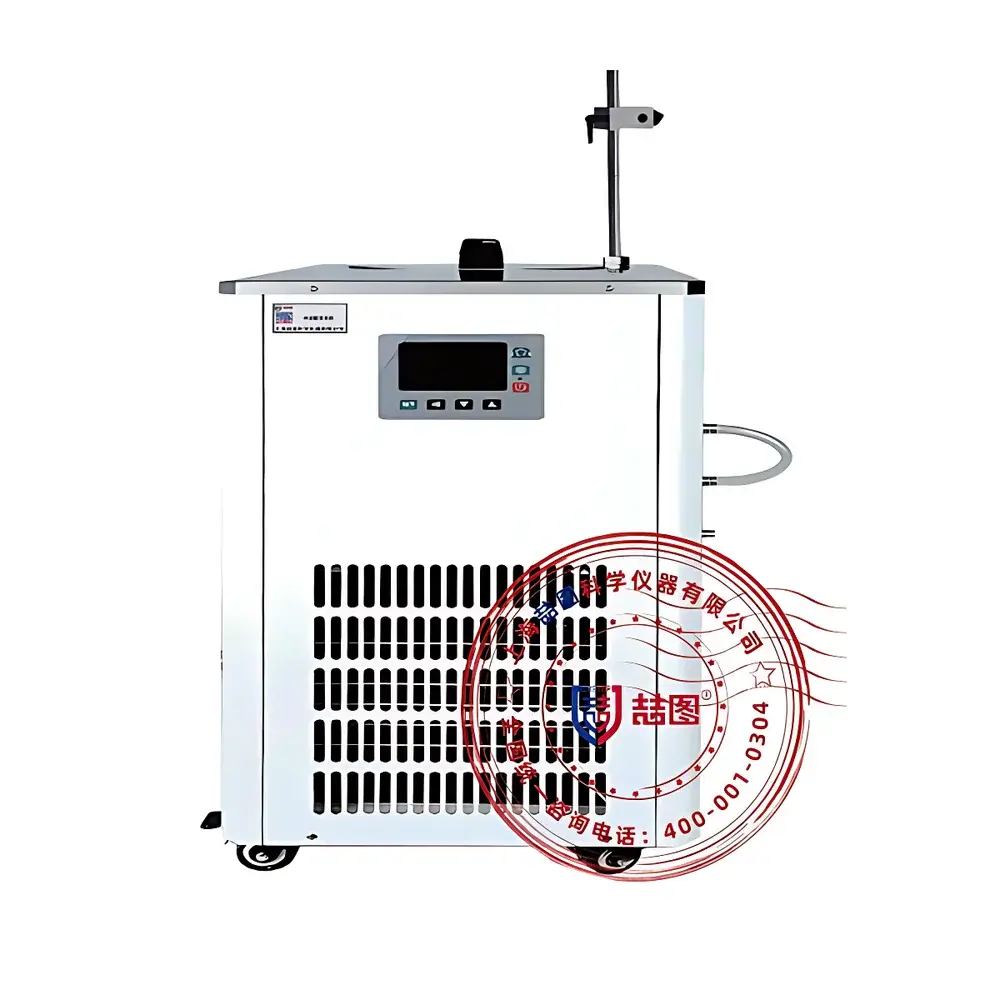
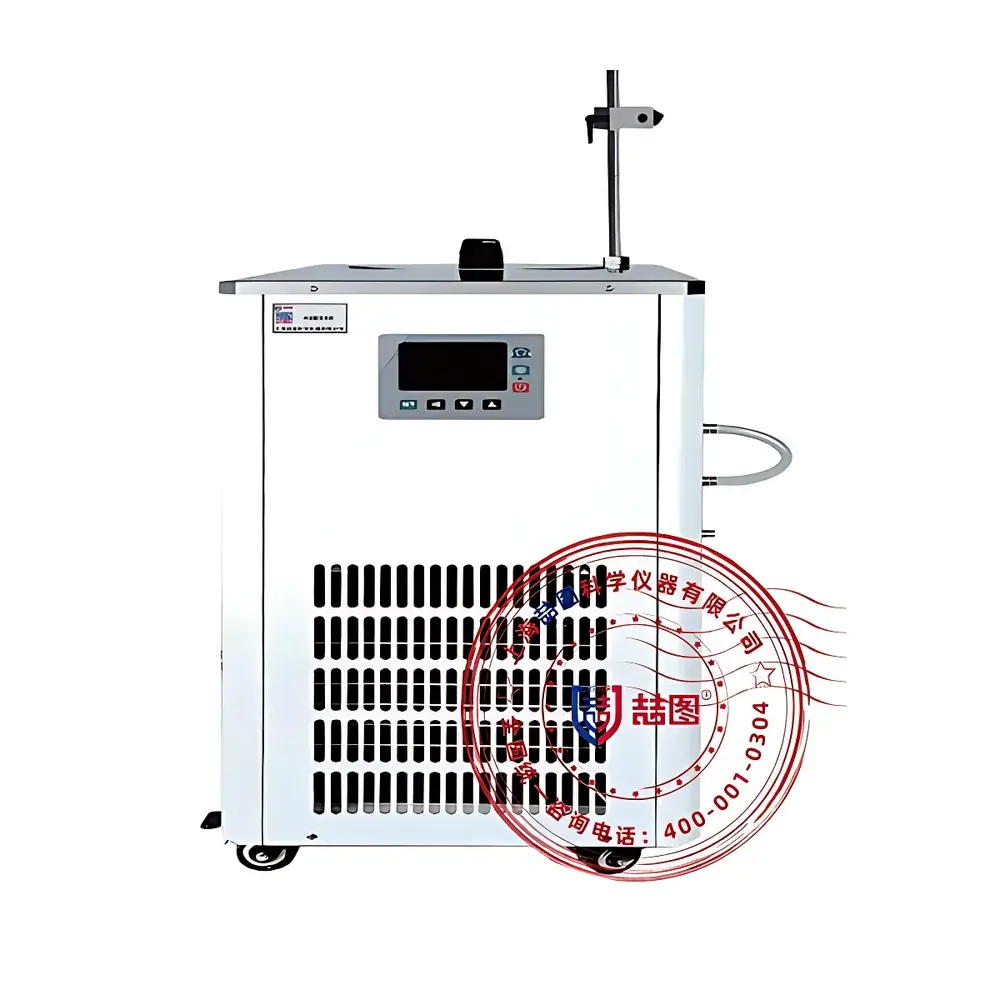
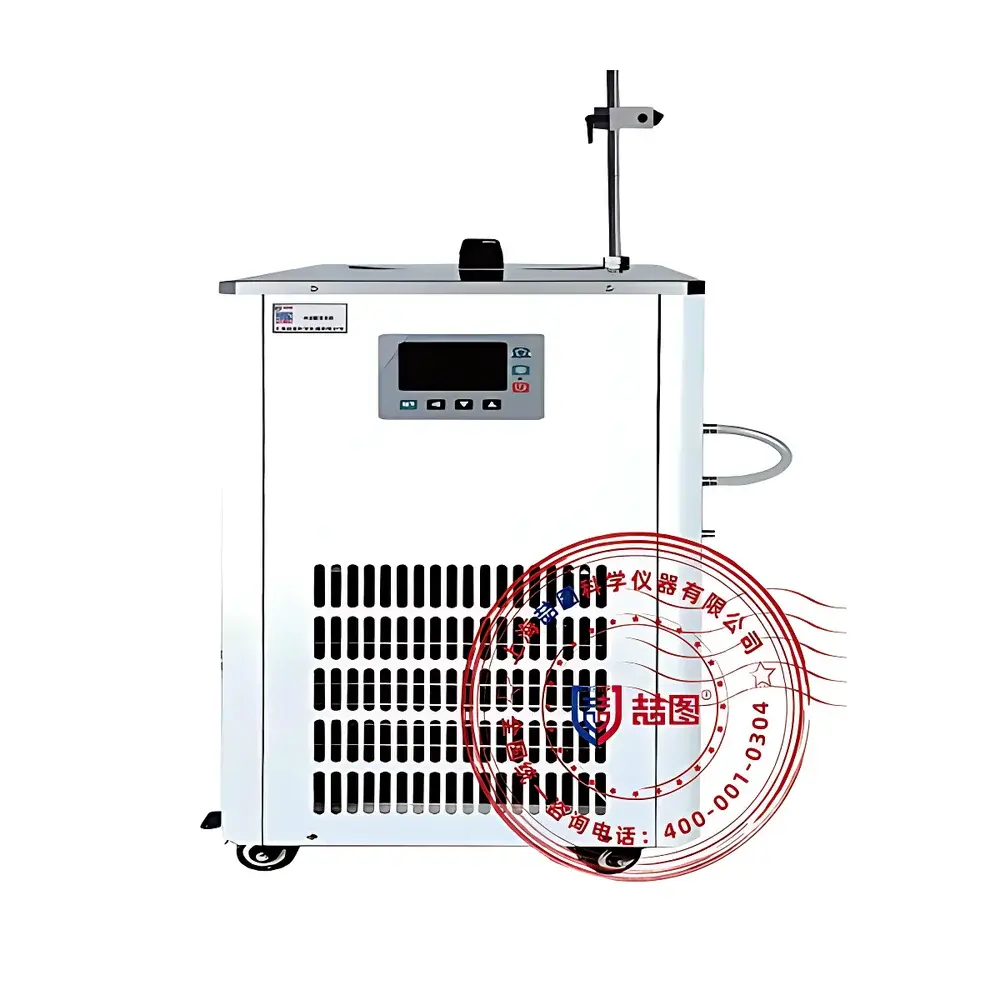
DRETOP LJF5-10 Low-Temperature Magnetic Stirring Circulating Bath
| Brand | DRETOP |
|---|---|
| Origin | Shanghai, China |
| Manufacturer Type | Direct Manufacturer |
| Product Category | Domestic |
| Model | LJF5-10 |
| Instrument Type | Integrated Unit |
| Cooling Method | Water-Cooled |
| Temperature Control Range | −10 °C to 100 °C |
| Temperature Stability | Not Specified (Consult Technical Support) |
| Circulating Pump Flow Rate | 20 L/min |
| Reservoir Volume | 5 L |
Overview
The DRETOP LJF5-10 Low-Temperature Magnetic Stirring Circulating Bath is an integrated precision temperature control system engineered for laboratory-scale chemical synthesis, material testing, and biological sample conditioning. Unlike standalone chillers or heating circulators, the LJF5-10 combines three core functions in a single compact unit: active refrigeration and electric heating, high-reliability magnetic stirring, and closed-loop fluid circulation. Its operational principle relies on a dual-mode thermodynamic cycle—employing a variable-speed compressor for efficient sub-ambient cooling and a stainless-steel immersion heater for rapid, uniform warming—coupled with a brushless magnetic drive pump that maintains laminar flow without introducing mechanical heat or contamination into the bath medium. The system is designed for direct immersion applications: reaction vessels (e.g., round-bottom flasks, jacketed reactors) are placed directly into the 5 L stainless-steel bath reservoir, where temperature homogeneity is enhanced by both conductive heat transfer and forced convection via magnetic stirring. This architecture eliminates external jacketing complexity and minimizes thermal lag—critical for exothermic or cryogenic reactions requiring tight temporal and spatial temperature control.
Key Features
- PID-based digital temperature controller with real-time feedback loop, delivering ±0.1 °C setpoint accuracy across the full −10 °C to 100 °C range (typical stability ≤ ±0.3 °C under static load)
- Integrated brushless magnetic stirrer with adjustable speed (0–1200 rpm), enabling uniform thermal distribution within viscous or heterogeneous reaction mixtures
- Corrosion-resistant 304 stainless-steel bath tank and circulation pathways; sealed construction prevents oxidation and evaporation of glycol/water or silicone oil coolants
- RS485 serial interface compliant with Modbus RTU protocol, supporting integration into LabVIEW, MATLAB, or custom SCADA environments for automated data logging and remote setpoint modulation
- Dual-mode circulation architecture: internal recirculation for bath homogenization + external port (12–23 mm NPT/BSPP) for connection to jacketed reactors, condensers, or spectroscopic cells
- Comprehensive safety suite including over-temperature cutoff, low-fluid-level detection, refrigerant pressure monitoring, ground-fault leakage protection, and power-loss memory retention
Sample Compatibility & Compliance
The LJF5-10 accommodates standard laboratory glassware up to Ø210 mm diameter (e.g., 1–5 L round-bottom flasks, Schlenk tubes, cryogenic vials). It supports common heat-transfer media—including 30–50% aqueous ethylene glycol (for −10 °C operation), silicone oils (up to 100 °C), and specialized low-vapor-pressure synthetic fluids—without degradation of seals or pump components. All wetted parts meet USP Class VI and ISO 10993 biocompatibility requirements. The unit complies with IEC 61010-1:2010 for electrical safety in laboratory equipment and carries CE marking per EU Machinery Directive 2006/42/EC. For regulated environments (GMP/GLP labs), optional audit-trail firmware enables 21 CFR Part 11–compliant electronic records when paired with validated software platforms.
Software & Data Management
The embedded controller stores ≥10,000 timestamped temperature readings with 1-second resolution. Via RS485, users can export CSV-formatted logs—including setpoint, actual bath temperature, stir speed, and alarm status—to track thermal profiles during reaction optimization or stability studies. Third-party integration supports automated ramp-hold sequences (e.g., −10 °C hold for 2 h → ramp to 25 °C at 0.5 °C/min → hold for crystallization). No proprietary software is required; open-protocol support allows scripting in Python (pySerial), LabVIEW drivers, or industrial HMI systems. Firmware updates are performed via USB flash drive—no internet connectivity needed—ensuring air-gapped compliance in secure facilities.
Applications
- Low-temperature organic synthesis: Grignard additions, lithiation, Diels–Alder cyclizations, and asymmetric reductions requiring precise −10 °C to 0 °C control
- Biopharmaceutical stability testing: accelerated degradation studies of monoclonal antibodies or mRNA-LNPs at controlled sub-zero temperatures
- Materials science: thermal cycling of superconducting ceramics, phase-change memory alloys, or polymer electrolytes between −10 °C and 80 °C
- Physical chemistry: calorimetric calibration, viscosity measurements of non-Newtonian fluids, and enzyme kinetics assays under defined thermal gradients
- Industrial QC: validation of cold-chain packaging performance, freeze-drying cycle development, and semiconductor wafer chuck temperature mapping
FAQ
What cooling media are compatible with the LJF5-10 at −10 °C?
Aqueous ethylene glycol solutions (30–40% v/v) or propylene glycol blends are recommended; avoid pure water below 0 °C.
Can the unit maintain temperature while stirring highly viscous reaction mixtures?
Yes—the magnetic coupling transmits torque through the bath medium without mechanical seal wear; verified performance with viscosities up to 5000 mPa·s using silicone oil.
Is external circulation mandatory, or does the unit function as a standalone bath?
It operates fully autonomously as a stirred bath; external circulation is optional for secondary temperature zones or jacketed reactor control.
Does the system support programmable multi-step temperature ramps?
Yes—via RS485 command set or front-panel interface; up to 10 segments per program with independent ramp rates and dwell times.
What maintenance intervals are recommended for long-term reliability?
Compressor oil and refrigerant charge require verification every 24 months; pump impeller and sensor calibration annually per ISO/IEC 17025 guidelines.



