
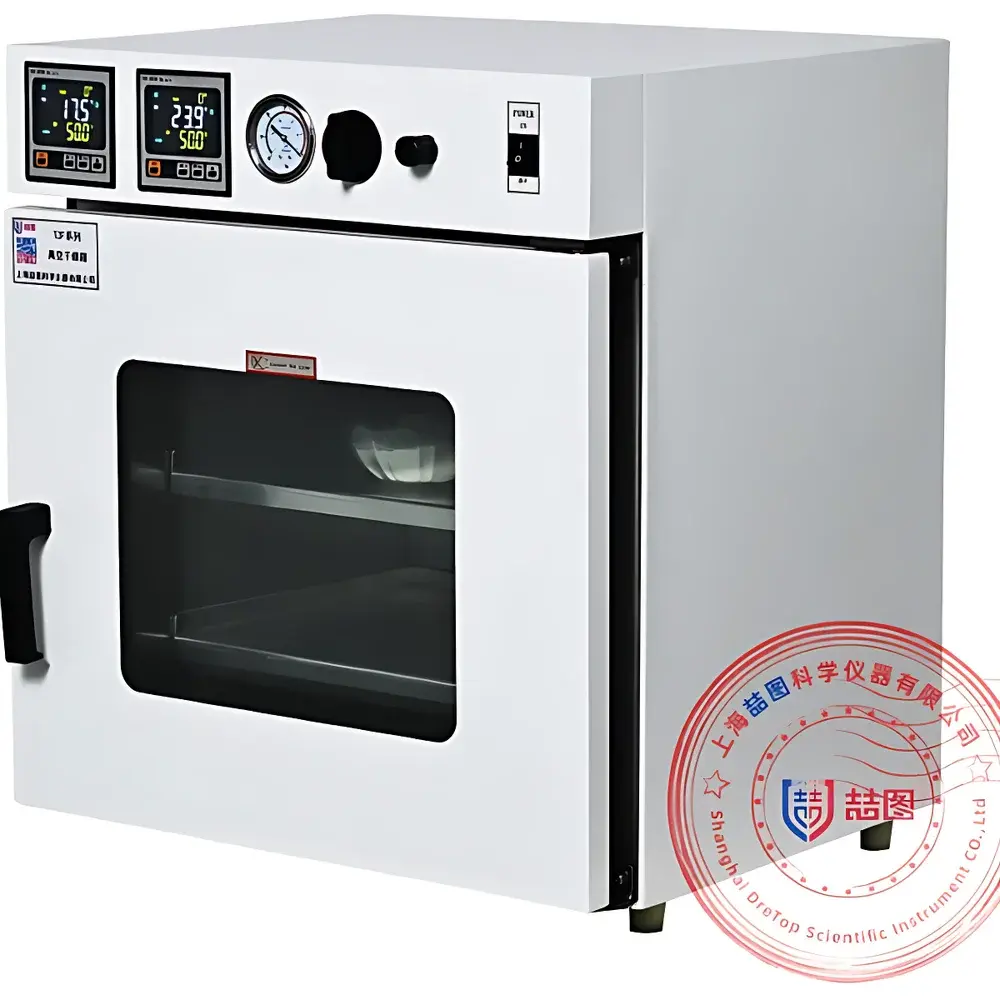
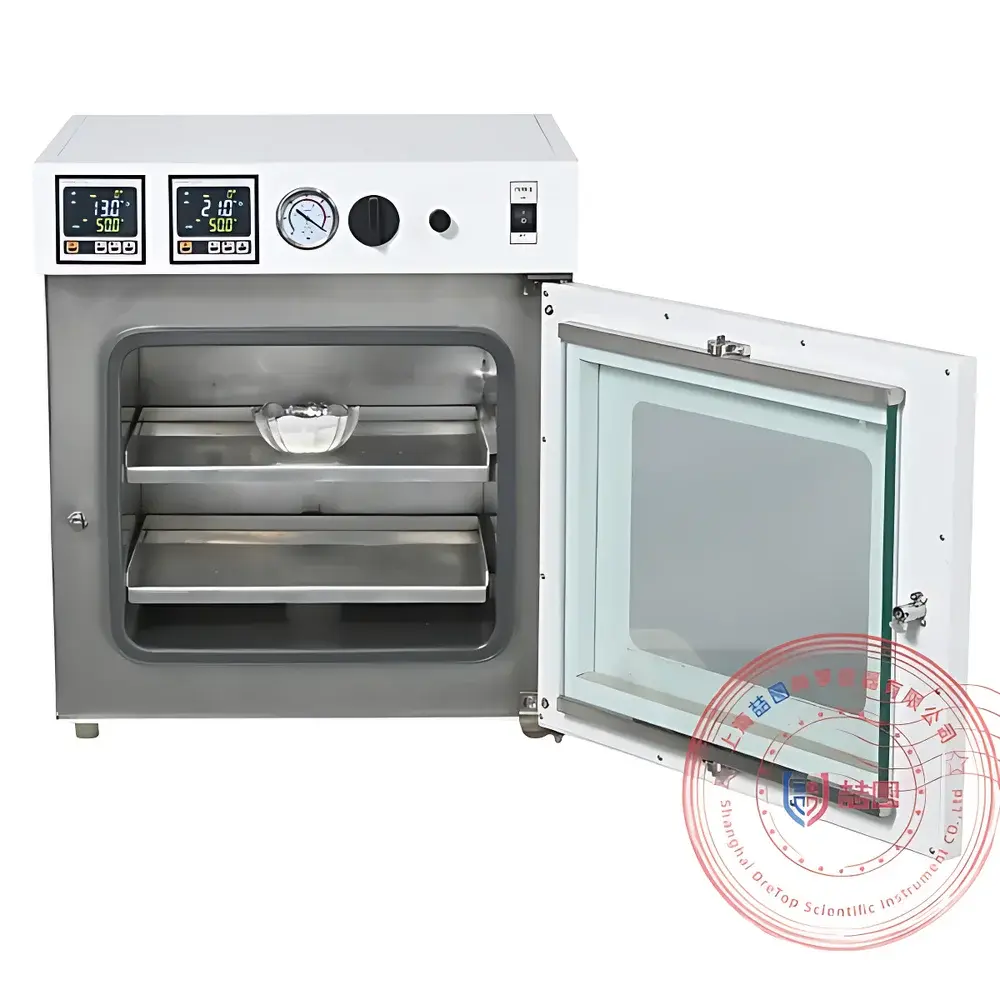
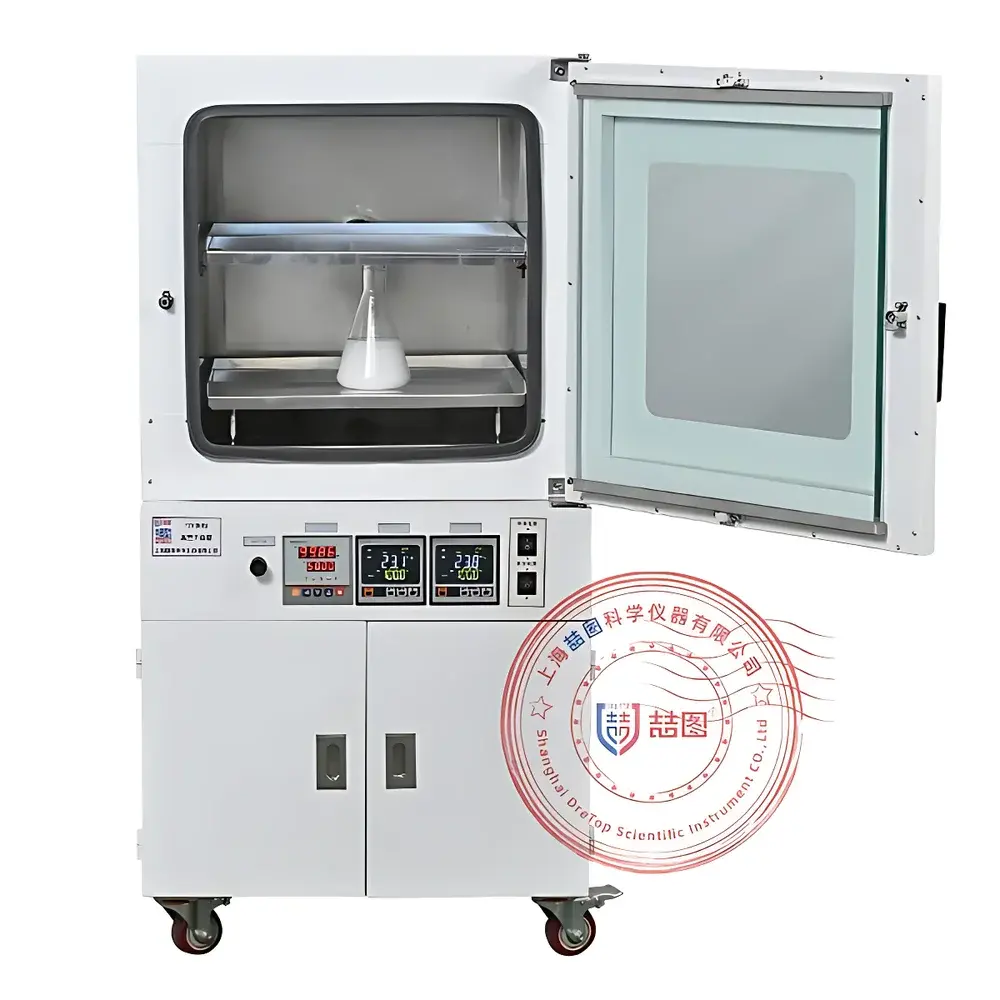
DRETOP PRO-1822 316 Stainless Steel Vacuum Drying Oven with Cold Trap
| Brand | DRETOP |
|---|---|
| Origin | Shanghai, China |
| Model | PRO-1822 |
| Instrument Type | Vacuum Oven |
| Temperature Range | RT+10°C to 300°C |
| Temperature Uniformity | ±0.1°C |
| Temperature Fluctuation | ±0.5°C |
| Temperature Resolution | 0.1°C |
| Vacuum Level | ≤133 Pa |
| Chamber Material | ASTM A240 S31603 Stainless Steel |
| Heating Method | Forced Air Circulation |
Overview
The DRETOP PRO-1822 is a high-performance vacuum drying oven engineered for precision thermal processing under controlled low-pressure environments. It operates on the fundamental principle of vacuum-assisted dehydration: by evacuating ambient air via integrated vacuum interface (standard KF25), the boiling point of volatile components—especially water and solvents—is significantly lowered, enabling gentle, oxidation-free drying at reduced temperatures. Unlike conventional convection ovens, the PRO-1822 eliminates convective heat transfer and oxygen exposure, making it indispensable for thermally labile compounds, hygroscopic materials, and oxygen-sensitive samples such as lithium cathode precursors, pharmaceutical intermediates, and semiconductor packaging substrates. Its chamber is constructed entirely from ASTM A240 S31603 stainless steel—a grade selected for superior resistance to chloride-induced pitting and corrosion from organic acids, alkaline residues, and halogenated solvents commonly encountered in battery electrolyte formulation or photolithography residue removal.
Key Features
- Corrosion-resistant S31603 stainless steel chamber and door gasket seating surface—validated per ASTM G48 for resistance to 10% FeCl₃ solution and compliant with ISO 10993-15 for biocompatibility-critical applications.
- Integrated cold trap (liquid nitrogen or recirculating chiller compatible) positioned upstream of the vacuum pump inlet, condensing vapors—including water, NMP, DMF, and low-boiling esters—to protect pump integrity and extend service intervals.
- Microprocessor-based PID temperature controller with dual-sensor redundancy, programmable ramp-soak profiles, and independent overtemperature cut-off (hardware-limited at 320°C) meeting IEC 61000-4-2/4-4 immunity requirements.
- Forced-air circulation system with tangential blower and baffle-guided airflow ensures uniform thermal distribution (±0.1°C across chamber volume) without turbulence-induced particle displacement—critical for fragile thin-film devices or nanoparticle agglomerates.
- Double-layer tempered glass observation window with anti-fog coating and argon-filled interlayer, providing real-time visual monitoring while maintaining vacuum integrity and thermal insulation (U-value <0.8 W/m²·K).
- Dual-stage rotary latch mechanism with fluorosilicone door seal (operating range: –40°C to +250°C) achieves leak rate <1×10⁻³ Pa·m³/s per ISO 20484, verified via helium mass spectrometry.
- Comprehensive safety architecture: earth leakage circuit breaker (30 mA), thermal fuse backup, short-circuit protected heating elements, and non-volatile parameter memory preserving setpoints after power interruption.
Sample Compatibility & Compliance
The PRO-1822 accommodates diverse sample formats—including wafers (up to 8-inch diameter), pouch cells, ceramic substrates, lyophilized vials, and powder-filled crucibles—without risk of oxidation, decomposition, or mechanical dispersion. Its inert S316 chamber complies with USP for extractables profiling and supports GLP/GMP workflows requiring audit-trail-capable operation. When paired with optional inert gas purge (N₂ or Ar via mass flow-controlled inlet), the system meets ASTM E1527-21 criteria for residual solvent analysis preparation and ISO 14644-1 Class 5 cleanroom-compatible drying protocols. All electrical components conform to UL 61010-1 and CE EN 61000-6-3 emission standards.
Software & Data Management
Equipped with RS485 Modbus RTU interface as standard, the PRO-1822 integrates seamlessly into centralized laboratory automation networks. Optional color touchscreen controller (DRETOP LP-700 series) provides 21 CFR Part 11-compliant electronic records—including user authentication, change audit trails, digital signature capture, and encrypted data export to CSV or PDF. Temperature and vacuum logs are timestamped with NTP-synchronized accuracy (±100 ms), and alarm events trigger automatic screenshot capture and email/SMS notification via optional Ethernet gateway module. Data retention exceeds 100,000 cycles without degradation, satisfying FDA requirement for long-term stability study documentation.
Applications
- Lithium-ion battery R&D: Electrode drying pre-calendering, separator moisture removal (<10 ppm H₂O), and solid-state electrolyte annealing under O₂-free conditions.
- Pharmaceutical manufacturing: Final drying of sterile APIs post-crystallization, excipient dehydration for direct compression blends, and residual solvent reduction per ICH Q3C thresholds.
- Semiconductor packaging: Wafer-level underfill curing, die-attach adhesive degassing, and flux residue volatilization prior to wire bonding.
- Materials science: MOF activation, aerogel supercritical drying precursor stabilization, and graphene oxide reduction without carbon defect formation.
- Environmental testing labs: Soil/sediment moisture content determination per ASTM D2216, and PCB congener stabilization prior to GC-MS analysis.
FAQ
What vacuum pumps are recommended for optimal performance with the PRO-1822?
DRETOP recommends oil-sealed rotary vane pumps (e.g., Edwards RV8) for ultimate base pressure (<5×10⁻³ Pa), or corrosion-resistant diaphragm pumps (e.g., KNF N814.3T) when handling acidic vapors. All pumps must be paired with the integrated cold trap to prevent oil contamination and premature wear.
Can the PRO-1822 operate under inert atmosphere without vacuum?
Yes—via optional mass-flow-controlled inert gas inlet (N₂, Ar, or forming gas), the chamber can be pressurized up to 1.2 bar(g) for annealing or passivation processes, with integrated pressure relief valve and burst disc per PED 2014/68/EU.
Is validation support available for IQ/OQ/PQ documentation?
DRETOP provides factory-verified calibration certificates traceable to NIST standards, along with customizable URS-aligned validation protocols (including sensor mapping, vacuum decay testing, and thermal uniformity qualification per ASTM E2297).
How is temperature uniformity verified across the working volume?
Per internal QA procedure DP-PRO1822-03, 9-point thermocouple mapping (per IEC 60068-3-5) is performed at 100°C, 150°C, and 250°C using calibrated Class A Pt100 sensors; results are archived with uncertainty budgets ±0.15°C (k=2).



