
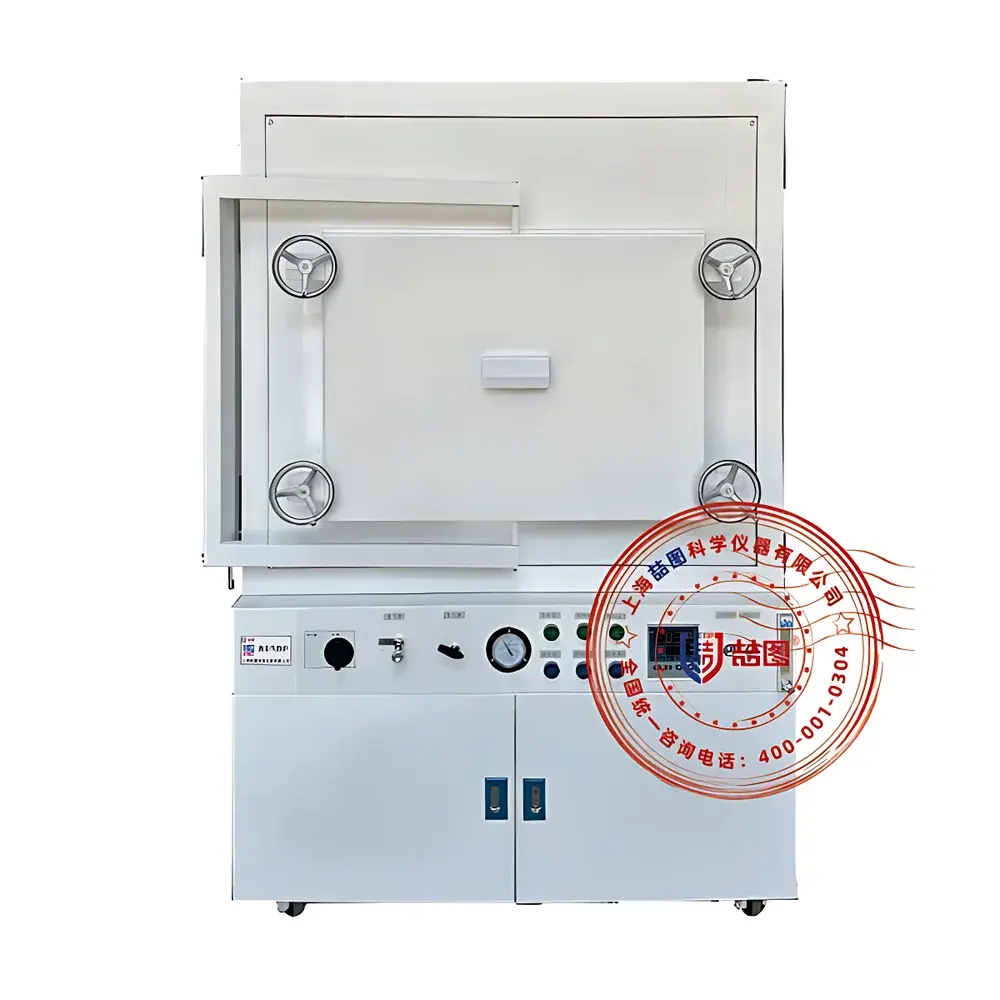
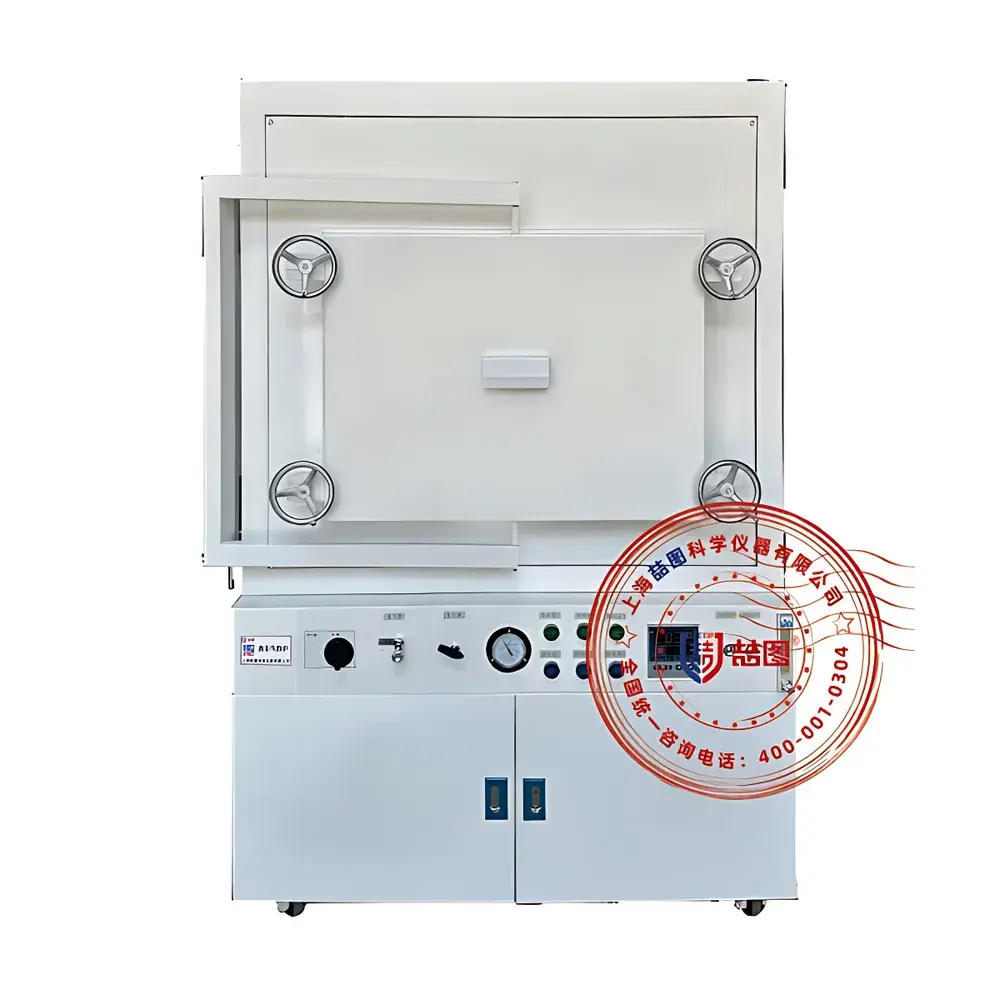
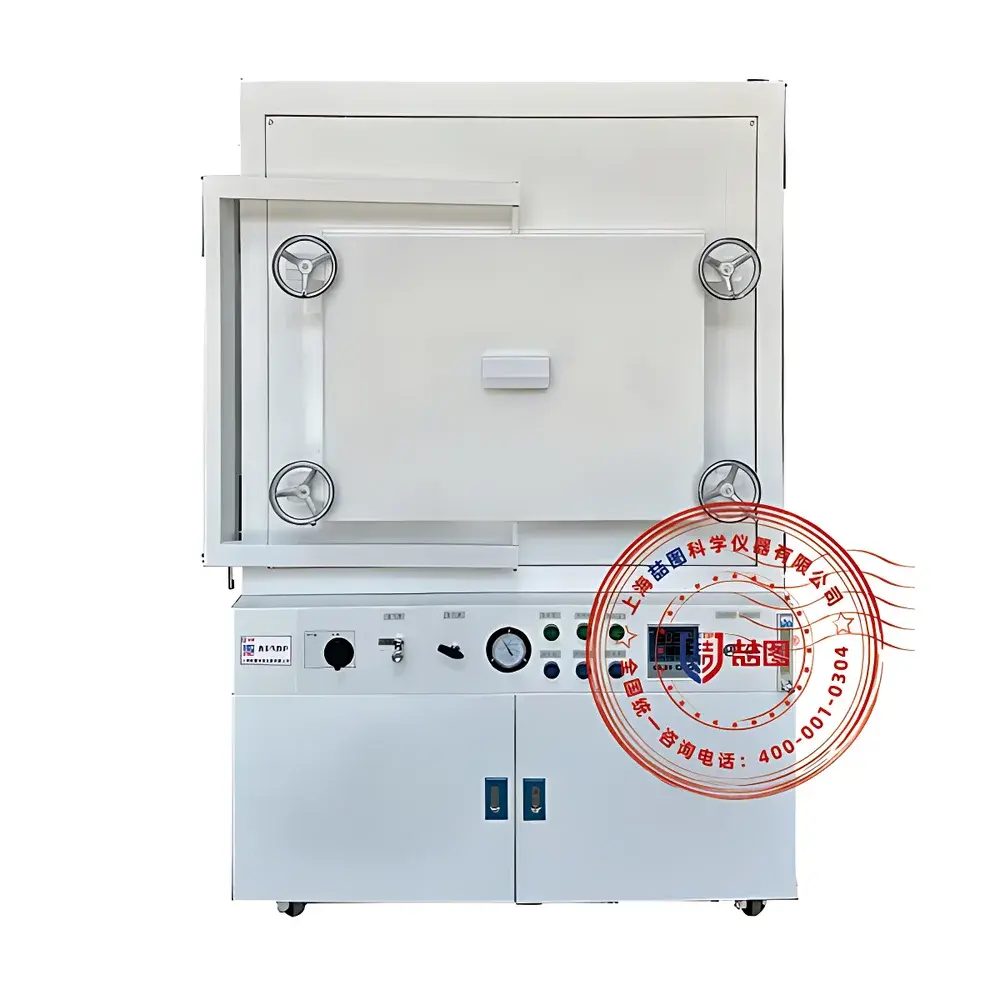
DRETOP QVB-9-16P Box-Type Vacuum & Atmosphere Muffle Furnace
| Brand | DRETOP |
|---|---|
| Origin | Shanghai, China |
| Model | QVB-9-16P |
| Furnace Type | Box-type |
| Max. Operating Temperature | 1600 °C (Continuous Use ≤1500 °C) |
| Temperature Control Accuracy | ±1 °C |
| Max. Input Power | 18000 W |
| Heating Rate to Max. Temp. | ≤30 min |
| Heating Elements | Silicon Molybdenum (MoSi₂) Rods |
| Internal Chamber Dimensions | 200 × 300 × 150 mm |
| Nominal Chamber Volume | 9 L |
| Control System | Programmable PID Controller with Auto-Tuning |
| Vacuum Capability | ≤−0.1 MPa (100 Pa) |
| Pressure Regulation Range | 10–1000 mbar (Gauge) |
| Max. Positive Pressure Rating | 0.02 MPa (200 mbar) |
| Safety Protections | Over-Temperature, Over-Pressure, Over-Current, Ground Fault, Thermocouple Break Detection, Password-Protected Parameter Access |
| Cooling Options | Forced inert gas purge or external ambient air convection |
| Compliance | Designed for GLP/GMP-aligned lab environments |
Overview
The DRETOP QVB-9-16P is a high-temperature box-type vacuum and controlled-atmosphere muffle furnace engineered for precision thermal processing under reproducible low-oxygen or inert gas conditions. It integrates vacuum technology with programmable thermal control to enable oxidation-free annealing, sintering, brazing, calcination, and heat treatment of advanced ceramics, refractory metals, functional oxides, and specialty alloys. Operating up to 1600 °C (with continuous service rated at ≤1500 °C), the furnace employs silicon molybdenum (MoSi₂) heating elements mounted in a double-walled, fiber-insulated chamber—ensuring rapid thermal response, uniform temperature distribution (<±3 °C radial gradient at 1500 °C), and surface temperatures below 60 °C under full load. Its sealed chamber design supports both dynamic vacuum pumping (down to 100 Pa) and precise partial-pressure atmosphere control (10–1000 mbar), making it suitable for processes requiring strict stoichiometric control—such as reduction of metal oxides, carburization inhibition, or volatile impurity removal via vacuum degassing.
Key Features
- Robust dual-shell construction with high-density ceramic fiber insulation and stainless-steel inner lining, minimizing thermal loss and enabling energy-efficient operation.
- Integrated vacuum system including mechanical rotary vane pump (rated ≤10⁻¹ Pa ultimate pressure) and digital vacuum gauge with real-time feedback to the controller.
- Multi-stage programmable temperature profile capability (up to 30 segments), supporting ramp-hold-cool sequences with independent rate and dwell settings.
- Intelligent PID controller with self-tuning algorithm, adaptive learning, and fuzzy logic compensation for stable setpoint maintenance across wide thermal loads.
- Gas inlet manifold with mass flow controller (MFC)-compatible interface and calibrated needle valves for accurate inert gas (N₂, Ar) or reducing gas (e.g., 5% H₂/N₂) introduction.
- Comprehensive safety architecture: redundant thermocouple monitoring, pressure interlock circuitry, automatic power cutoff on vacuum breach or overpressure event, and encrypted parameter lockout.
- Front-loading horizontal chamber with reinforced quartz-glass viewport (optional) and water-cooled flange for extended observation during high-temperature operation.
Sample Compatibility & Compliance
The QVB-9-16P accommodates samples up to 9 L volume (200 × 300 × 150 mm internal dimensions), supporting crucibles of alumina, zirconia, graphite, or molybdenum—compatible with most oxide, nitride, carbide, and metallic systems. It meets structural and operational requirements for ISO 15148 (vacuum furnace performance testing), ASTM F2621 (thermal processing of medical device components), and USP (thermal sterilization validation). The furnace’s pressure-rated chamber (0.02 MPa max working pressure) and documented thermal uniformity data support IQ/OQ documentation per FDA 21 CFR Part 11 and EU Annex 11 guidelines. All electrical components comply with IEC 61000-6-3 (EMC) and IEC 61000-6-4 (immunity) standards.
Software & Data Management
The embedded controller logs time-stamped temperature, pressure, and power data at user-defined intervals (1–60 s resolution) to internal non-volatile memory (≥10,000 cycles retention). Optional RS485/Modbus RTU or Ethernet TCP/IP interface enables integration with LabVIEW, MATLAB, or enterprise MES platforms. Data export is supported via USB flash drive in CSV format, preserving audit trail integrity—including operator ID, program version, and deviation flags. Full electronic record compliance includes tamper-evident timestamps, user-level access control (admin/operator/guest), and configurable alarm history retention (≥30 days). Raw data files are compatible with JMP, OriginLab, and Python-based analysis pipelines for statistical process control (SPC) and DoE modeling.
Applications
- Oxidation-sensitive sintering of TiAl, Ni-based superalloys, and rare-earth permanent magnets (NdFeB, SmCo).
- Vacuum annealing of semiconductor substrates (SiC, GaN wafers) and optical-grade fused silica components.
- Controlled-atmosphere synthesis of Li-ion battery cathode materials (NMC, LFP) and solid electrolytes (LLZO, LATP).
- Thermal gravimetric analysis (TGA) pre-conditioning and ash content determination per ASTM D3174.
- High-purity ceramic densification (Al₂O₃, Y₂O₃, Si₃N₄) without grain boundary contamination.
- Calibration standard preparation for thermocouple wire (Type B, R, S) and fixed-point cells (Ag, Cu, Co-C).
FAQ
What vacuum level can the QVB-9-16P achieve, and how is it measured?
The furnace achieves ≤100 Pa (0.1 mbar) base pressure using the integrated two-stage rotary vane pump. A digital piezoresistive vacuum gauge provides real-time readout with ±5% full-scale accuracy, traceable to NIST standards.
Can hydrogen be used safely in this furnace?
Hydrogen is not recommended due to explosion risk above 4% concentration in air. If required, use only with certified explosion-proof accessories, external hydrogen sensors, and strict adherence to NFPA 55 and CGA G-5.5 protocols.
Is the furnace suitable for GMP-regulated production environments?
Yes—when configured with optional 21 CFR Part 11-compliant software, electronic signature support, and full audit trail generation, it satisfies GMP Annex 15 and PIC/S PE 009 requirements for qualified thermal equipment.
How is temperature uniformity validated across the chamber?
Uniformity is verified per ASTM E2203 using nine-point mapping with calibrated Class 1 platinum resistance thermometers (PRTs), performed at 1000 °C, 1300 °C, and 1500 °C prior to shipment.
What maintenance is required for long-term vacuum integrity?
Quarterly inspection of O-rings (Viton® FKM), annual calibration of vacuum gauge and thermocouples, and biannual replacement of pump oil are recommended. A leak-check protocol using helium mass spectrometry is included in the user manual.



