
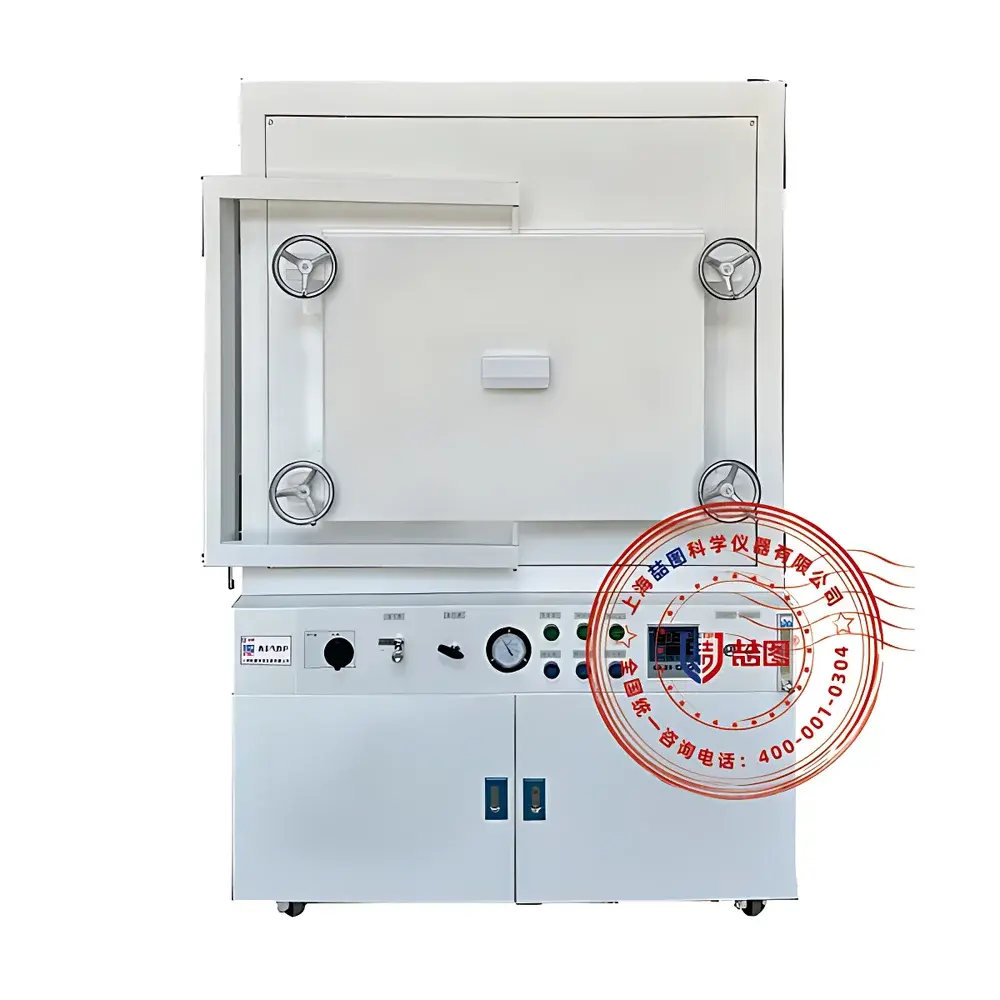
DRETOP QVS-36-14P Box-Type Vacuum & Controlled-Atmosphere Muffle Furnace
| Brand | DRETOP |
|---|---|
| Origin | Shanghai, China |
| Manufacturer Type | Direct Manufacturer |
| Product Category | Domestic |
| Model | QVS-36-14P |
| Instrument Type | Box-Type Furnace |
| Maximum Temperature | 1400 °C |
| Temperature Control Accuracy | ±1 °C |
| Rated Power | 16 kW |
| Internal Dimensions | 400 × 300 × 300 mm |
| Nominal Chamber Volume | 36 L |
| Heating Element | Silicon Carbide Rods |
| Control System | Microcomputer-Based AI Controller |
| Vacuum Performance | ≤ −0.1 MPa (absolute) |
| Operating Pressure Range | 0.01–0.02 MPa (gauge) |
| Safety Features | Over-Temperature, Over-Pressure, Over-Current, Leakage Protection, Thermocouple Failure Cut-off, Password-Protected Parameter Access |
Overview
The DRETOP QVS-36-14P is a precision-engineered box-type muffle furnace integrating high-vacuum capability with programmable inert or reactive gas atmosphere control. Designed for advanced thermal processing in research and industrial laboratories, it operates on the principle of vacuum-assisted thermal treatment—where process environments are maintained at pressures significantly below atmospheric (≤ −0.1 MPa absolute), eliminating oxidative, carburizing, and decarburizing reactions. Unlike conventional air or inert-gas furnaces, this system enables true oxide-free annealing, sintering, brazing, and degassing by removing ambient oxygen prior to heating and sustaining controlled partial pressures (10–1000 mbar) during thermal cycles. Its operational envelope spans from ambient +50 °C up to 1400 °C, with continuous duty rated at ≤1300 °C—making it suitable for high-stability heat treatment of refractory metals, ceramics, battery cathode materials, and advanced composites.
Key Features
- Robust dual-layer steel shell construction with high-efficiency ceramic fiber insulation, minimizing surface temperature rise and improving energy efficiency.
- High-purity silicon carbide (SiC) heating elements delivering uniform radiant heating and long service life under repeated thermal cycling.
- Microcomputer-based AI controller with PID tuning, auto-tuning function, and multi-segment programmable ramp-soak-cool profiles (up to 30 segments per program).
- Integrated vacuum system including mechanical vacuum pump and calibrated analog vacuum gauge; achieves base pressure ≤ −0.1 MPa within 30 minutes (typical).
- Gas inlet manifold with precision mass flow metering (optional upgrade available), enabling accurate regulation of N₂, Ar, He, or forming gas mixtures at pressures between 0.01–0.02 MPa gauge.
- Comprehensive safety architecture: real-time monitoring of chamber pressure, thermocouple integrity, current draw, and ground leakage; automatic shutdown upon fault detection.
- Front-access horizontal chamber design with reinforced quartz or alumina viewing window (optional), facilitating visual process observation without compromising vacuum integrity.
Sample Compatibility & Compliance
The QVS-36-14P accommodates a broad spectrum of sample geometries and material classes—including metallic alloys (e.g., stainless steel, titanium, nickel-based superalloys), powder metallurgy compacts, ceramic green bodies, semiconductor substrates, and catalytic precursors. Its 36 L chamber volume and 400 × 300 × 300 mm internal dimensions support batch processing of multiple crucibles or custom fixtures. The furnace meets structural and electrical safety requirements per IEC 61000-6-3 (EMC) and IEC 61000-6-4, and its control firmware supports audit-ready operation under GLP and GMP frameworks when configured with optional data logging and electronic signature modules compliant with FDA 21 CFR Part 11.
Software & Data Management
The embedded controller logs time-stamped temperature, pressure, and power data at user-defined intervals (1–60 s). Export is supported via USB interface in CSV format for traceable post-processing in MATLAB, Python, or LIMS platforms. Optional Ethernet/WiFi connectivity enables remote monitoring and integration into centralized lab automation systems. All parameter changes—including setpoints, alarm thresholds, and password access levels—are recorded with timestamp and operator ID, satisfying documentation requirements for ISO/IEC 17025-accredited laboratories.
Applications
- Oxide-free annealing of copper, silver, platinum, and aluminum alloys—preserving surface reflectivity and dimensional stability.
- Sintering of oxide ceramics (Al₂O₃, ZrO₂), nitrides (Si₃N₄), and carbides (SiC, WC-Co) under vacuum or low-pO₂ atmospheres.
- Thermal debinding and pyrolysis of polymer-bonded metal injection molding (MIM) parts.
- Heat treatment of lithium-ion battery cathode precursors (e.g., NMC, LFP) to optimize crystallinity and cation ordering.
- High-temperature calibration of thermocouples and reference materials per ASTM E230/E230M.
- Controlled-atmosphere brazing of aerospace-grade components using Cu-P or Ag-Cu-Zn filler metals.
FAQ
What vacuum level can the QVS-36-14P achieve, and how is it measured?
The furnace achieves a base vacuum of ≤ −0.1 MPa (absolute), verified using a calibrated Pirani + thermocouple composite vacuum gauge mounted directly on the chamber flange.
Can hydrogen be used as a process gas?
Hydrogen is not recommended due to explosion risk; the system is certified for use with inert gases (N₂, Ar, He) and reducing mixtures such as 5% H₂/95% N₂ only when installed with additional explosion-proof venting and gas detection per IEC 60079-10-1.
Is the furnace compatible with automated sample handling systems?
Yes—the unit provides dry-contact relay outputs and Modbus RTU over RS485 for integration with robotic arms, conveyor loaders, or PLC-controlled material transfer systems.
What is the maximum safe operating pressure inside the chamber during gas purging?
The working pressure must remain between 0.01 and 0.02 MPa gauge; exceeding 0.025 MPa voids warranty and violates ASME BPVC Section VIII Division 1 design limits.
Does the furnace support ISO/IEC 17025-compliant calibration records?
Yes—when equipped with optional NIST-traceable Class 1 thermocouple calibration kit and digital log export, full calibration history and uncertainty budgets can be generated per ILAC-G8:2022 requirements.



