
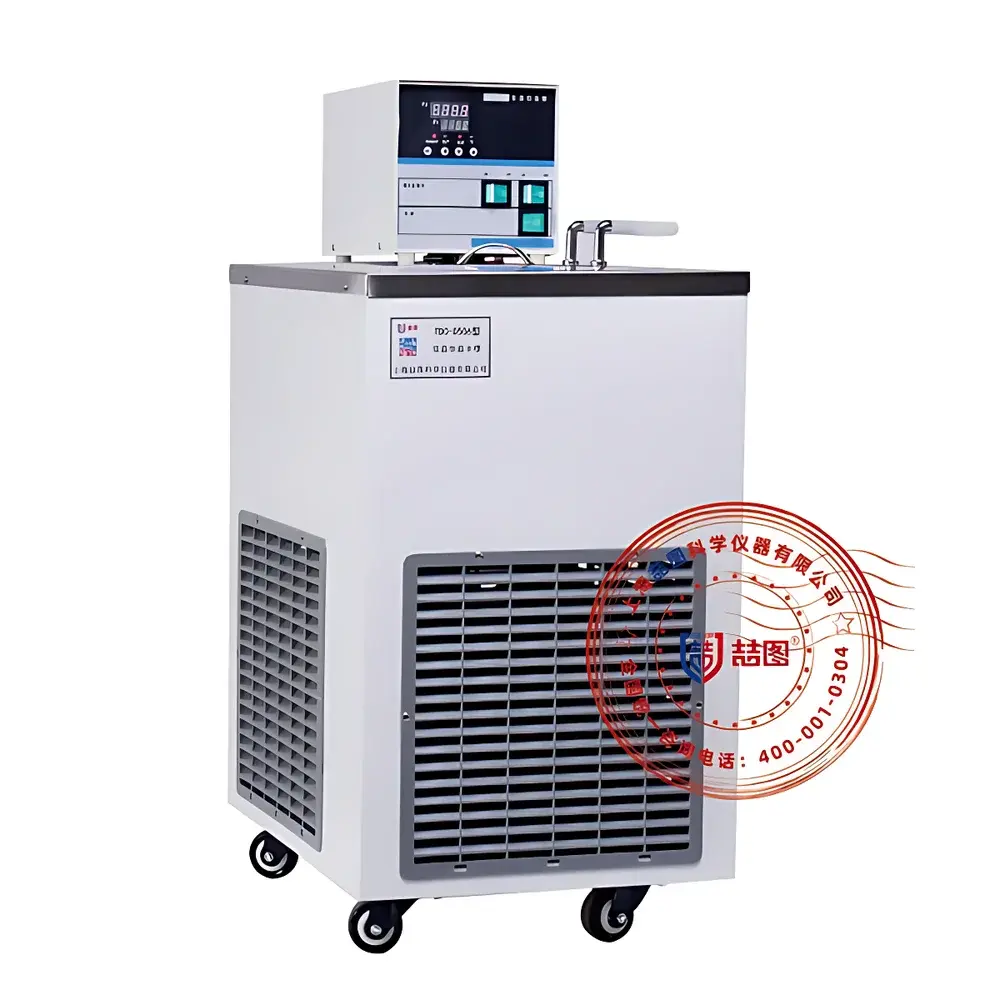
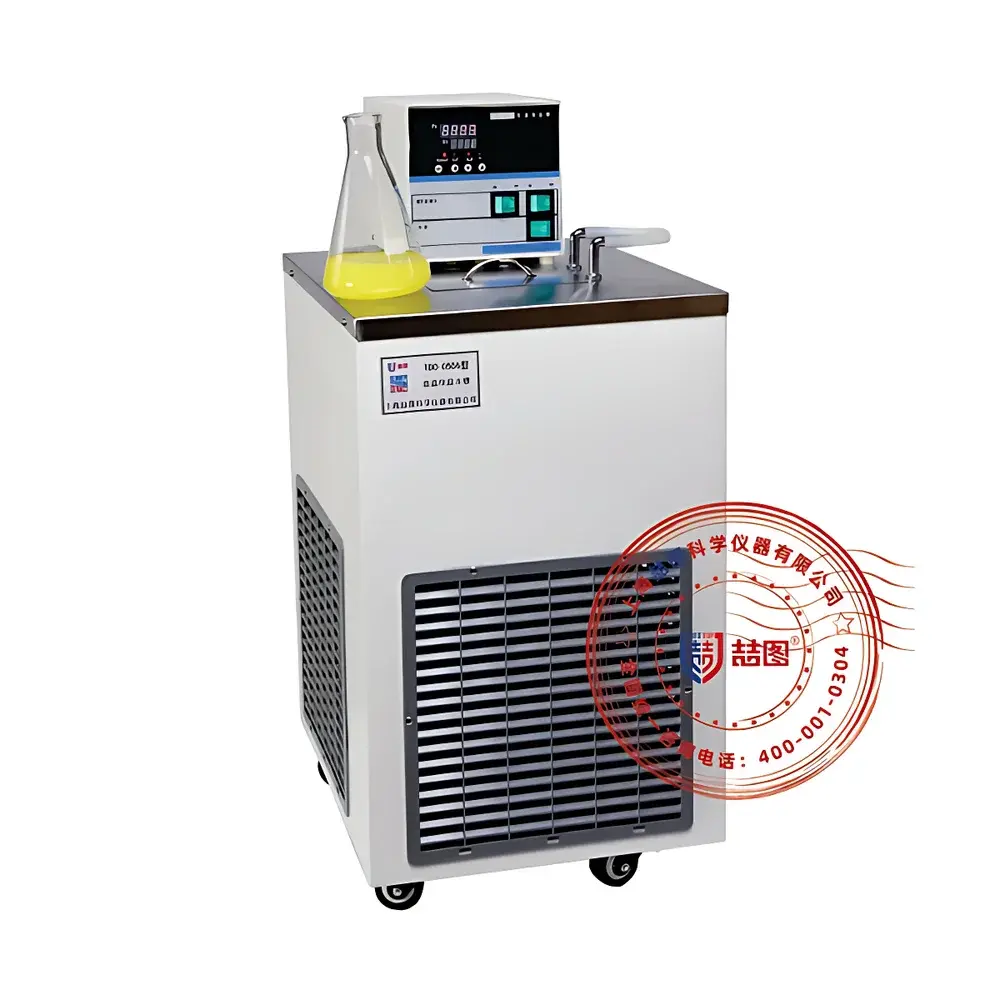
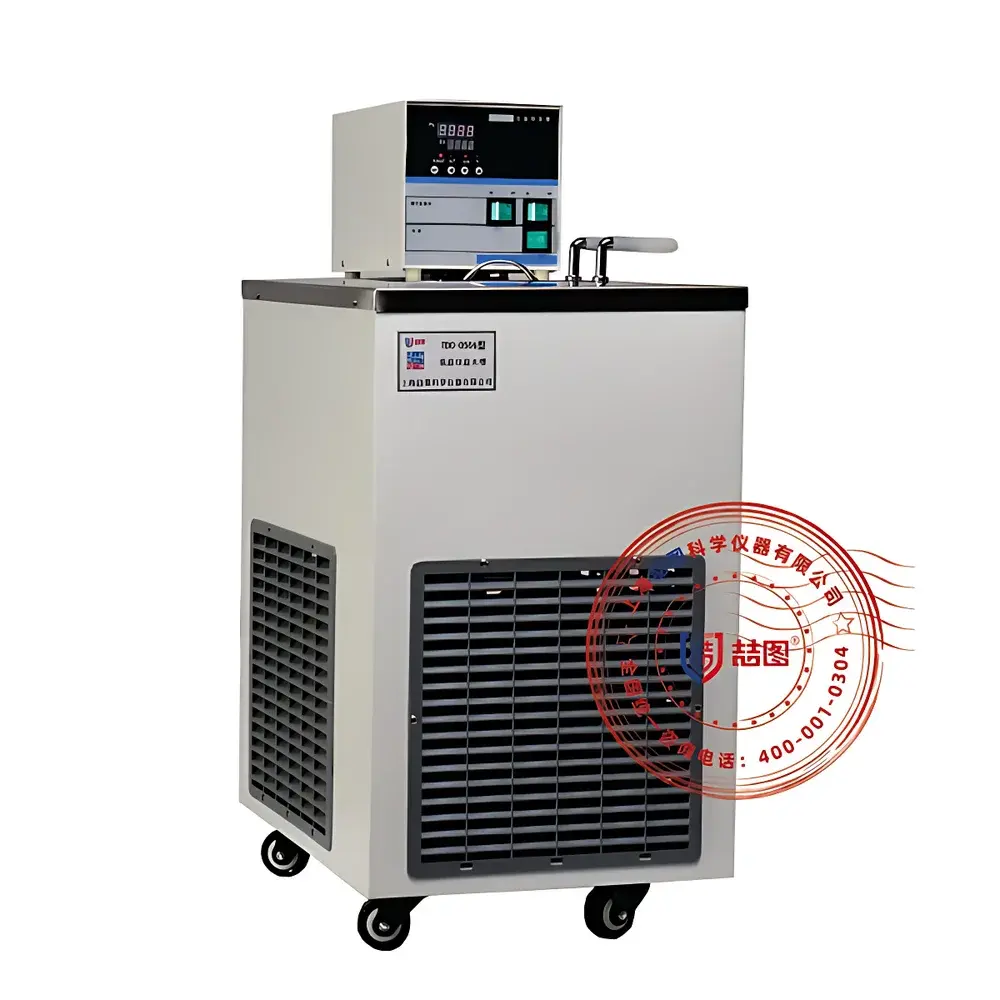
DRETOP TDC-0506 Precision Low-Temperature Circulating Bath
| Brand | DRETOP |
|---|---|
| Origin | Shanghai, China |
| Manufacturer Type | Direct Manufacturer |
| Model | TDC-0506 |
| Instrument Type | Circulating Temperature Bath |
| Circulation Mode | Internal & External |
| Temperature Control | Refrigeration + Heating |
| Bath Volume | 6 L |
| Temperature Range | −5 °C to 100 °C |
| Temperature Stability | ±0.1 °C |
| Temperature Resolution | 0.1 °C |
| Power Supply | 220 V, 50 Hz |
| Construction | 304 Stainless Steel Interior & Work Surface |
| Display & Control | LCD Touch Panel with PID Algorithm |
| Safety Protections | Over-temperature alarm, low-level fluid detection, compressor overheat/overcurrent protection, power-fail memory |
Overview
The DRETOP TDC-0506 Precision Low-Temperature Circulating Bath is a compact, benchtop-compatible thermal control system engineered for high-reproducibility temperature regulation in laboratory and industrial R&D environments. Utilizing a closed-loop refrigeration-heating cycle with dual-stage thermoelectric and compressor-assisted cooling, the unit delivers stable, uniform thermal environments across a broad operational range (−5 °C to 100 °C). Its design follows the Couette flow principle in internal circulation—employing a heat-isolated, brushless centrifugal pump to eliminate self-heating artifacts and ensure minimal thermal gradient (< ±0.05 °C uniformity in standard operation). As a self-contained constant-temperature source, it functions both as a direct immersion bath and as an external thermal interface for reactors, condensers, synthesis modules, and analytical instrumentation requiring precise auxiliary temperature control.
Key Features
- High-accuracy PID temperature control algorithm with real-time adaptive tuning, enabling rapid stabilization (<15 min to ±0.1 °C at 25 °C) and minimal overshoot
- 304 stainless steel tank and work surface—corrosion-resistant, non-porous, and compliant with ISO 15190:2020 (laboratory safety) and ASTM E2877-22 (thermal stability testing)
- Dual-circuit fluid management: integrated inlet/outlet ports support seamless transition between internal recirculation (via silicone tubing) and external loop connection to third-party equipment
- Drain valve assembly enables full media exchange without disassembly—critical for protocol compliance in GLP/GMP-regulated QC labs handling multiple solvents (e.g., ethylene glycol/water, anhydrous ethanol, or specialty low-temperature heat transfer fluids)
- Zero-heat-output circulation pump eliminates localized thermal drift; combined with multi-port U-shaped return manifold, ensures turbulent flow regime and homogeneous temperature distribution throughout the 6 L working volume
- Comprehensive hardware safeguards: electronic dry-run prevention, real-time compressor thermal monitoring, voltage fluctuation compensation, and automatic shutdown on sensor fault or fluid level anomaly
Sample Compatibility & Compliance
The TDC-0506 accommodates a wide spectrum of thermal media—including deionized water (5–80 °C), 1:2 ethylene glycol/water mixtures (−35–100 °C), ≥99.5% anhydrous ethanol (−80–20 °C), and non-volatile synthetic heat transfer fluids (−80–100 °C). All wetted surfaces are electropolished 304 stainless steel, certified per ASTM A240/A240M for resistance to chloride-induced pitting and compatible with USP Class VI pharmaceutical excipients. The unit meets IEC 61010-1:2010 safety requirements for laboratory electrical equipment and supports audit-ready documentation for FDA 21 CFR Part 11–compliant workflows when paired with optional data logging software.
Software & Data Management
While the TDC-0506 operates autonomously via its embedded microcontroller and tactile LCD interface, optional USB/RS-485 connectivity enables integration into centralized lab management systems. Logged parameters—including setpoint, actual bath temperature, pump status, and alarm history—are timestamped with millisecond precision and exportable in CSV format. Firmware supports configurable logging intervals (1 s–30 min), user-defined alarm thresholds, and password-protected parameter lockout—facilitating adherence to ISO/IEC 17025:2017 clause 7.7 (control of equipment records) and internal SOPs governing instrument qualification (IQ/OQ/PQ).
Applications
- Calibration of temperature-sensitive sensors (RTDs, thermistors, infrared pyrometers) per ISO/IEC 17025 Clause 6.4.10
- Thermal conditioning of viscometers, densitometers, and refractometers prior to measurement
- Controlled cooling/heating of jacketed glass reactors during exothermic/endothermic synthesis (e.g., Grignard reactions, polymerization kinetics)
- Stabilization of laser diodes, photodetectors, and optical alignment stages in metrology labs
- Accelerated stability testing of pharmaceutical formulations under ICH Q1A(R3) guidelines
- Material property evaluation—including coefficient of thermal expansion (CTE), glass transition (Tg), and crystallinity onset—using DSC or TMA sample stages
FAQ
What thermal fluids are validated for use with the TDC-0506 at −40 °C?
Only certified low-viscosity, non-aqueous heat transfer fluids rated for ≤−40 °C (e.g., propylene glycol–ethanol–water ternary blends meeting MIL-PRF-27617 Type II specifications) are recommended. Aqueous glycol solutions freeze below −35 °C and must be avoided.
Can the TDC-0506 maintain ±0.01 °C stability over 24 hours?
Yes—when operated within its optimal range (10–60 °C) using deionized water and with ambient temperature variation <±2 °C, the standard model achieves ±0.02 °C long-term stability; the optional TDC-0506U upgrade provides ±0.01 °C specification per ASTM E2877-22 Annex A2.
Is external circulation compatible with pressurized reactor systems?
The unit’s maximum outlet pressure is 0.25 bar (gauge); it is intended for open-loop or gravity-fed external circuits only. For pressurized applications (>0.1 bar), a secondary buffer reservoir and pressure-regulated recirculator are required.
How often should the heat transfer fluid be replaced in routine QC use?
Deionized water: replace every 3 months; ethylene glycol/water (1:2): replace every 6 months; anhydrous ethanol: replace upon visible discoloration or >5% viscosity increase (measured via capillary viscometer per ASTM D445).
Does the TDC-0506 comply with EU RoHS and REACH directives?
Yes—certified per Directive 2011/65/EU (RoHS 2) and Regulation (EC) No. 1907/2006 (REACH), with full material declaration available upon request for supply chain due diligence.



