

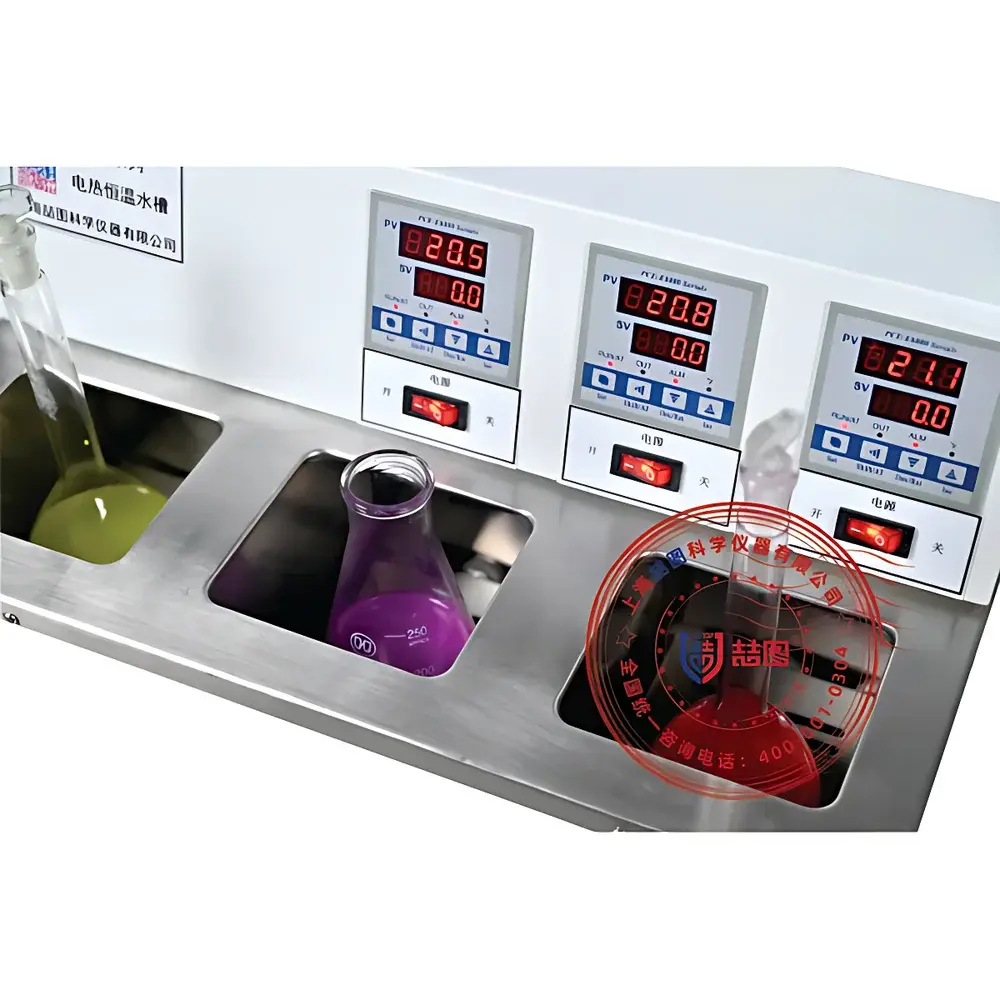
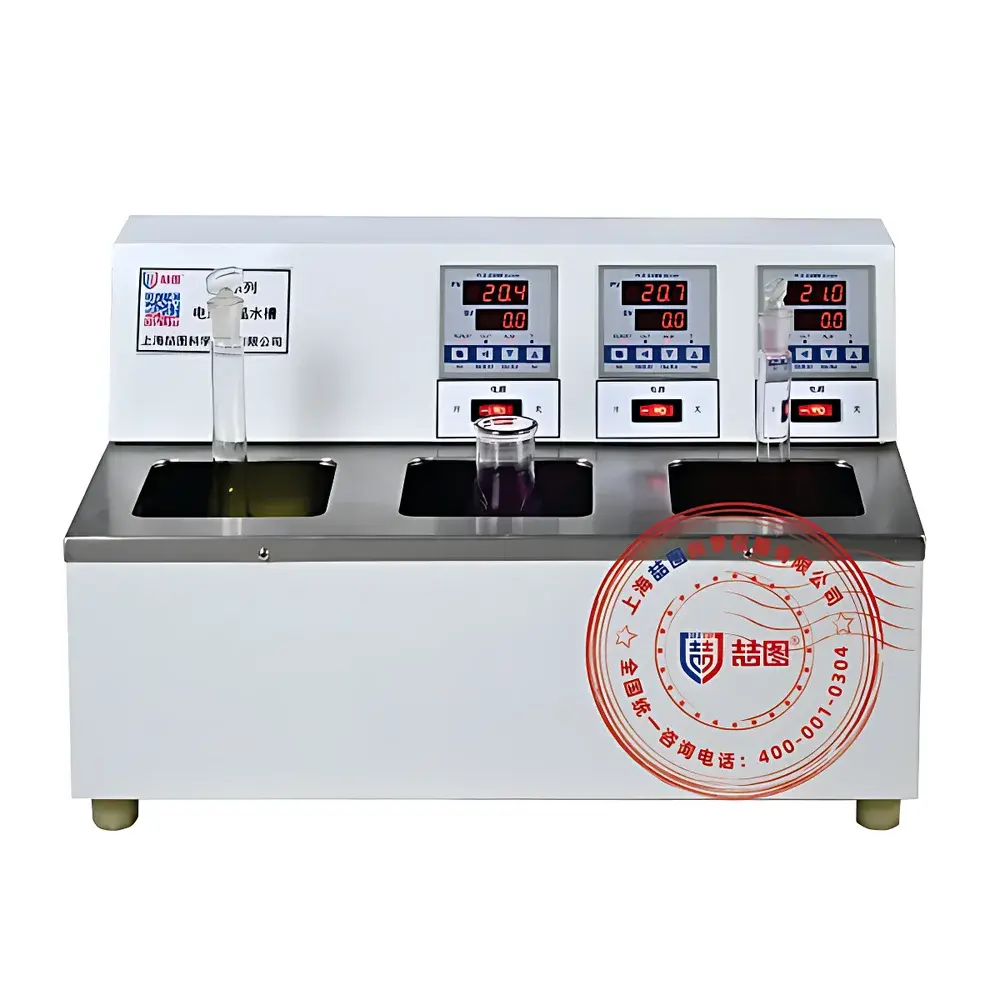
DRETOP TDK-8D Triple-Zone Independent Temperature-Controlled Water Bath
| Brand | DRETOP |
|---|---|
| Origin | Shanghai, China |
| Manufacturer Type | Direct Manufacturer |
| Country of Origin | China |
| Model | TDK-8D |
| Instrument Type | Constant-Temperature Bath |
| Circulation Function | Non-Circulating |
| Temperature Control Mode | Heating-Only |
| Total Capacity | 3 × 2.1 L (6.3 L total) |
| Temperature Range | RT + 5°C to 100°C |
| Temperature Stability | ±0.3°C |
| Temperature Resolution | 0.1°C |
| Input Power | 1500 W |
| Supply Voltage | AC 220 V, 50 Hz |
Overview
The DRETOP TDK-8D Triple-Zone Independent Temperature-Controlled Water Bath is a precision-engineered laboratory bath system designed for applications requiring simultaneous yet independent thermal control across three physically separated water compartments. Unlike conventional single-zone baths, the TDK-8D implements a true “three-control-three-temperature” architecture—each 2.1 L chamber is equipped with its own dedicated heating element, high-accuracy PT100 sensor, and microprocessor-based PID temperature controller. This configuration enables concurrent experiments at distinct setpoints (e.g., 37°C, 65°C, and 95°C) within a single footprint, eliminating cross-contamination risk and reducing inter-chamber thermal interference. The unit operates on resistive immersion heating without forced circulation, relying on natural convection and optimized internal geometry—including laser-cut 304 stainless steel perforated liners—to ensure uniform temperature distribution within each zone (±0.3°C stability at setpoint). Its design adheres to fundamental thermodynamic principles for static liquid-phase thermal equilibrium, making it suitable for ISO/IEC 17025-compliant calibration environments where traceable, reproducible heating is required.
Key Features
- Triple independent control zones: Three sealed, corrosion-resistant 304 stainless steel water chambers (2.1 L each), each with dedicated PID controller, high-sensitivity PT100 sensor, and sealed immersion heater.
- Precision temperature regulation: Microprocessor-based PID algorithm with auto-tuning capability; resolution of 0.1°C and stability of ±0.3°C at steady state across all zones.
- Durable construction: Electrostatically sprayed steel exterior; 304 stainless steel inner tank and lid; multi-layer insulated sidewalls to minimize heat loss and prevent external condensation.
- Integrated safety systems: Dry-run protection via submerged water-level sensor; over-temperature cut-off with audible/visual alarm; power-loss parameter retention and auto-recovery upon restart.
- User-centric interface: Large LED display with intuitive menu navigation; programmable timer (1–9999 minutes); real-time display of actual vs. set temperature per zone.
Sample Compatibility & Compliance
The TDK-8D accommodates standard laboratory glassware including test tubes (up to Ø25 mm), beakers (≤500 mL), flasks, and small-volume reaction vessels placed directly into any of the three zones. Its non-circulating design eliminates mechanical agitation, preserving delicate biological samples or sedimentation-sensitive suspensions. The unit complies with IEC 61010-1:2010 for electrical safety in laboratory equipment and meets GB/T 28026.1–2011 (Chinese national standard equivalent to EN 61010-1). While not intrinsically compliant with FDA 21 CFR Part 11, its optional RS485 interface supports integration into validated data acquisition systems when paired with audit-trail-capable software. For GLP/GMP environments, users may configure logging intervals and export timestamped temperature records per zone for traceability.
Software & Data Management
The TDK-8D operates as a standalone instrument with no embedded operating system. All control logic resides in hardened firmware; no external PC is required for basic operation. Optional accessories include an RS485 communication module (Modbus RTU protocol) enabling remote monitoring and setpoint adjustment via third-party SCADA or LIMS platforms. When connected, the device transmits real-time temperature readings from all three zones, operational status flags (heating active, alarm triggered, low-water condition), and timer countdown values. Data logging frequency is configurable (1–60 s intervals), and exported CSV files include ISO 8601 timestamps, zone identifiers, and raw sensor values—facilitating post-hoc analysis in MATLAB, Python, or Excel. Firmware updates are performed manually via USB-to-serial adapter and vendor-provided utility.
Applications
- Biochemical incubation: Simultaneous enzyme assays at varying activation temperatures (e.g., amylase at 40°C, protease at 55°C, lipase at 37°C).
- Pharmaceutical QC: Dissolution testing of multiple tablet batches under USP conditions using separate dissolution vessels per zone.
- Material science: Controlled aging of polymer films or hydrogels at discrete thermal histories without cross-zone thermal coupling.
- Environmental analysis: Parallel BOD incubation, nutrient digestion (EPA Method 365.4), and microbial enrichment at species-specific optimal temperatures.
- Educational labs: Multi-group experiments in undergraduate chemistry or microbiology courses—each student team assigned a dedicated, independently controlled zone.
FAQ
Does the TDK-8D support refrigeration or sub-ambient operation?
No. The TDK-8D is a heating-only bath with a minimum operating temperature of ambient +5°C. For cooling capability, consider the DRETOP TDK-24R series (15–70°C range) or integrate an external chiller via custom manifold.
Can the three zones be operated at identical temperatures simultaneously?
Yes. Each zone is fully independent but can be programmed to the same setpoint; the system maintains synchronization without mutual interference.
Is distilled water mandatory for operation?
Distilled or Type III purified water is strongly recommended. Tap water introduces mineral deposits that impair heater efficiency, accelerate sensor drift, and compromise long-term stability—particularly critical in regulated environments.
What maintenance is required to sustain ±0.3°C stability?
Monthly descaling with 5% citric acid solution (followed by triple rinse), quarterly verification of sensor calibration against a NIST-traceable reference thermometer, and annual inspection of silicone gaskets for seal integrity.
Does the unit meet CE or UL certification requirements?
It carries CCC (China Compulsory Certification) and conforms to IEC 61010-1:2010. CE marking is not applied; UL listing is not available. Customers requiring North American certification should consult DRETOP’s engineering team for OEM evaluation pathways.



