
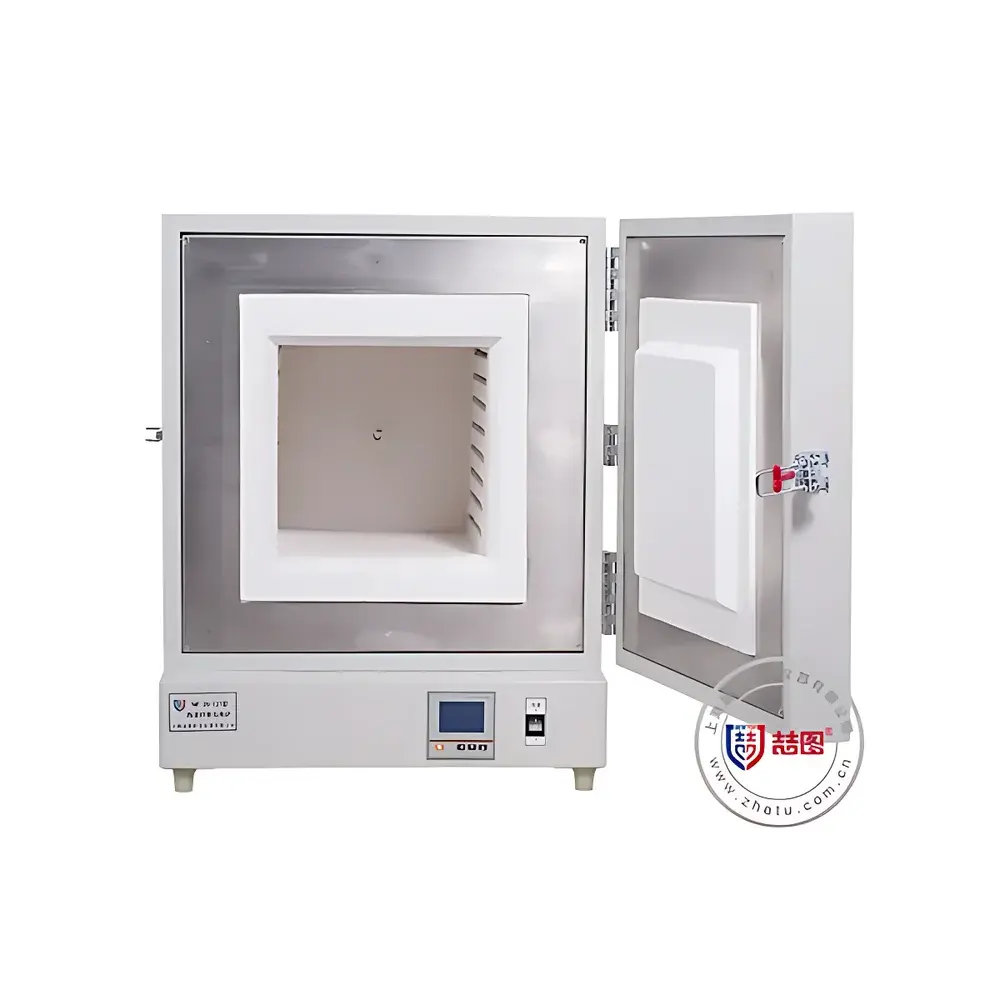
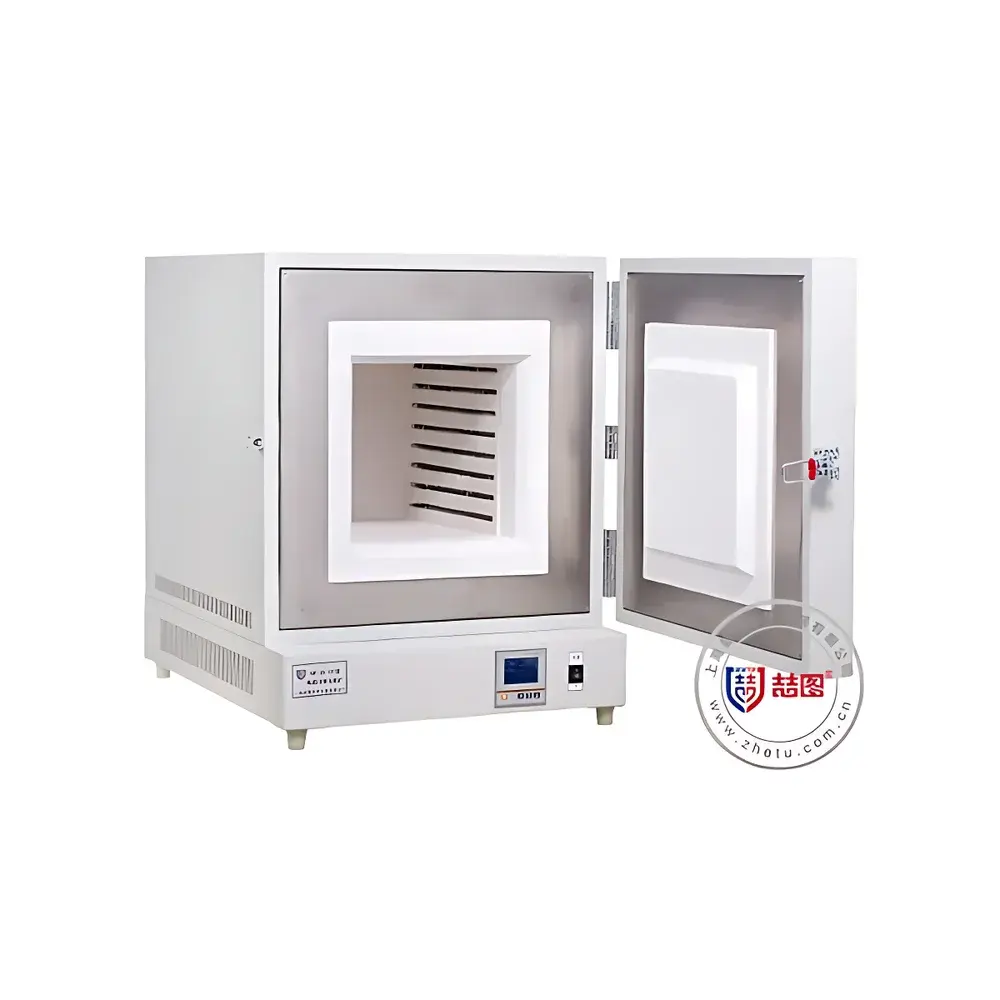
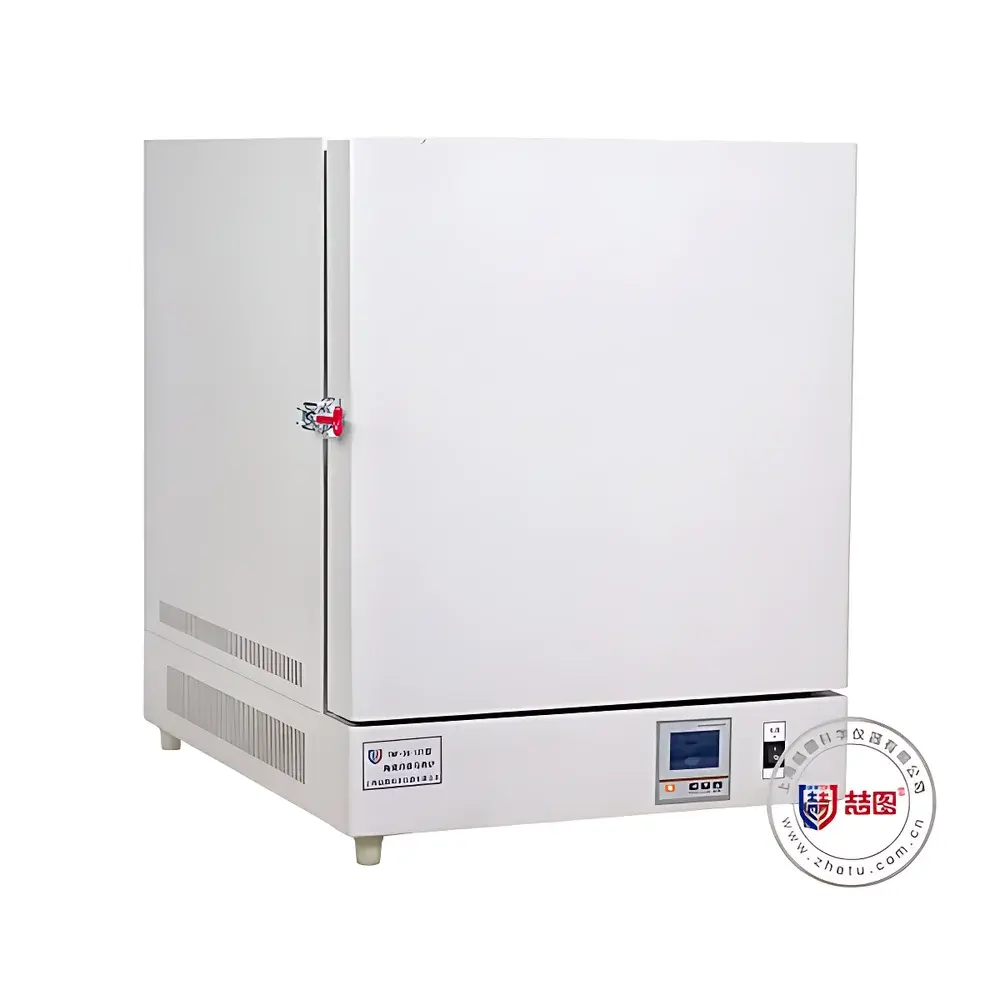
DRETOP TMF-48-14AI Ceramic Fiber Muffle Furnace
| Brand | DRETOP |
|---|---|
| Origin | Shanghai, China |
| Manufacturer Type | Direct Manufacturer |
| Product Category | Domestic |
| Model | TMF-48-14AI |
| Instrument Type | Box-Type Muffle Furnace |
| Maximum Temperature | 1400 °C |
| Temperature Control Accuracy | ±1 °C |
| Rated Power | 18 kW |
| Heating Time to Max Temp | ≤60 min |
| Heating Element | Silicon Carbide Rods |
| Internal Chamber Dimensions | 300 × 400 × 400 mm |
| Nominal Volume | 48 L |
| Control System | Color Touchscreen with AI Logic PID Controller |
| Programmability | 30-Stage Programmable Ramp/Soak Profile |
| Safety Features | Dual Over-Temperature Protection, Auto-Power Recovery, Ambient Temperature Compensation, Door-Interlocked Heating Cut-off (Optional) |
Overview
The DRETOP TMF-48-14AI is a high-performance ceramic fiber box-type muffle furnace engineered for precision thermal processing in research laboratories, materials science facilities, and industrial quality control environments. Operating up to 1400 °C, it employs high-purity silicon carbide (SiC) heating elements and a vacuum-microporous ceramic fiber insulation architecture—delivering rapid thermal response, exceptional energy efficiency, and superior temperature uniformity across its 48-liter chamber. Unlike traditional refractory brick furnaces, the TMF-48-14AI eliminates thermal lag and element degradation through optimized heat transfer dynamics and low-thermal-mass construction. Its measurement principle relies on closed-loop feedback control via S-type thermocouples, integrated with AI-enhanced PID algorithms to minimize overshoot and stabilize setpoints within ±1 °C under steady-state conditions. Designed for compliance-critical workflows, the furnace supports GLP/GMP-aligned documentation protocols when paired with optional RS485 communication and embedded data logging.
Key Features
- Advanced ceramic fiber insulation system: Vacuum-microporous boards provide >90% thermal retention at 1400 °C; external casing surface temperature remains <50 °C during operation—ensuring operator safety and reducing ambient heat load.
- High-stability silicon carbide rod heating elements: Uniformly dimensioned rods with proprietary sintering ensure consistent resistance characteristics over time; no performance drift due to aging or thermal cycling.
- AI logic PID controller with color touchscreen interface: Supports 30-segment programmable ramp/soak profiles, real-time curve visualization, automatic slope correction, and user-defined hold times—enabling precise replication of complex thermal cycles (e.g., controlled nucleation in glass devitrification or multi-step sintering of oxide ceramics).
- Dual-stage over-temperature protection: Independent hardware-based cutoff circuitry activates at preset thresholds (primary: 1450 °C; secondary: 1500 °C), meeting IEC 61000-4-5 surge immunity and EN 60519-2 electrical safety requirements for industrial heating equipment.
- Ergonomic structural integration: Cold-rolled steel housing with phosphate conversion coating and electrostatic gray powder coating resists corrosion and mechanical wear; front-loading door features stainless-steel inner frame and high-density refractory gasketing for long-term sealing integrity.
- Intelligent ambient compensation: Built-in environmental sensor detects ambient temperature prior to startup, dynamically adjusting initial power output to reduce warm-up latency by up to 18% compared to fixed-ramp systems.
Sample Compatibility & Compliance
The TMF-48-14AI accommodates standard crucibles (alumina, quartz, silicon carbide), ceramic setters, metal trays, and custom fixtures up to 300 mm × 400 mm × 400 mm. It is routinely deployed in ASTM C865 (sintering shrinkage), ISO 5660-1 (fire calorimetry preconditioning), USP (heavy metal residue ashing), and ISO 1171 (ash content determination) workflows. All electrical components comply with CE marking directives (2014/30/EU EMC, 2014/35/EU LVD); firmware supports audit-trail generation per FDA 21 CFR Part 11 when used with optional USB data export or network-connected SCADA integration.
Software & Data Management
The AI-series touchscreen interface includes an embedded data logger with timestamped temperature history (sampling interval: 1 s), graphical trend display, and CSV export capability via USB 2.0 port. Optional RS485 Modbus RTU interface enables bidirectional communication with LabVIEW, MATLAB, or MES platforms for automated batch reporting. The system records event logs—including power interruptions, alarm triggers, and manual overrides—with non-volatile memory retention. When configured with the optional thermal printer, hard-copy reports include calibration ID, operator tag, cycle parameters, and pass/fail status against predefined acceptance criteria.
Applications
- Materials synthesis: Oxide ceramic sintering (e.g., YSZ, Al2O3, TiO2), powder metallurgy densification, nanomaterial annealing, and precursor decomposition.
- Thermal analysis support: Sample pre-treatment for TGA-DSC coupling, ashing of organic matrices prior to ICP-OES quantification, and flux-assisted fusion for XRF bead preparation.
- Quality assurance: Heat treatment validation for aerospace alloys (annealing, stress relieving), ASTM E8/E21 mechanical test specimen conditioning, and MIL-STD-883 thermal shock screening.
- Academic research: Controlled crystallization studies, glass transition mapping, solid-state reaction kinetics, and catalyst calcination under inert or oxidizing atmospheres (when equipped with optional gas inlet valve).
FAQ
What is the maximum continuous operating temperature?
The furnace is rated for continuous operation at 1400 °C; however, prolonged use above 1300 °C is not recommended without periodic verification of thermocouple drift and insulation integrity.
Does the unit include factory calibration documentation?
Yes—each unit ships with a traceable NIST-compatible calibration certificate covering three points (600 °C, 1000 °C, 1300 °C) verified using a Fluke 1524 reference thermometer and Class 1 S-type thermocouples.
Can this furnace be operated under inert gas atmosphere?
Yes—optional inert gas inlet valve (standard NPT 1/4″ fitting) allows purging with Ar or N2; exhaust chimney (recommended for volatile organics) must be installed to maintain pressure equilibrium and prevent backflow.
Is remote monitoring supported out-of-the-box?
Local Ethernet or Wi-Fi connectivity is not built-in, but RS485-to-Ethernet gateways (e.g., Moxa NPort 5110) are fully compatible and widely deployed in pharmaceutical cleanroom environments.
What maintenance intervals are recommended?
Visual inspection of door seal integrity every 200 operational hours; thermocouple verification every 500 hours; full insulation density assessment recommended after 2,000 cumulative hours at >1200 °C.



